

q E þ v  B
ð
Þ ) ρE þ j  B
ð5:2:1Þ
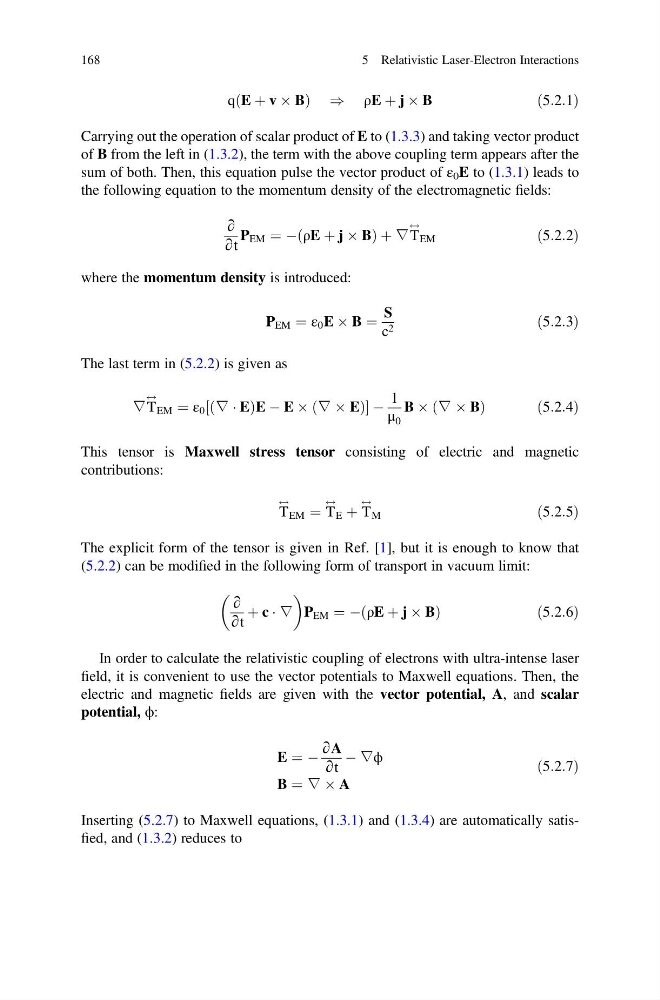
Carrying out the operation of scalar product of E to (1.3.3) and taking vector product
of B from the left in (1.3.2), the term with the above coupling term appears after the
sum of both. Then, this equation pulse the vector product of ε 0 E to (1.3.1) leads to
the following equation to the momentum density of the electromagnetic fields:
∂
∂t
P EM ¼ À ρE þ j  B
ð
Þþ∇T
$
EM
ð5:2:2Þ
where the momentum density is introduced:
P EM ¼ ε 0 E Â B ¼
S
c 2
ð5:2:3Þ
The last term in (5.2.2) is given as
∇T
$
EM ¼ ε 0 ∇ Á E
ð
ÞE À E Â ∇ Â E
ð
Þ
½
À
1
μ 0
B Â ∇ Â B
ð
Þ
ð5:2:4Þ
This tensor is Maxwell stress tensor consisting of electric and magnetic
contributions:
T
$
EM ¼ T
$
E þ T
$
M
ð5:2:5Þ
The explicit form of the tensor is given in Ref. [1], but it is enough to know that
(5.2.2) can be modified in the following form of transport in vacuum limit:
∂
∂t
þ c Á ∇
P EM ¼ À ρE þ j  B
ð
Þ
ð 5:2:6Þ
In order to calculate the relativistic coupling of electrons with ultra-intense laser
field, it is convenient to use the vector potentials to Maxwell equations. Then, the
electric and magnetic fields are given with the vector potential, A, and scalar
potential, ϕ:
E ¼ À
∂A
∂t
À ∇ϕ
B ¼ ∇ Â A
ð5:2:7Þ
Inserting (5.2.7) to Maxwell equations, (1.3.1) and (1.3.4) are automatically satisfied, and (1.3.2) reduces to
168
5 Relativistic Laser-Electron Interactions
ð
Þ ) ρE þ j  B
ð5:2:1Þ
Carrying out the operation of scalar product of E to (1.3.3) and taking vector product
of B from the left in (1.3.2), the term with the above coupling term appears after the
sum of both. Then, this equation pulse the vector product of ε 0 E to (1.3.1) leads to
the following equation to the momentum density of the electromagnetic fields:
∂
∂t
P EM ¼ À ρE þ j  B
ð
Þþ∇T
$
EM
ð5:2:2Þ
where the momentum density is introduced:
P EM ¼ ε 0 E Â B ¼
S
c 2
ð5:2:3Þ
The last term in (5.2.2) is given as
∇T
$
EM ¼ ε 0 ∇ Á E
ð
ÞE À E Â ∇ Â E
ð
Þ
½
À
1
μ 0
B Â ∇ Â B
ð
Þ
ð5:2:4Þ
This tensor is Maxwell stress tensor consisting of electric and magnetic
contributions:
T
$
EM ¼ T
$
E þ T
$
M
ð5:2:5Þ
The explicit form of the tensor is given in Ref. [1], but it is enough to know that
(5.2.2) can be modified in the following form of transport in vacuum limit:
∂
∂t
þ c Á ∇
P EM ¼ À ρE þ j  B
ð
Þ
ð 5:2:6Þ
In order to calculate the relativistic coupling of electrons with ultra-intense laser
field, it is convenient to use the vector potentials to Maxwell equations. Then, the
electric and magnetic fields are given with the vector potential, A, and scalar
potential, ϕ:
E ¼ À
∂A
∂t
À ∇ϕ
B ¼ ∇ Â A
ð5:2:7Þ
Inserting (5.2.7) to Maxwell equations, (1.3.1) and (1.3.4) are automatically satisfied, and (1.3.2) reduces to
168
5 Relativistic Laser-Electron Interactions