

in the wide range of the density and SRS stemming from relatively low density was
observed in the early time. This is explained that without band; the density ripples
are induced by the self-focusing and filamentation, which also produces electron
plasma waves with wide range of frequency.
In order to suppress such nonlinear phenomena, a broadband laser with Δω/
ω 0 ¼ 0.1% is irradiated. Then, the SRS spectrum is suppressed as shown in Fig. 4.12
(c). It is clear that only 0.1% of the band width is effective to kill the growth of selffocusing and filamentation instability at the intensity of 2x10
15 W/cm
2 . The SRS
spectra at time 0.95 ns are compared for with and without broadband in Fig. 4.12(d).
The density is calculated from the spectrum using the matching condition for SRS
instability. It is clear that with self-focusing, electron density is almost 100%
perturbed in the interaction region from the maximum density of about 0.1n cr . The
sharp peak in red in Fig. 4.12(d) indicates that the band width of 0.1% is not enough
to suppress SRS instability; wider band is preferable for killing the instability.
It should be noted that this intensity in Fig. 4.10 is a bit above the threshold
intensity, and the linear growth rate gives us a good indication of the SRS
backscatter. For higher intensity, however, there is no evidence that broadband can
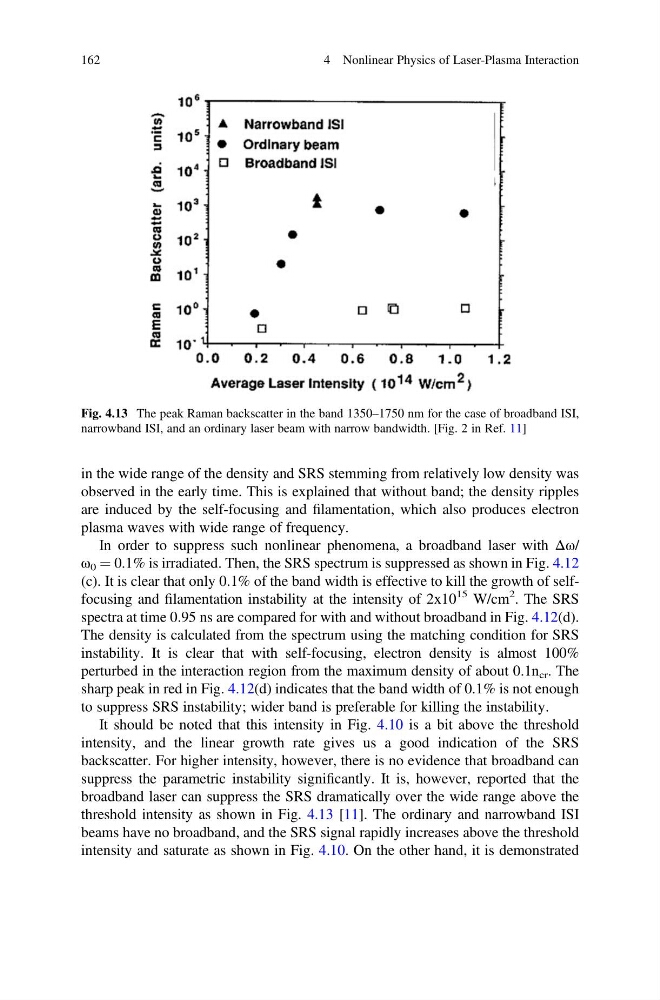
suppress the parametric instability significantly. It is, however, reported that the
broadband laser can suppress the SRS dramatically over the wide range above the
threshold intensity as shown in Fig. 4.13 [11]. The ordinary and narrowband ISI
beams have no broadband, and the SRS signal rapidly increases above the threshold
intensity and saturate as shown in Fig. 4.10. On the other hand, it is demonstrated
Fig. 4.13 The peak Raman backscatter in the band 1350–1750 nm for the case of broadband ISI,
narrowband ISI, and an ordinary laser beam with narrow bandwidth. [Fig. 2 in Ref. 11]
162
4 Nonlinear Physics of Laser-Plasma Interaction
observed in the early time. This is explained that without band; the density ripples
are induced by the self-focusing and filamentation, which also produces electron
plasma waves with wide range of frequency.
In order to suppress such nonlinear phenomena, a broadband laser with Δω/
ω 0 ¼ 0.1% is irradiated. Then, the SRS spectrum is suppressed as shown in Fig. 4.12
(c). It is clear that only 0.1% of the band width is effective to kill the growth of selffocusing and filamentation instability at the intensity of 2x10
15 W/cm
2 . The SRS
spectra at time 0.95 ns are compared for with and without broadband in Fig. 4.12(d).
The density is calculated from the spectrum using the matching condition for SRS
instability. It is clear that with self-focusing, electron density is almost 100%
perturbed in the interaction region from the maximum density of about 0.1n cr . The
sharp peak in red in Fig. 4.12(d) indicates that the band width of 0.1% is not enough
to suppress SRS instability; wider band is preferable for killing the instability.
It should be noted that this intensity in Fig. 4.10 is a bit above the threshold
intensity, and the linear growth rate gives us a good indication of the SRS
backscatter. For higher intensity, however, there is no evidence that broadband can
suppress the parametric instability significantly. It is, however, reported that the
broadband laser can suppress the SRS dramatically over the wide range above the
threshold intensity as shown in Fig. 4.13 [11]. The ordinary and narrowband ISI
beams have no broadband, and the SRS signal rapidly increases above the threshold
intensity and saturate as shown in Fig. 4.10. On the other hand, it is demonstrated
Fig. 4.13 The peak Raman backscatter in the band 1350–1750 nm for the case of broadband ISI,
narrowband ISI, and an ordinary laser beam with narrow bandwidth. [Fig. 2 in Ref. 11]
162
4 Nonlinear Physics of Laser-Plasma Interaction