

4.11 Broadband Effect
As already mentioned in Sec. 4.6, the broadband lasers are widely used to suppress
the collective phenomena in laser-plasma interaction physics. As the plasma scale
increases with the increase of incident laser energy, the parametric instabilities
become more important, and laser energy is reflected by SRS and SBS processes.
In addition, the large amplitude electron waves and ion waves are generated in
plasmas, and their energy is not used for hydrodynamics but goes to hot electrons
which heats over the long rage in plasmas. It is important to show how the broadband
laser can suppress such parametric instabilities.
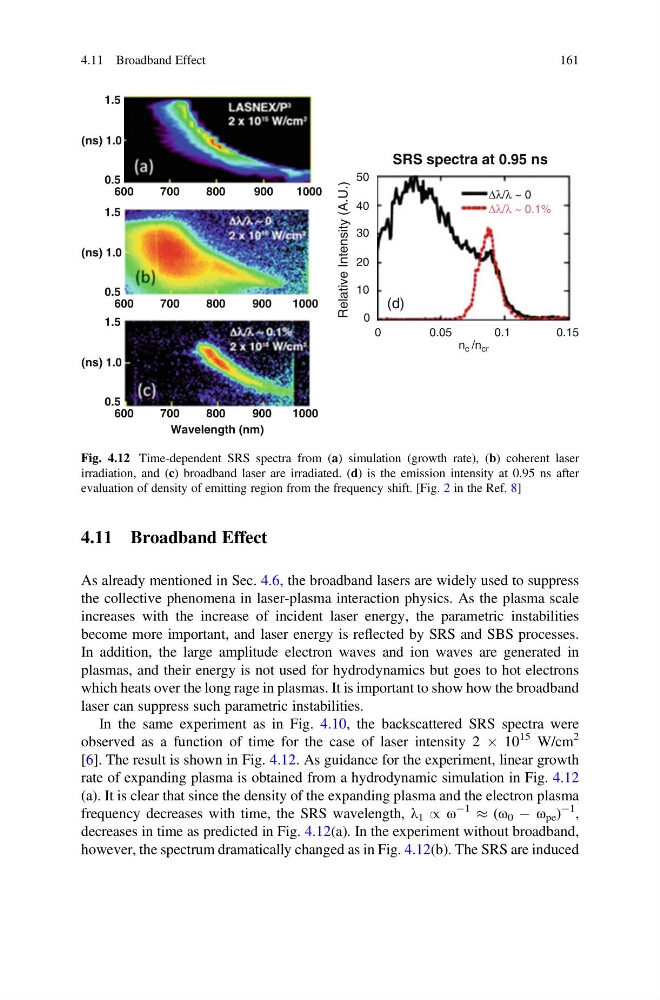
In the same experiment as in Fig. 4.10, the backscattered SRS spectra were
observed as a function of time for the case of laser intensity 2 Â 10
15 W/cm
2
[6]. The result is shown in Fig. 4.12. As guidance for the experiment, linear growth
rate of expanding plasma is obtained from a hydrodynamic simulation in Fig. 4.12
(a). It is clear that since the density of the expanding plasma and the electron plasma
frequency decreases with time, the SRS wavelength, λ 1 / ω
À1
% (ω 0 À ω pe )
À1 ,
decreases in time as predicted in Fig. 4.12(a). In the experiment without broadband,
however, the spectrum dramatically changed as in Fig. 4.12(b). The SRS are induced
50
SRS spectra at 0.95 ns
40
Δλ/λ ~ 0
Δλ/λ ~ 0.1%
30
20
10
0
0
0.05
n c /n cr
(d)
Relative Intensity (A.U.)
0.1
0.15
1.5
0.5
600
700
800
900
1000
(ns) 1.0
1.5
0.5
600
700
800
900
1000
(ns) 1.0
1.5
0.5
600
700
Wavelength (nm)
800
900
1000
(ns) 1.0
Fig. 4.12 Time-dependent SRS spectra from (a) simulation (growth rate), (b) coherent laser
irradiation, and (c) broadband laser are irradiated. (d) is the emission intensity at 0.95 ns after
evaluation of density of emitting region from the frequency shift. [Fig. 2 in the Ref. 8]
4.11 Broadband Effect
161
As already mentioned in Sec. 4.6, the broadband lasers are widely used to suppress
the collective phenomena in laser-plasma interaction physics. As the plasma scale
increases with the increase of incident laser energy, the parametric instabilities
become more important, and laser energy is reflected by SRS and SBS processes.
In addition, the large amplitude electron waves and ion waves are generated in
plasmas, and their energy is not used for hydrodynamics but goes to hot electrons
which heats over the long rage in plasmas. It is important to show how the broadband
laser can suppress such parametric instabilities.
In the same experiment as in Fig. 4.10, the backscattered SRS spectra were
observed as a function of time for the case of laser intensity 2 Â 10
15 W/cm
2
[6]. The result is shown in Fig. 4.12. As guidance for the experiment, linear growth
rate of expanding plasma is obtained from a hydrodynamic simulation in Fig. 4.12
(a). It is clear that since the density of the expanding plasma and the electron plasma
frequency decreases with time, the SRS wavelength, λ 1 / ω
À1
% (ω 0 À ω pe )
À1 ,
decreases in time as predicted in Fig. 4.12(a). In the experiment without broadband,
however, the spectrum dramatically changed as in Fig. 4.12(b). The SRS are induced
50
SRS spectra at 0.95 ns
40
Δλ/λ ~ 0
Δλ/λ ~ 0.1%
30
20
10
0
0
0.05
n c /n cr
(d)
Relative Intensity (A.U.)
0.1
0.15
1.5
0.5
600
700
800
900
1000
(ns) 1.0
1.5
0.5
600
700
800
900
1000
(ns) 1.0
1.5
0.5
600
700
Wavelength (nm)
800
900
1000
(ns) 1.0
Fig. 4.12 Time-dependent SRS spectra from (a) simulation (growth rate), (b) coherent laser
irradiation, and (c) broadband laser are irradiated. (d) is the emission intensity at 0.95 ns after
evaluation of density of emitting region from the frequency shift. [Fig. 2 in the Ref. 8]
4.11 Broadband Effect
161