

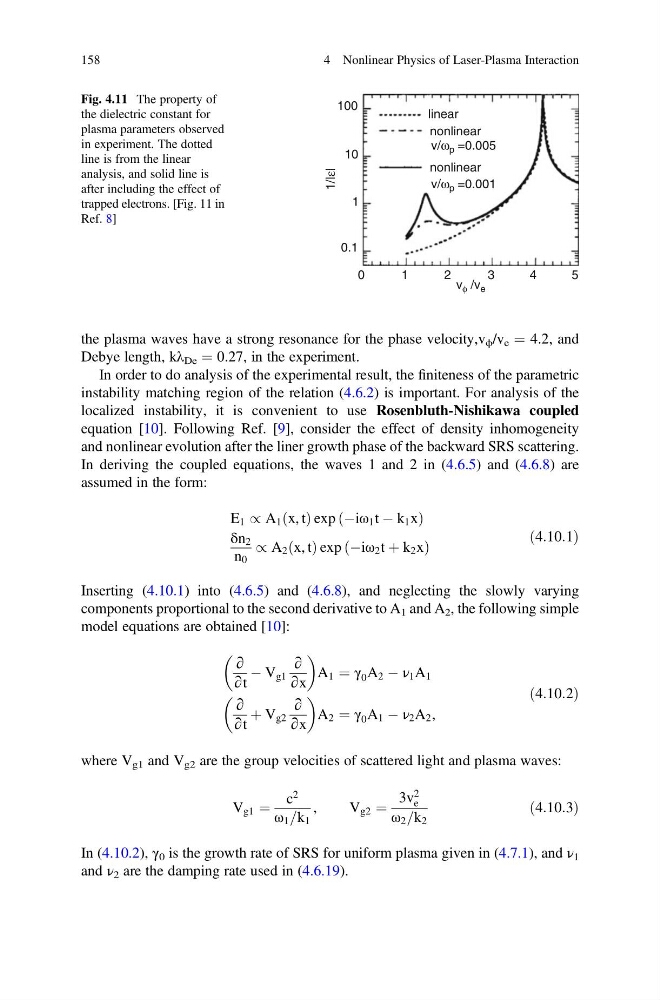
the plasma waves have a strong resonance for the phase velocity,v ϕ /v e ¼ 4.2, and
Debye length, kλ De ¼ 0.27, in the experiment.
In order to do analysis of the experimental result, the finiteness of the parametric
instability matching region of the relation (4.6.2) is important. For analysis of the
localized instability, it is convenient to use Rosenbluth-Nishikawa coupled
equation [10]. Following Ref. [9], consider the effect of density inhomogeneity
and nonlinear evolution after the liner growth phase of the backward SRS scattering.
In deriving the coupled equations, the waves 1 and 2 in (4.6.5) and (4.6.8) are
assumed in the form:
E 1 / A 1 x, t
ð Þexp Àiω 1 t À k 1 x
ð
Þ
δn 2
n 0
/ A 2 x, t
ð Þexp Àiω 2 t þ k 2 x
ð
Þ
ð4:10:1Þ
Inserting (4.10.1) into (4.6.5) and (4.6.8), and neglecting the slowly varying
components proportional to the second derivative to A 1 and A 2 , the following simple
model equations are obtained [10]:
∂
∂t
À V g1
∂
∂x
A 1 ¼ γ 0 A 2 À ν 1 A 1
∂
∂t
þ V g2
∂
∂x
A 2 ¼ γ 0 A 1 À ν 2 A 2 ,
ð4:10:2Þ
where V g1 and V g2 are the group velocities of scattered light and plasma waves:
V g1 ¼
c
2
ω 1 =k 1
,
V g2 ¼
3v
2
e
ω 2 =k 2
ð4:10:3Þ
In (4.10.2), γ 0 is the growth rate of SRS for uniform plasma given in (4.7.1), and ν 1
and ν 2 are the damping rate used in (4.6.19).
100
linear
nonlinear
nonlinear
v/ω p =0.005
v/ω p =0.001
v φ /v e
1/|ε|
10
1
0.1
0
1
2
3
4
5
Fig. 4.11 The property of
the dielectric constant for
plasma parameters observed
in experiment. The dotted
line is from the linear
analysis, and solid line is
after including the effect of
trapped electrons. [Fig. 11 in
Ref. 8]
158
4 Nonlinear Physics of Laser-Plasma Interaction
Debye length, kλ De ¼ 0.27, in the experiment.
In order to do analysis of the experimental result, the finiteness of the parametric
instability matching region of the relation (4.6.2) is important. For analysis of the
localized instability, it is convenient to use Rosenbluth-Nishikawa coupled
equation [10]. Following Ref. [9], consider the effect of density inhomogeneity
and nonlinear evolution after the liner growth phase of the backward SRS scattering.
In deriving the coupled equations, the waves 1 and 2 in (4.6.5) and (4.6.8) are
assumed in the form:
E 1 / A 1 x, t
ð Þexp Àiω 1 t À k 1 x
ð
Þ
δn 2
n 0
/ A 2 x, t
ð Þexp Àiω 2 t þ k 2 x
ð
Þ
ð4:10:1Þ
Inserting (4.10.1) into (4.6.5) and (4.6.8), and neglecting the slowly varying
components proportional to the second derivative to A 1 and A 2 , the following simple
model equations are obtained [10]:
∂
∂t
À V g1
∂
∂x
A 1 ¼ γ 0 A 2 À ν 1 A 1
∂
∂t
þ V g2
∂
∂x
A 2 ¼ γ 0 A 1 À ν 2 A 2 ,
ð4:10:2Þ
where V g1 and V g2 are the group velocities of scattered light and plasma waves:
V g1 ¼
c
2
ω 1 =k 1
,
V g2 ¼
3v
2
e
ω 2 =k 2
ð4:10:3Þ
In (4.10.2), γ 0 is the growth rate of SRS for uniform plasma given in (4.7.1), and ν 1
and ν 2 are the damping rate used in (4.6.19).
100
linear
nonlinear
nonlinear
v/ω p =0.005
v/ω p =0.001
v φ /v e
1/|ε|
10
1
0.1
0
1
2
3
4
5
Fig. 4.11 The property of
the dielectric constant for
plasma parameters observed
in experiment. The dotted
line is from the linear
analysis, and solid line is
after including the effect of
trapped electrons. [Fig. 11 in
Ref. 8]
158
4 Nonlinear Physics of Laser-Plasma Interaction