

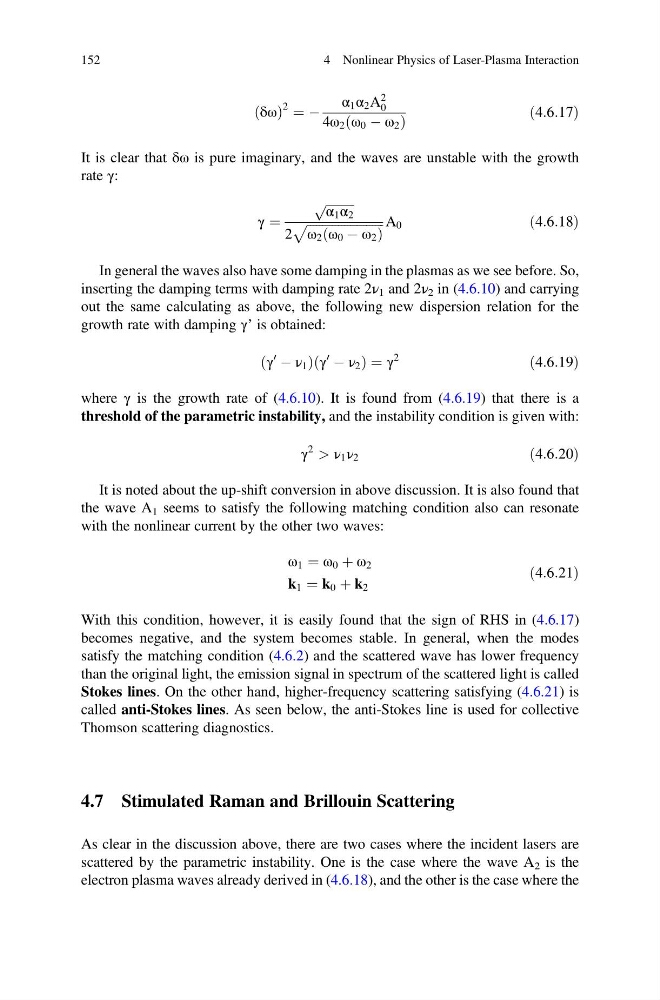
δω
ð Þ
2 ¼ À
α 1 α 2 A
2
0
4ω 2 ω 0 À ω 2
ð
Þ
ð4:6:17Þ
It is clear that δω is pure imaginary, and the waves are unstable with the growth
rate γ:
γ ¼
ffiffiffiffiffiffiffiffiffi ffi
α 1 α 2
p
2
ffiffiffiffiffiffiffiffiffiffiffiffiffiffiffiffiffiffiffiffiffiffiffiffi ffi
ω 2 ω 0 À ω 2
ð
Þ
p
A 0
ð4:6:18Þ
In general the waves also have some damping in the plasmas as we see before. So,
inserting the damping terms with damping rate 2ν 1 and 2ν 2 in (4.6.10) and carrying
out the same calculating as above, the following new dispersion relation for the
growth rate with damping γ’ is obtained:
γ
0
À ν 1
ð
Þ γ
0
À ν 2
ð
Þ¼γ
2
ð4:6:19Þ
where γ is the growth rate of (4.6.10). It is found from (4.6.19) that there is a
threshold of the parametric instability, and the instability condition is given with:
γ
2
> ν 1 ν 2
ð4:6:20Þ
It is noted about the up-shift conversion in above discussion. It is also found that
the wave A 1 seems to satisfy the following matching condition also can resonate
with the nonlinear current by the other two waves:
ω 1 ¼ ω 0 þ ω 2
k 1 ¼ k 0 þ k 2
ð4:6:21Þ
With this condition, however, it is easily found that the sign of RHS in (4.6.17)
becomes negative, and the system becomes stable. In general, when the modes
satisfy the matching condition (4.6.2) and the scattered wave has lower frequency
than the original light, the emission signal in spectrum of the scattered light is called
Stokes lines. On the other hand, higher-frequency scattering satisfying (4.6.21) is
called anti-Stokes lines. As seen below, the anti-Stokes line is used for collective
Thomson scattering diagnostics.
4.7 Stimulated Raman and Brillouin Scattering
As clear in the discussion above, there are two cases where the incident lasers are
scattered by the parametric instability. One is the case where the wave A 2 is the
electron plasma waves already derived in (4.6.18), and the other is the case where the
152
4 Nonlinear Physics of Laser-Plasma Interaction
ð Þ
2 ¼ À
α 1 α 2 A
2
0
4ω 2 ω 0 À ω 2
ð
Þ
ð4:6:17Þ
It is clear that δω is pure imaginary, and the waves are unstable with the growth
rate γ:
γ ¼
ffiffiffiffiffiffiffiffiffi ffi
α 1 α 2
p
2
ffiffiffiffiffiffiffiffiffiffiffiffiffiffiffiffiffiffiffiffiffiffiffiffi ffi
ω 2 ω 0 À ω 2
ð
Þ
p
A 0
ð4:6:18Þ
In general the waves also have some damping in the plasmas as we see before. So,
inserting the damping terms with damping rate 2ν 1 and 2ν 2 in (4.6.10) and carrying
out the same calculating as above, the following new dispersion relation for the
growth rate with damping γ’ is obtained:
γ
0
À ν 1
ð
Þ γ
0
À ν 2
ð
Þ¼γ
2
ð4:6:19Þ
where γ is the growth rate of (4.6.10). It is found from (4.6.19) that there is a
threshold of the parametric instability, and the instability condition is given with:
γ
2
> ν 1 ν 2
ð4:6:20Þ
It is noted about the up-shift conversion in above discussion. It is also found that
the wave A 1 seems to satisfy the following matching condition also can resonate
with the nonlinear current by the other two waves:
ω 1 ¼ ω 0 þ ω 2
k 1 ¼ k 0 þ k 2
ð4:6:21Þ
With this condition, however, it is easily found that the sign of RHS in (4.6.17)
becomes negative, and the system becomes stable. In general, when the modes
satisfy the matching condition (4.6.2) and the scattered wave has lower frequency
than the original light, the emission signal in spectrum of the scattered light is called
Stokes lines. On the other hand, higher-frequency scattering satisfying (4.6.21) is
called anti-Stokes lines. As seen below, the anti-Stokes line is used for collective
Thomson scattering diagnostics.
4.7 Stimulated Raman and Brillouin Scattering
As clear in the discussion above, there are two cases where the incident lasers are
scattered by the parametric instability. One is the case where the wave A 2 is the
electron plasma waves already derived in (4.6.18), and the other is the case where the
152
4 Nonlinear Physics of Laser-Plasma Interaction