

It is seen that the fluctuation spectrum is high near the resonance points, because
the resonant modes are always spontaneously excided in plasmas and decays due to
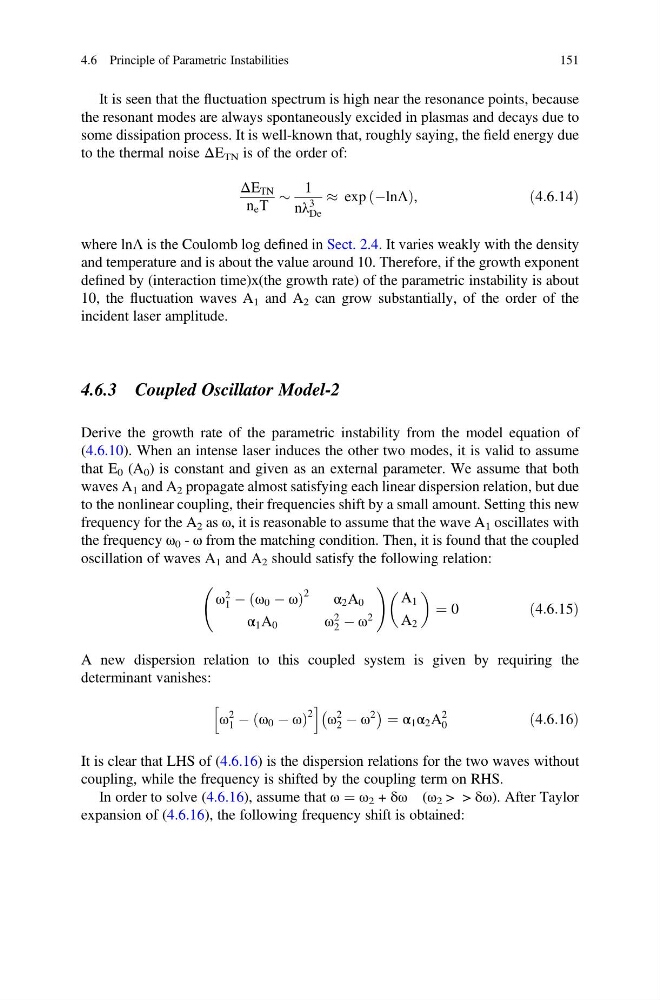
some dissipation process. It is well-known that, roughly saying, the field energy due
to the thermal noise ΔE TN is of the order of:
ΔE TN
n e T
$
1
nλ
3
De
% exp ÀlnΛ
ð
Þ,
ð4:6:14Þ
where lnΛ is the Coulomb log defined in Sect. 2.4. It varies weakly with the density
and temperature and is about the value around 10. Therefore, if the growth exponent
defined by (interaction time)x(the growth rate) of the parametric instability is about
10, the fluctuation waves A 1 and A 2 can grow substantially, of the order of the
incident laser amplitude.
4.6.3 Coupled Oscillator Model-2
Derive the growth rate of the parametric instability from the model equation of
(4.6.10). When an intense laser induces the other two modes, it is valid to assume
that E 0 (A 0 ) is constant and given as an external parameter. We assume that both
waves A 1 and A 2 propagate almost satisfying each linear dispersion relation, but due
to the nonlinear coupling, their frequencies shift by a small amount. Setting this new
frequency for the A 2 as ω, it is reasonable to assume that the wave A 1 oscillates with
the frequency ω 0 - ω from the matching condition. Then, it is found that the coupled
oscillation of waves A 1 and A 2 should satisfy the following relation:
ω
2
1 À ω 0 À ω
ð
Þ
2
α 2 A 0
α 1 A 0
ω
2
2 À ω
2
!
A 1
A 2
¼ 0
ð4:6:15Þ
A new dispersion relation to this coupled system is given by requiring the
determinant vanishes:
ω
2
1 À ω 0 À ω
ð
Þ
2
h
i
ω
2
2 À ω
2
À
Á ¼ α 1 α 2 A
2
0
ð4:6:16Þ
It is clear that LHS of (4.6.16) is the dispersion relations for the two waves without
coupling, while the frequency is shifted by the coupling term on RHS.
In order to solve (4.6.16), assume that ω ¼ ω 2 + δω (ω 2 > > δω). After Taylor
expansion of (4.6.16), the following frequency shift is obtained:
4.6 Principle of Parametric Instabilities
151
the resonant modes are always spontaneously excided in plasmas and decays due to
some dissipation process. It is well-known that, roughly saying, the field energy due
to the thermal noise ΔE TN is of the order of:
ΔE TN
n e T
$
1
nλ
3
De
% exp ÀlnΛ
ð
Þ,
ð4:6:14Þ
where lnΛ is the Coulomb log defined in Sect. 2.4. It varies weakly with the density
and temperature and is about the value around 10. Therefore, if the growth exponent
defined by (interaction time)x(the growth rate) of the parametric instability is about
10, the fluctuation waves A 1 and A 2 can grow substantially, of the order of the
incident laser amplitude.
4.6.3 Coupled Oscillator Model-2
Derive the growth rate of the parametric instability from the model equation of
(4.6.10). When an intense laser induces the other two modes, it is valid to assume
that E 0 (A 0 ) is constant and given as an external parameter. We assume that both
waves A 1 and A 2 propagate almost satisfying each linear dispersion relation, but due
to the nonlinear coupling, their frequencies shift by a small amount. Setting this new
frequency for the A 2 as ω, it is reasonable to assume that the wave A 1 oscillates with
the frequency ω 0 - ω from the matching condition. Then, it is found that the coupled
oscillation of waves A 1 and A 2 should satisfy the following relation:
ω
2
1 À ω 0 À ω
ð
Þ
2
α 2 A 0
α 1 A 0
ω
2
2 À ω
2
!
A 1
A 2
¼ 0
ð4:6:15Þ
A new dispersion relation to this coupled system is given by requiring the
determinant vanishes:
ω
2
1 À ω 0 À ω
ð
Þ
2
h
i
ω
2
2 À ω
2
À
Á ¼ α 1 α 2 A
2
0
ð4:6:16Þ
It is clear that LHS of (4.6.16) is the dispersion relations for the two waves without
coupling, while the frequency is shifted by the coupling term on RHS.
In order to solve (4.6.16), assume that ω ¼ ω 2 + δω (ω 2 > > δω). After Taylor
expansion of (4.6.16), the following frequency shift is obtained:
4.6 Principle of Parametric Instabilities
151