

V
j j ¼
V d
2
ωt
ð3:9:11Þ
The effective wavenumber and phase velocity of this wave are evaluated from the
last term of (3.9.10):
k eff ¼
ωt
2L
, V ph ¼
ω
k eff
¼ À
2L
t
ð3:9:12Þ
(3.9.12) means the effective wavelength becomes shorter, and the phase velocity
decreases with time. When the amplitude grows to satisfy the condition
∂
∂t
% V
∂
∂x
ð3:9:13Þ
the wave-breaking condition given in (3.9.8) is subject to satisfy. The wave-breaking
is taken place around the time when the oscillation velocity increases as follows:
ωt ¼
2Lω
V d
1=2
, V ¼ LωV d
ð
Þ
1=2
ð3:9:14Þ
Namely,
Vph
j
j % V t, 0
ð Þ
j
j
ð3:9:15Þ
If this is the case of conventional fluid, the fluid viscosity becomes important, and
a shock wave structure will appear to inhibit the wave-breaking. In the present
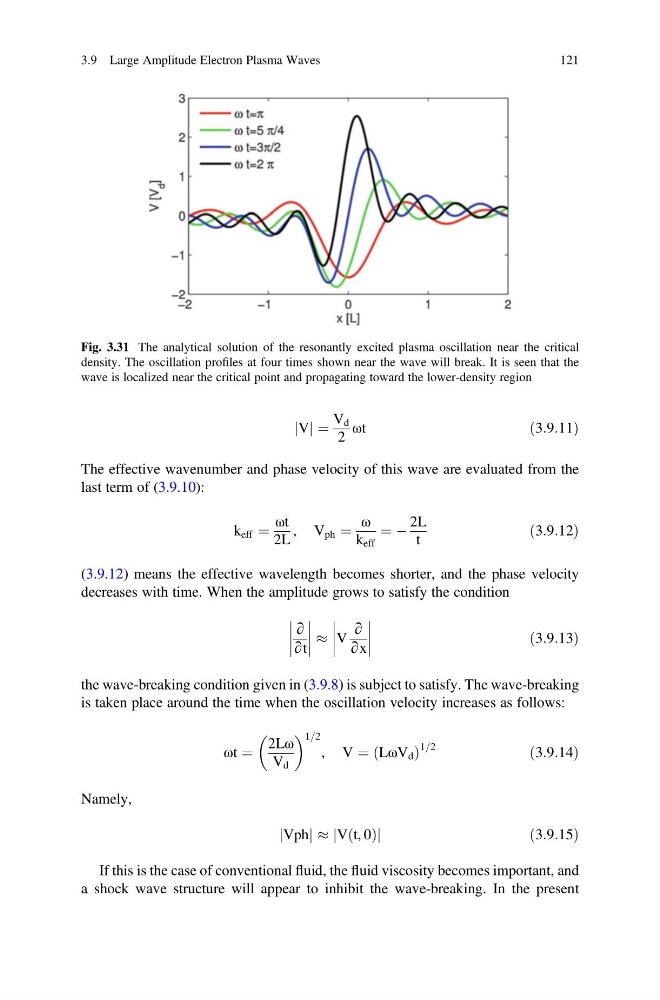
Fig. 3.31 The analytical solution of the resonantly excited plasma oscillation near the critical
density. The oscillation profiles at four times shown near the wave will break. It is seen that the
wave is localized near the critical point and propagating toward the lower-density region
3.9 Large Amplitude Electron Plasma Waves
121
j j ¼
V d
2
ωt
ð3:9:11Þ
The effective wavenumber and phase velocity of this wave are evaluated from the
last term of (3.9.10):
k eff ¼
ωt
2L
, V ph ¼
ω
k eff
¼ À
2L
t
ð3:9:12Þ
(3.9.12) means the effective wavelength becomes shorter, and the phase velocity
decreases with time. When the amplitude grows to satisfy the condition
∂
∂t
% V
∂
∂x
ð3:9:13Þ
the wave-breaking condition given in (3.9.8) is subject to satisfy. The wave-breaking
is taken place around the time when the oscillation velocity increases as follows:
ωt ¼
2Lω
V d
1=2
, V ¼ LωV d
ð
Þ
1=2
ð3:9:14Þ
Namely,
Vph
j
j % V t, 0
ð Þ
j
j
ð3:9:15Þ
If this is the case of conventional fluid, the fluid viscosity becomes important, and
a shock wave structure will appear to inhibit the wave-breaking. In the present
Fig. 3.31 The analytical solution of the resonantly excited plasma oscillation near the critical
density. The oscillation profiles at four times shown near the wave will break. It is seen that the
wave is localized near the critical point and propagating toward the lower-density region
3.9 Large Amplitude Electron Plasma Waves
121