

3.4 Nonlinear Inverse Bremsstrahlung (IB) Absorption
(v e < v os )
In the case where a strong laser field is irradiated on matters with cold temperature,
the electron quivering velocity v os defined in (2.3.5) is larger than the electron
thermal velocity v e . In such case, it is intuitively understand that the collision
cross section σ L should be evaluated with the transit velocity at the time of
nonadiabatic collision with a scattering ion. In obtaining Maxwell distribution
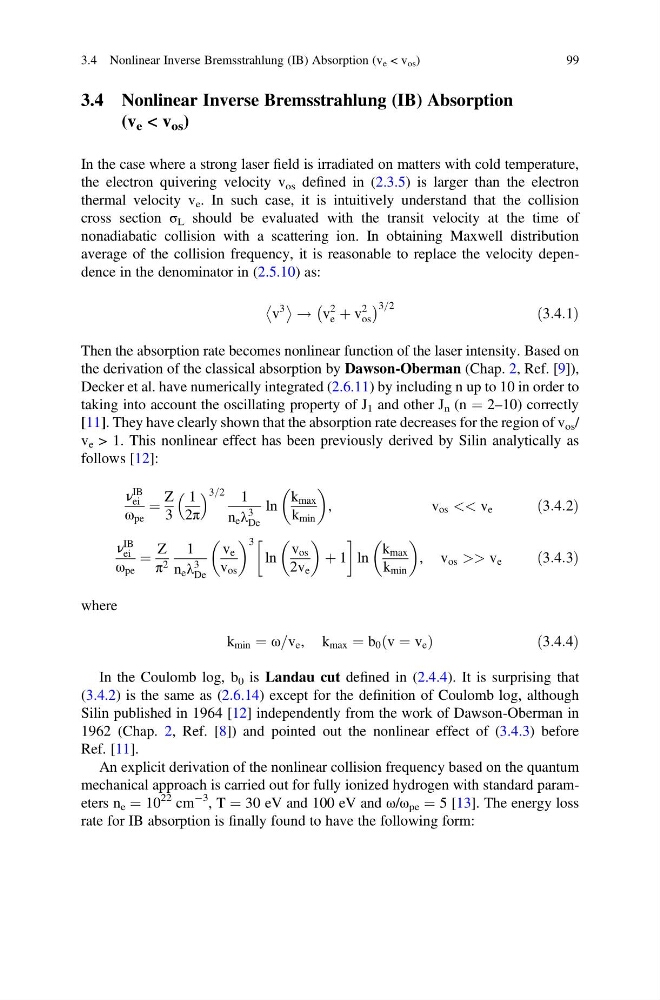
average of the collision frequency, it is reasonable to replace the velocity dependence in the denominator in (2.5.10) as:
v
3
! v
2
e þ v
2
os
À
Á 3=2
ð3:4:1Þ
Then the absorption rate becomes nonlinear function of the laser intensity. Based on
the derivation of the classical absorption by Dawson-Oberman (Chap. 2, Ref. [9]),
Decker et al. have numerically integrated (2.6.11) by including n up to 10 in order to
taking into account the oscillating property of J 1 and other J n (n ¼ 2–10) correctly
[11]. They have clearly shown that the absorption rate decreases for the region of v os /
v e > 1. This nonlinear effect has been previously derived by Silin analytically as
follows [12]:
ν
IB
ei
ω pe
¼
Z
3
1
2π
3=2 1
n e λ
3
De
ln
k max
k min
,
v os << v e
ð3:4:2Þ
ν
IB
ei
ω pe
¼
Z
π 2
1
n e λ
3
De
v e
v os
3
ln
v os
2v e
þ 1
!
ln
k max
k min
, v os >> v e
ð3:4:3Þ
where
k min ¼ ω=v e , k max ¼ b 0 v ¼ v e
ð
Þ
ð3:4:4Þ
In the Coulomb log, b 0 is Landau cut defined in (2.4.4). It is surprising that
(3.4.2) is the same as (2.6.14) except for the definition of Coulomb log, although
Silin published in 1964 [12] independently from the work of Dawson-Oberman in
1962 (Chap. 2, Ref. [8]) and pointed out the nonlinear effect of (3.4.3) before
Ref. [11].
An explicit derivation of the nonlinear collision frequency based on the quantum
mechanical approach is carried out for fully ionized hydrogen with standard parameters n e ¼ 10
22 cm
À3 , T ¼ 30 eV and 100 eV and ω/ω pe ¼ 5 [13]. The energy loss
rate for IB absorption is finally found to have the following form:
3.4 Nonlinear Inverse Bremsstrahlung (IB) Absorption (v e < v os )
9 9
(v e < v os )
In the case where a strong laser field is irradiated on matters with cold temperature,
the electron quivering velocity v os defined in (2.3.5) is larger than the electron
thermal velocity v e . In such case, it is intuitively understand that the collision
cross section σ L should be evaluated with the transit velocity at the time of
nonadiabatic collision with a scattering ion. In obtaining Maxwell distribution
average of the collision frequency, it is reasonable to replace the velocity dependence in the denominator in (2.5.10) as:
v
3
! v
2
e þ v
2
os
À
Á 3=2
ð3:4:1Þ
Then the absorption rate becomes nonlinear function of the laser intensity. Based on
the derivation of the classical absorption by Dawson-Oberman (Chap. 2, Ref. [9]),
Decker et al. have numerically integrated (2.6.11) by including n up to 10 in order to
taking into account the oscillating property of J 1 and other J n (n ¼ 2–10) correctly
[11]. They have clearly shown that the absorption rate decreases for the region of v os /
v e > 1. This nonlinear effect has been previously derived by Silin analytically as
follows [12]:
ν
IB
ei
ω pe
¼
Z
3
1
2π
3=2 1
n e λ
3
De
ln
k max
k min
,
v os << v e
ð3:4:2Þ
ν
IB
ei
ω pe
¼
Z
π 2
1
n e λ
3
De
v e
v os
3
ln
v os
2v e
þ 1
!
ln
k max
k min
, v os >> v e
ð3:4:3Þ
where
k min ¼ ω=v e , k max ¼ b 0 v ¼ v e
ð
Þ
ð3:4:4Þ
In the Coulomb log, b 0 is Landau cut defined in (2.4.4). It is surprising that
(3.4.2) is the same as (2.6.14) except for the definition of Coulomb log, although
Silin published in 1964 [12] independently from the work of Dawson-Oberman in
1962 (Chap. 2, Ref. [8]) and pointed out the nonlinear effect of (3.4.3) before
Ref. [11].
An explicit derivation of the nonlinear collision frequency based on the quantum
mechanical approach is carried out for fully ionized hydrogen with standard parameters n e ¼ 10
22 cm
À3 , T ¼ 30 eV and 100 eV and ω/ω pe ¼ 5 [13]. The energy loss
rate for IB absorption is finally found to have the following form:
3.4 Nonlinear Inverse Bremsstrahlung (IB) Absorption (v e < v os )
9 9