

10
14 W/cm
2 and 10
15 W/cm
2 with dash-dotted line and dashed line, respectively.
Although it was mentioned above that at higher intensity, the multiphoton ionization
will commit the laser absorption, the collision frequency is smaller in higher
intensity than the lower one in Fig. 3.16. This is due to another type of nonlinear
effect in the collisional absorption, when the electron mean velocity is smaller than
the electron quivering velocity by laser field and will be explained in the next
session.
In Fig. 3.16, the Spitzer’s collision frequency is also plotted with thin dotted line,
and it is clear that it is overestimated at low temperature. In addition, even in the ideal
plasma, the Spitzer’s collision frequency is about factor three higher than the
present nonlinear one. This is resulted after taking account of the higher velocity
moment more precisely as shown in [10].
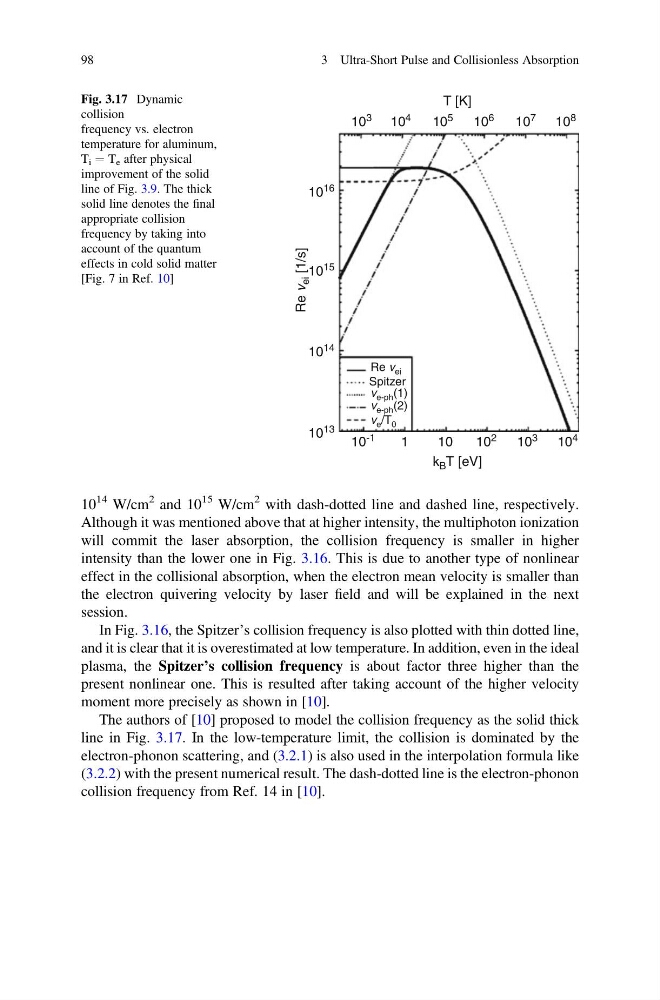
The authors of [10] proposed to model the collision frequency as the solid thick
line in Fig. 3.17. In the low-temperature limit, the collision is dominated by the
electron-phonon scattering, and (3.2.1) is also used in the interpolation formula like
(3.2.2) with the present numerical result. The dash-dotted line is the electron-phonon
collision frequency from Ref. 14 in [10].
10
4
10
3
10
16
10
15
10 14
Re v ei
v e-ph (1)
v e-ph (2)
v e /T 0
Spitzer
10
13
1
10
10 -1
k B T [eV]
10
2
10 3 10 4
10
5
T [K]
Re v
ei [1/s]
10
6
10
7
10
8
Fig. 3.17 Dynamic
collision
frequency vs. electron
temperature for aluminum,
T i ¼ T e after physical
improvement of the solid
line of Fig. 3.9. The thick
solid line denotes the final
appropriate collision
frequency by taking into
account of the quantum
effects in cold solid matter
[Fig. 7 in Ref. 10]
98
3 Ultra-Short Pulse and Collisionless Absorption
14 W/cm
2 and 10
15 W/cm
2 with dash-dotted line and dashed line, respectively.
Although it was mentioned above that at higher intensity, the multiphoton ionization
will commit the laser absorption, the collision frequency is smaller in higher
intensity than the lower one in Fig. 3.16. This is due to another type of nonlinear
effect in the collisional absorption, when the electron mean velocity is smaller than
the electron quivering velocity by laser field and will be explained in the next
session.
In Fig. 3.16, the Spitzer’s collision frequency is also plotted with thin dotted line,
and it is clear that it is overestimated at low temperature. In addition, even in the ideal
plasma, the Spitzer’s collision frequency is about factor three higher than the
present nonlinear one. This is resulted after taking account of the higher velocity
moment more precisely as shown in [10].
The authors of [10] proposed to model the collision frequency as the solid thick
line in Fig. 3.17. In the low-temperature limit, the collision is dominated by the
electron-phonon scattering, and (3.2.1) is also used in the interpolation formula like
(3.2.2) with the present numerical result. The dash-dotted line is the electron-phonon
collision frequency from Ref. 14 in [10].
10
4
10
3
10
16
10
15
10 14
Re v ei
v e-ph (1)
v e-ph (2)
v e /T 0
Spitzer
10
13
1
10
10 -1
k B T [eV]
10
2
10 3 10 4
10
5
T [K]
Re v
ei [1/s]
10
6
10
7
10
8
Fig. 3.17 Dynamic
collision
frequency vs. electron
temperature for aluminum,
T i ¼ T e after physical
improvement of the solid
line of Fig. 3.9. The thick
solid line denotes the final
appropriate collision
frequency by taking into
account of the quantum
effects in cold solid matter
[Fig. 7 in Ref. 10]
98
3 Ultra-Short Pulse and Collisionless Absorption