

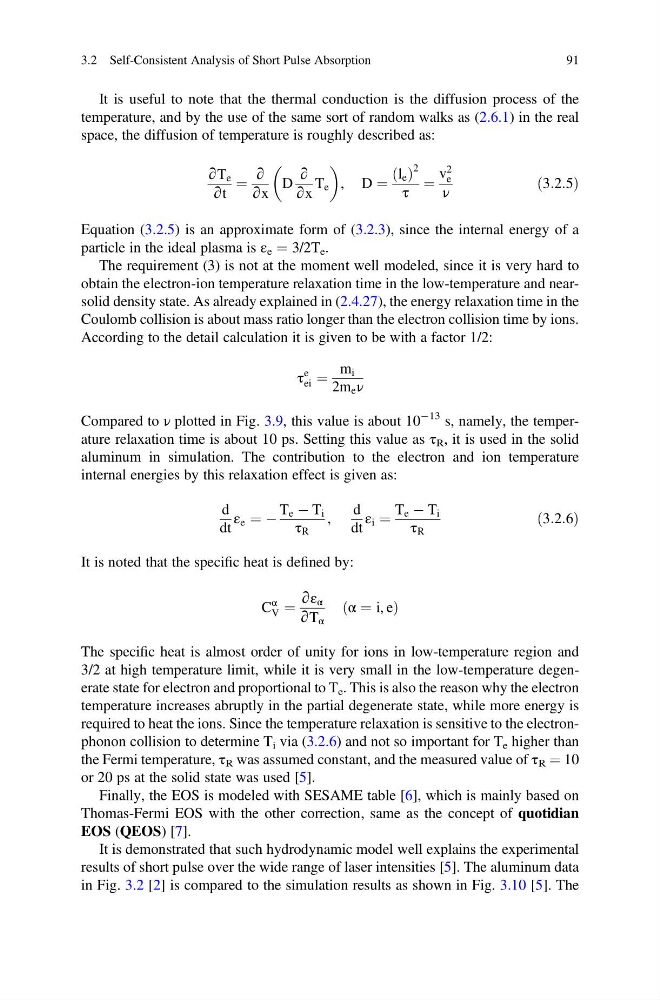
It is useful to note that the thermal conduction is the diffusion process of the
temperature, and by the use of the same sort of random walks as (2.6.1) in the real
space, the diffusion of temperature is roughly described as:
∂T e
∂t
¼
∂
∂x
D
∂
∂x
T e
, D ¼
l e
ð Þ
2
τ
¼
v
2
e
ν
ð3:2:5Þ
Equation (3.2.5) is an approximate form of (3.2.3), since the internal energy of a
particle in the ideal plasma is ε e ¼ 3/2T e .
The requirement (3) is not at the moment well modeled, since it is very hard to
obtain the electron-ion temperature relaxation time in the low-temperature and nearsolid density state. As already explained in (2.4.27), the energy relaxation time in the
Coulomb collision is about mass ratio longer than the electron collision time by ions.
According to the detail calculation it is given to be with a factor 1/2:
τ
e
ei ¼
m i
2m e ν
Compared to ν plotted in Fig. 3.9, this value is about 10
À13 s, namely, the temperature relaxation time is about 10 ps. Setting this value as τ R , it is used in the solid
aluminum in simulation. The contribution to the electron and ion temperature
internal energies by this relaxation effect is given as:
d
dt
ε e ¼ À
T e À T i
τ R
,
d
dt
ε i ¼
T e À T i
τ R
ð3:2:6Þ
It is noted that the specific heat is defined by:
C
α
V ¼
∂ε α
∂T α
α ¼ i, e
ð
Þ
The specific heat is almost order of unity for ions in low-temperature region and
3/2 at high temperature limit, while it is very small in the low-temperature degenerate state for electron and proportional to T e . This is also the reason why the electron
temperature increases abruptly in the partial degenerate state, while more energy is
required to heat the ions. Since the temperature relaxation is sensitive to the electronphonon collision to determine T i via (3.2.6) and not so important for T e higher than
the Fermi temperature, τ R was assumed constant, and the measured value of τ R ¼ 10
or 20 ps at the solid state was used [5].
Finally, the EOS is modeled with SESAME table [6], which is mainly based on
Thomas-Fermi EOS with the other correction, same as the concept of quotidian
EOS (QEOS) [7].
It is demonstrated that such hydrodynamic model well explains the experimental
results of short pulse over the wide range of laser intensities [5]. The aluminum data
in Fig. 3.2 [2] is compared to the simulation results as shown in Fig. 3.10 [5]. The
3.2 Self-Consistent Analysis of Short Pulse Absorption
91
temperature, and by the use of the same sort of random walks as (2.6.1) in the real
space, the diffusion of temperature is roughly described as:
∂T e
∂t
¼
∂
∂x
D
∂
∂x
T e
, D ¼
l e
ð Þ
2
τ
¼
v
2
e
ν
ð3:2:5Þ
Equation (3.2.5) is an approximate form of (3.2.3), since the internal energy of a
particle in the ideal plasma is ε e ¼ 3/2T e .
The requirement (3) is not at the moment well modeled, since it is very hard to
obtain the electron-ion temperature relaxation time in the low-temperature and nearsolid density state. As already explained in (2.4.27), the energy relaxation time in the
Coulomb collision is about mass ratio longer than the electron collision time by ions.
According to the detail calculation it is given to be with a factor 1/2:
τ
e
ei ¼
m i
2m e ν
Compared to ν plotted in Fig. 3.9, this value is about 10
À13 s, namely, the temperature relaxation time is about 10 ps. Setting this value as τ R , it is used in the solid
aluminum in simulation. The contribution to the electron and ion temperature
internal energies by this relaxation effect is given as:
d
dt
ε e ¼ À
T e À T i
τ R
,
d
dt
ε i ¼
T e À T i
τ R
ð3:2:6Þ
It is noted that the specific heat is defined by:
C
α
V ¼
∂ε α
∂T α
α ¼ i, e
ð
Þ
The specific heat is almost order of unity for ions in low-temperature region and
3/2 at high temperature limit, while it is very small in the low-temperature degenerate state for electron and proportional to T e . This is also the reason why the electron
temperature increases abruptly in the partial degenerate state, while more energy is
required to heat the ions. Since the temperature relaxation is sensitive to the electronphonon collision to determine T i via (3.2.6) and not so important for T e higher than
the Fermi temperature, τ R was assumed constant, and the measured value of τ R ¼ 10
or 20 ps at the solid state was used [5].
Finally, the EOS is modeled with SESAME table [6], which is mainly based on
Thomas-Fermi EOS with the other correction, same as the concept of quotidian
EOS (QEOS) [7].
It is demonstrated that such hydrodynamic model well explains the experimental
results of short pulse over the wide range of laser intensities [5]. The aluminum data
in Fig. 3.2 [2] is compared to the simulation results as shown in Fig. 3.10 [5]. The
3.2 Self-Consistent Analysis of Short Pulse Absorption
91