

At the beginning of laser absorption, the temperature increases only at the solid
surface and the heated energy is carried into the inner solid region via electron
thermal conduction. This electron thermal conductivity K e should be modeled in the
electron energy equation in the form:
d
dt
ε e ¼ ∇ K e ∇T e
ð
Þ
ð3:2:3Þ
where ε e is the internal electron energy per electron particle. Since the electrons
transfer their energy by random walks via scattering by the background ions, the
thermal conductivity can be also derived with the collision frequency and is known
to have the form (Chap. 2, Ref. [1]):
K e ¼ K 0
T e
mν
ð3:2:4Þ
In (3.2.4), K 0 is a nondimensional constant and is given in the form K 0 ¼ 320/(3π)δε,
where δ and ε are correction factors weekly dependent on the charge state, since the
electron scattering also contributes to the thermal conductivity (Chap. 2, Ref. [1]).
For the fully ionized aluminum, K 0 ¼ 10.
10
17
10 16
collision frequency (1/s)
10
15
10
14
10
-2
10
-1
10
0
10
1
ν el-phonon ∝ T i
v e /r 0
ν spitzer ∝ T e
-3/2
ν cold A1 = 8.5x10
14 /s
temperature (eV)
10
2
10
3
10
4
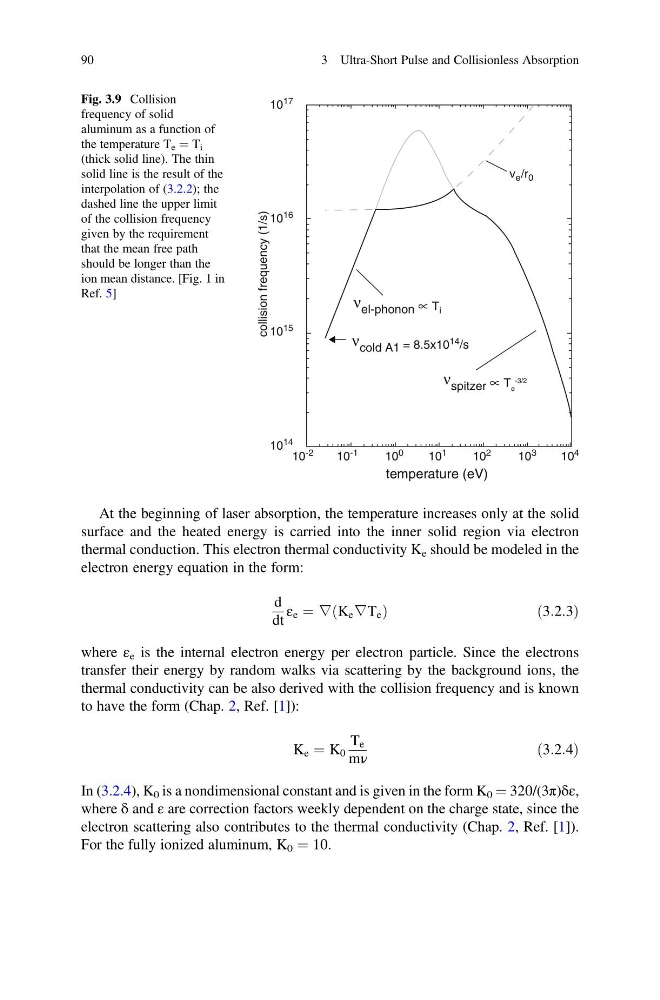
Fig. 3.9 Collision
frequency of solid
aluminum as a function of
the temperature T e ¼ T i
(thick solid line). The thin
solid line is the result of the
interpolation of (3.2.2); the
dashed line the upper limit
of the collision frequency
given by the requirement
that the mean free path
should be longer than the
ion mean distance. [Fig. 1 in
Ref. 5]
90
3 Ultra-Short Pulse and Collisionless Absorption
surface and the heated energy is carried into the inner solid region via electron
thermal conduction. This electron thermal conductivity K e should be modeled in the
electron energy equation in the form:
d
dt
ε e ¼ ∇ K e ∇T e
ð
Þ
ð3:2:3Þ
where ε e is the internal electron energy per electron particle. Since the electrons
transfer their energy by random walks via scattering by the background ions, the
thermal conductivity can be also derived with the collision frequency and is known
to have the form (Chap. 2, Ref. [1]):
K e ¼ K 0
T e
mν
ð3:2:4Þ
In (3.2.4), K 0 is a nondimensional constant and is given in the form K 0 ¼ 320/(3π)δε,
where δ and ε are correction factors weekly dependent on the charge state, since the
electron scattering also contributes to the thermal conductivity (Chap. 2, Ref. [1]).
For the fully ionized aluminum, K 0 ¼ 10.
10
17
10 16
collision frequency (1/s)
10
15
10
14
10
-2
10
-1
10
0
10
1
ν el-phonon ∝ T i
v e /r 0
ν spitzer ∝ T e
-3/2
ν cold A1 = 8.5x10
14 /s
temperature (eV)
10
2
10
3
10
4
Fig. 3.9 Collision
frequency of solid
aluminum as a function of
the temperature T e ¼ T i
(thick solid line). The thin
solid line is the result of the
interpolation of (3.2.2); the
dashed line the upper limit
of the collision frequency
given by the requirement
that the mean free path
should be longer than the
ion mean distance. [Fig. 1 in
Ref. 5]
90
3 Ultra-Short Pulse and Collisionless Absorption