

Topics in Current Chemistry (2019) 377:35
1 3
involving the catalytic generation of acyl anion, enolate or homoenolate equivalents
from aldehydes [7, 8]. Along with this development, the application to asymmetric transformation using this cooperative catalysis has also been accomplished by
the design of chiral NHC scaffold or ligand for metal. This review aims to provide
examples of asymmetric NHC/metal cooperative catalysis.
2 NHC/Metal‑Based Lewis Acid Cooperative Catalysis
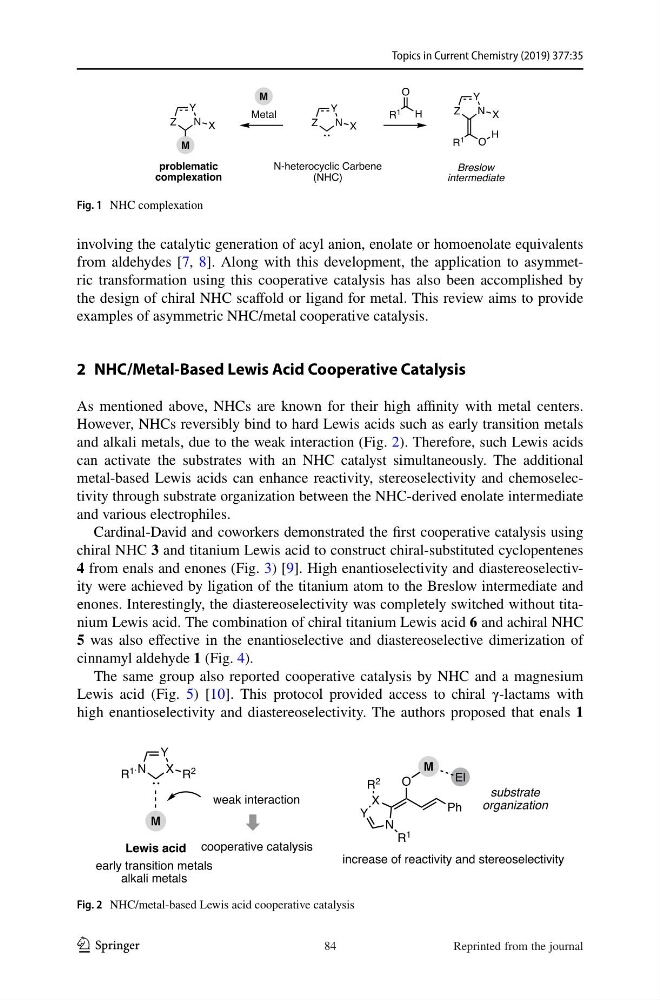
As mentioned above, NHCs are known for their high affinity with metal centers.
However, NHCs reversibly bind to hard Lewis acids such as early transition metals
and alkali metals, due to the weak interaction (Fig. 2). Therefore, such Lewis acids
can activate the substrates with an NHC catalyst simultaneously. The additional
metal-based Lewis acids can enhance reactivity, stereoselectivity and chemoselectivity through substrate organization between the NHC-derived enolate intermediate
and various electrophiles.
Cardinal-David and coworkers demonstrated the first cooperative catalysis using
chiral NHC 3 and titanium Lewis acid to construct chiral-substituted cyclopentenes
4 from enals and enones (Fig. 3) [9]. High enantioselectivity and diastereoselectivity were achieved by ligation of the titanium atom to the Breslow intermediate and
enones. Interestingly, the diastereoselectivity was completely switched without titanium Lewis acid. The combination of chiral titanium Lewis acid 6 and achiral NHC
5 was also effective in the enantioselective and diastereoselective dimerization of
cinnamyl aldehyde 1 (Fig. 4).
The same group also reported cooperative catalysis by NHC and a magnesium
Lewis acid (Fig. 5) [10]. This protocol provided access to chiral γ-lactams with
high enantioselectivity and diastereoselectivity. The authors proposed that enals 1
Fig. 1 NHC complexation
Fig. 2 NHC/metal-based Lewis acid cooperative catalysis
Reprinted from the journal
84
1 3
involving the catalytic generation of acyl anion, enolate or homoenolate equivalents
from aldehydes [7, 8]. Along with this development, the application to asymmetric transformation using this cooperative catalysis has also been accomplished by
the design of chiral NHC scaffold or ligand for metal. This review aims to provide
examples of asymmetric NHC/metal cooperative catalysis.
2 NHC/Metal‑Based Lewis Acid Cooperative Catalysis
As mentioned above, NHCs are known for their high affinity with metal centers.
However, NHCs reversibly bind to hard Lewis acids such as early transition metals
and alkali metals, due to the weak interaction (Fig. 2). Therefore, such Lewis acids
can activate the substrates with an NHC catalyst simultaneously. The additional
metal-based Lewis acids can enhance reactivity, stereoselectivity and chemoselectivity through substrate organization between the NHC-derived enolate intermediate
and various electrophiles.
Cardinal-David and coworkers demonstrated the first cooperative catalysis using
chiral NHC 3 and titanium Lewis acid to construct chiral-substituted cyclopentenes
4 from enals and enones (Fig. 3) [9]. High enantioselectivity and diastereoselectivity were achieved by ligation of the titanium atom to the Breslow intermediate and
enones. Interestingly, the diastereoselectivity was completely switched without titanium Lewis acid. The combination of chiral titanium Lewis acid 6 and achiral NHC
5 was also effective in the enantioselective and diastereoselective dimerization of
cinnamyl aldehyde 1 (Fig. 4).
The same group also reported cooperative catalysis by NHC and a magnesium
Lewis acid (Fig. 5) [10]. This protocol provided access to chiral γ-lactams with
high enantioselectivity and diastereoselectivity. The authors proposed that enals 1
Fig. 1 NHC complexation
Fig. 2 NHC/metal-based Lewis acid cooperative catalysis
Reprinted from the journal
84