

Topics in Current Chemistry (2019) 377:38
1 3
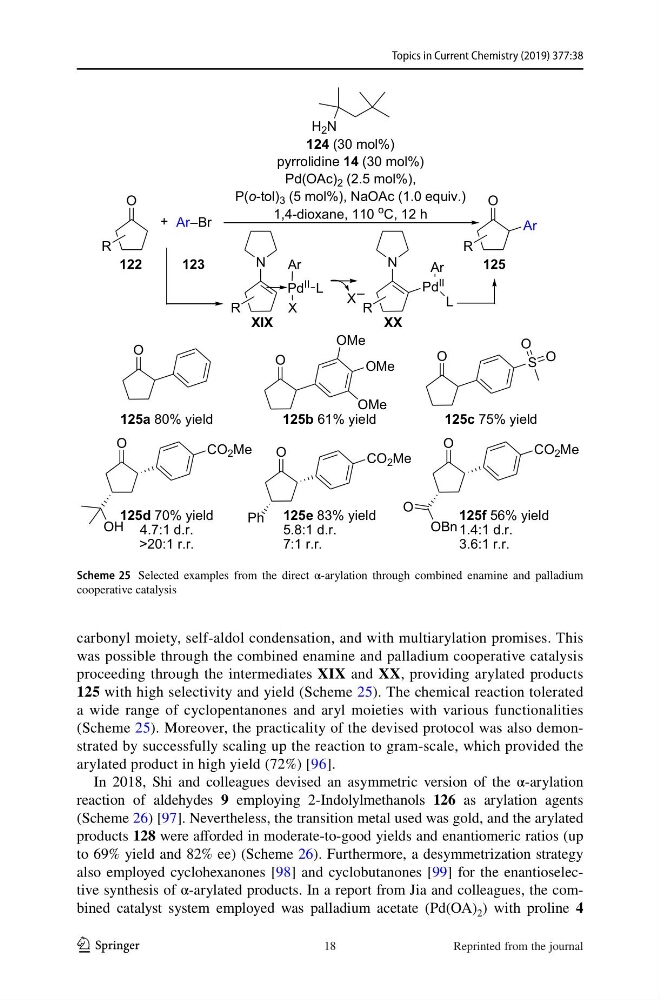
carbonyl moiety, self-aldol condensation, and with multiarylation promises. This
was possible through the combined enamine and palladium cooperative catalysis
proceeding through the intermediates XIX and XX, providing arylated products
125 with high selectivity and yield (Scheme 25). The chemical reaction tolerated
a wide range of cyclopentanones and aryl moieties with various functionalities
(Scheme 25). Moreover, the practicality of the devised protocol was also demonstrated by successfully scaling up the reaction to gram-scale, which provided the
arylated product in high yield (72%) [96].
In 2018, Shi and colleagues devised an asymmetric version of the α-arylation
reaction of aldehydes 9 employing 2-Indolylmethanols 126 as arylation agents
(Scheme 26) [97]. Nevertheless, the transition metal used was gold, and the arylated
products 128 were afforded in moderate-to-good yields and enantiomeric ratios (up
to 69% yield and 82% ee) (Scheme 26). Furthermore, a desymmetrization strategy
also employed cyclohexanones [98] and cyclobutanones [99] for the enantioselective synthesis of α-arylated products. In a report from Jia and colleagues, the combined catalyst system employed was palladium acetate (Pd(OA) 2 ) with proline 4
O
+ Ar–Br
R
O
R
Ar
pyrrolidine 14 (30 mol%)
Pd(OAc) 2 (2.5 mol%),
P(o-tol) 3 (5 mol%), NaOAc (1.0 equiv.)
1,4-dioxane, 110
o
C, 12 h
H 2 N
124 (30 mol%)
122
123
1 25
N
R
Pd
II
X
L
Ar
N
R
Pd
II
Ar
L
X –
XIX
X X
O
125a 80% yield
O
125b 61% yield
OMe
OMe
OMe
O
125c 75% yield
S O
O
O
125d 70% yield
4.7:1 d.r.
>20:1 r.r.
CO 2 Me
OH
O
125e 83% yield
5.8:1 d.r.
7:1 r.r.
CO 2 Me
Ph
O
125f 56% yield
1.4:1 d.r.
3.6:1 r.r.
CO 2 Me
O
OBn
Scheme 25 Selected examples from the direct α-arylation through combined enamine and palladium
cooperative catalysis
Reprinted from the journal
18
1 3
carbonyl moiety, self-aldol condensation, and with multiarylation promises. This
was possible through the combined enamine and palladium cooperative catalysis
proceeding through the intermediates XIX and XX, providing arylated products
125 with high selectivity and yield (Scheme 25). The chemical reaction tolerated
a wide range of cyclopentanones and aryl moieties with various functionalities
(Scheme 25). Moreover, the practicality of the devised protocol was also demonstrated by successfully scaling up the reaction to gram-scale, which provided the
arylated product in high yield (72%) [96].
In 2018, Shi and colleagues devised an asymmetric version of the α-arylation
reaction of aldehydes 9 employing 2-Indolylmethanols 126 as arylation agents
(Scheme 26) [97]. Nevertheless, the transition metal used was gold, and the arylated
products 128 were afforded in moderate-to-good yields and enantiomeric ratios (up
to 69% yield and 82% ee) (Scheme 26). Furthermore, a desymmetrization strategy
also employed cyclohexanones [98] and cyclobutanones [99] for the enantioselective synthesis of α-arylated products. In a report from Jia and colleagues, the combined catalyst system employed was palladium acetate (Pd(OA) 2 ) with proline 4
O
+ Ar–Br
R
O
R
Ar
pyrrolidine 14 (30 mol%)
Pd(OAc) 2 (2.5 mol%),
P(o-tol) 3 (5 mol%), NaOAc (1.0 equiv.)
1,4-dioxane, 110
o
C, 12 h
H 2 N
124 (30 mol%)
122
123
1 25
N
R
Pd
II
X
L
Ar
N
R
Pd
II
Ar
L
X –
XIX
X X
O
125a 80% yield
O
125b 61% yield
OMe
OMe
OMe
O
125c 75% yield
S O
O
O
125d 70% yield
4.7:1 d.r.
>20:1 r.r.
CO 2 Me
OH
O
125e 83% yield
5.8:1 d.r.
7:1 r.r.
CO 2 Me
Ph
O
125f 56% yield
1.4:1 d.r.
3.6:1 r.r.
CO 2 Me
O
OBn
Scheme 25 Selected examples from the direct α-arylation through combined enamine and palladium
cooperative catalysis
Reprinted from the journal
18