

1 3
Topics in Current Chemistry (2019) 377:38
6 Miscellaneous Reactions
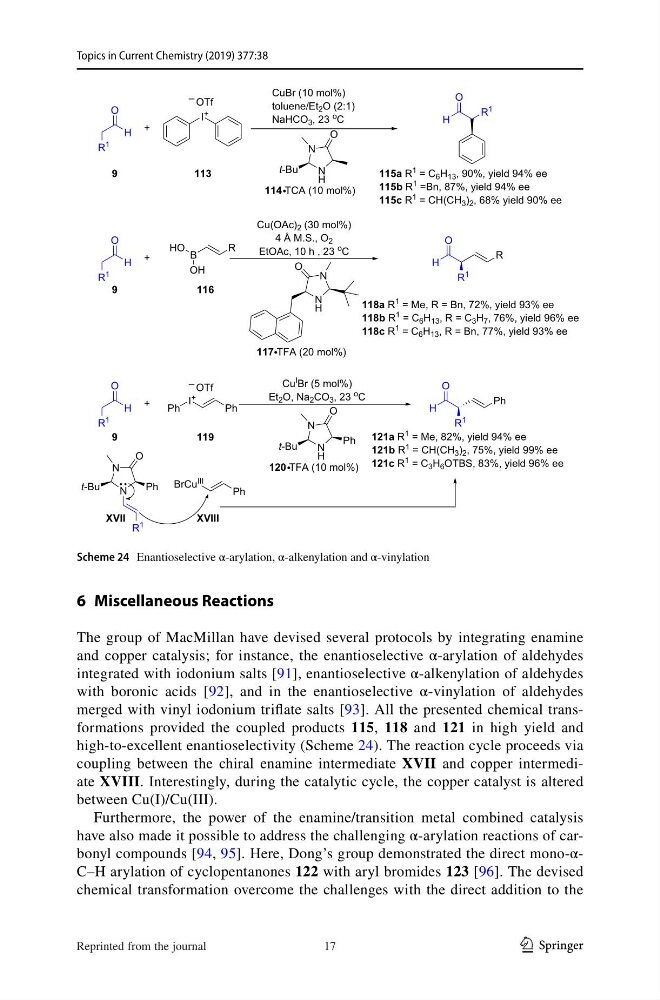
The group of MacMillan have devised several protocols by integrating enamine
and copper catalysis; for instance, the enantioselective α-arylation of aldehydes
integrated with iodonium salts [91], enantioselective α-alkenylation of aldehydes
with boronic acids [92], and in the enantioselective α-vinylation of aldehydes
merged with vinyl iodonium triflate salts [93]. All the presented chemical transformations provided the coupled products 115, 118 and 121 in high yield and
high-to-excellent enantioselectivity (Scheme 24). The reaction cycle proceeds via
coupling between the chiral enamine intermediate XVII and copper intermediate XVIII. Interestingly, during the catalytic cycle, the copper catalyst is altered
between Cu(I)/Cu(III).
Furthermore, the power of the enamine/transition metal combined catalysis
have also made it possible to address the challenging α-arylation reactions of carbonyl compounds [94, 95]. Here, Dong’s group demonstrated the direct mono-αC–H arylation of cyclopentanones 122 with aryl bromides 123 [96]. The devised
chemical transformation overcome the challenges with the direct addition to the
R
1
H
O
+
I
+
– OTf
H
O
R
1
CuBr (10 mol%)
toluene/Et 2 O (2:1)
NaHCO 3 , 23
o
C
N
N
H
t-Bu
O
9
1 13
114 TCA (10 mol%)
115a R
1 = C 6 H 13 , 90%, yield 94% ee
115b R
1 =Bn, 87%, yield 94% ee
115c R
1 = CH(CH 3 ) 2 , 68% yield 90% ee
R
1
H
O
+
Cu(OAc) 2 (30 mol%)
4 Å M.S., O 2
EtOAc, 10 h , 23
o
C
N
H
N
O
9
1 16
117 TFA (20 mol%)
B
OH
HO
R
H
O
R
1
R
R
1
H
O
+
Cu
I
Br (5 mol%)
Et 2 O, Na 2 CO 3 , 23
o
C
9
1 19
I
+
Ph
H
O
R
1
Ph
N
N
H
Ph
t-Bu
O
120 TFA (10 mol%)
– OTf
121a R
1 = Me, 82%, yield 94% ee
121b R
1 = CH(CH 3 ) 2 , 75%, yield 99% ee
121c R
1 = C 3 H 6 OTBS, 83%, yield 96% ee
118a R
1 = Me, R = Bn, 72%, yield 93% ee
118b R
1 = C 6 H 13 , R = C 3 H 7 , 76%, yield 96% ee
118c R
1 = C 6 H 13 , R = Bn, 77%, yield 93% ee
Ph
XVII
BrCu
III
Ph
N
N
Ph
t-Bu
O
R
1
XVIII
Scheme 24 Enantioselective α-arylation, α-alkenylation and α-vinylation
Reprinted from the journal
17
Topics in Current Chemistry (2019) 377:38
6 Miscellaneous Reactions
The group of MacMillan have devised several protocols by integrating enamine
and copper catalysis; for instance, the enantioselective α-arylation of aldehydes
integrated with iodonium salts [91], enantioselective α-alkenylation of aldehydes
with boronic acids [92], and in the enantioselective α-vinylation of aldehydes
merged with vinyl iodonium triflate salts [93]. All the presented chemical transformations provided the coupled products 115, 118 and 121 in high yield and
high-to-excellent enantioselectivity (Scheme 24). The reaction cycle proceeds via
coupling between the chiral enamine intermediate XVII and copper intermediate XVIII. Interestingly, during the catalytic cycle, the copper catalyst is altered
between Cu(I)/Cu(III).
Furthermore, the power of the enamine/transition metal combined catalysis
have also made it possible to address the challenging α-arylation reactions of carbonyl compounds [94, 95]. Here, Dong’s group demonstrated the direct mono-αC–H arylation of cyclopentanones 122 with aryl bromides 123 [96]. The devised
chemical transformation overcome the challenges with the direct addition to the
R
1
H
O
+
I
+
– OTf
H
O
R
1
CuBr (10 mol%)
toluene/Et 2 O (2:1)
NaHCO 3 , 23
o
C
N
N
H
t-Bu
O
9
1 13
114 TCA (10 mol%)
115a R
1 = C 6 H 13 , 90%, yield 94% ee
115b R
1 =Bn, 87%, yield 94% ee
115c R
1 = CH(CH 3 ) 2 , 68% yield 90% ee
R
1
H
O
+
Cu(OAc) 2 (30 mol%)
4 Å M.S., O 2
EtOAc, 10 h , 23
o
C
N
H
N
O
9
1 16
117 TFA (20 mol%)
B
OH
HO
R
H
O
R
1
R
R
1
H
O
+
Cu
I
Br (5 mol%)
Et 2 O, Na 2 CO 3 , 23
o
C
9
1 19
I
+
Ph
H
O
R
1
Ph
N
N
H
Ph
t-Bu
O
120 TFA (10 mol%)
– OTf
121a R
1 = Me, 82%, yield 94% ee
121b R
1 = CH(CH 3 ) 2 , 75%, yield 99% ee
121c R
1 = C 3 H 6 OTBS, 83%, yield 96% ee
118a R
1 = Me, R = Bn, 72%, yield 93% ee
118b R
1 = C 6 H 13 , R = C 3 H 7 , 76%, yield 96% ee
118c R
1 = C 6 H 13 , R = Bn, 77%, yield 93% ee
Ph
XVII
BrCu
III
Ph
N
N
Ph
t-Bu
O
R
1
XVIII
Scheme 24 Enantioselective α-arylation, α-alkenylation and α-vinylation
Reprinted from the journal
17