

1 3
Topics in Current Chemistry (2020) 378:9
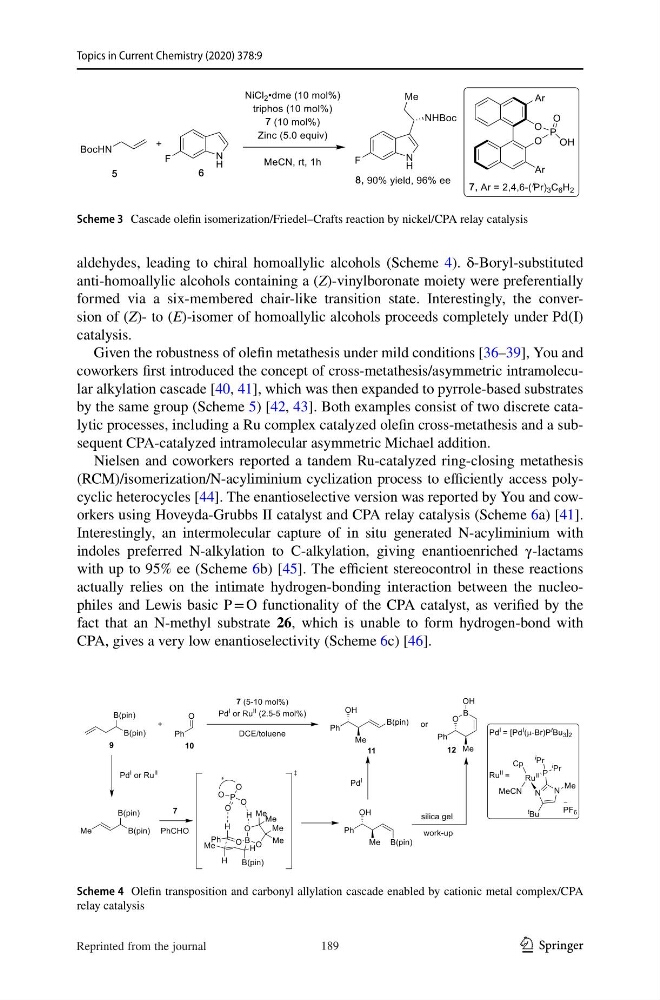
aldehydes, leading to chiral homoallylic alcohols (Scheme 4). δ-Boryl-substituted
anti-homoallylic alcohols containing a (Z)-vinylboronate moiety were preferentially
formed via a six-membered chair-like transition state. Interestingly, the conversion of (Z)- to (E)-isomer of homoallylic alcohols proceeds completely under Pd(I)
catalysis.
Given the robustness of olefin metathesis under mild conditions [36–39], You and
coworkers first introduced the concept of cross-metathesis/asymmetric intramolecular alkylation cascade [40, 41], which was then expanded to pyrrole-based substrates
by the same group (Scheme 5) [42, 43]. Both examples consist of two discrete catalytic processes, including a Ru complex catalyzed olefin cross-metathesis and a subsequent CPA-catalyzed intramolecular asymmetric Michael addition.
Nielsen and coworkers reported a tandem Ru-catalyzed ring-closing metathesis
(RCM)/isomerization/N-acyliminium cyclization process to efficiently access polycyclic heterocycles [44]. The enantioselective version was reported by You and coworkers using Hoveyda-Grubbs II catalyst and CPA relay catalysis (Scheme 6a) [41].
Interestingly, an intermolecular capture of in situ generated N-acyliminium with
indoles preferred N-alkylation to C-alkylation, giving enantioenriched γ-lactams
with up to 95% ee (Scheme 6b) [45]. The efficient stereocontrol in these reactions
actually relies on the intimate hydrogen-bonding interaction between the nucleophiles and Lewis basic P = O functionality of the CPA catalyst, as verified by the
fact that an N-methyl substrate 26, which is unable to form hydrogen-bond with
CPA, gives a very low enantioselectivity (Scheme 6c) [46].
Scheme 3 Cascade olefin isomerization/Friedel–Crafts reaction by nickel/CPA relay catalysis
Scheme 4 Olefin transposition and carbonyl allylation cascade enabled by cationic metal complex/CPA
relay catalysis
Reprinted from the journal
189
Topics in Current Chemistry (2020) 378:9
aldehydes, leading to chiral homoallylic alcohols (Scheme 4). δ-Boryl-substituted
anti-homoallylic alcohols containing a (Z)-vinylboronate moiety were preferentially
formed via a six-membered chair-like transition state. Interestingly, the conversion of (Z)- to (E)-isomer of homoallylic alcohols proceeds completely under Pd(I)
catalysis.
Given the robustness of olefin metathesis under mild conditions [36–39], You and
coworkers first introduced the concept of cross-metathesis/asymmetric intramolecular alkylation cascade [40, 41], which was then expanded to pyrrole-based substrates
by the same group (Scheme 5) [42, 43]. Both examples consist of two discrete catalytic processes, including a Ru complex catalyzed olefin cross-metathesis and a subsequent CPA-catalyzed intramolecular asymmetric Michael addition.
Nielsen and coworkers reported a tandem Ru-catalyzed ring-closing metathesis
(RCM)/isomerization/N-acyliminium cyclization process to efficiently access polycyclic heterocycles [44]. The enantioselective version was reported by You and coworkers using Hoveyda-Grubbs II catalyst and CPA relay catalysis (Scheme 6a) [41].
Interestingly, an intermolecular capture of in situ generated N-acyliminium with
indoles preferred N-alkylation to C-alkylation, giving enantioenriched γ-lactams
with up to 95% ee (Scheme 6b) [45]. The efficient stereocontrol in these reactions
actually relies on the intimate hydrogen-bonding interaction between the nucleophiles and Lewis basic P = O functionality of the CPA catalyst, as verified by the
fact that an N-methyl substrate 26, which is unable to form hydrogen-bond with
CPA, gives a very low enantioselectivity (Scheme 6c) [46].
Scheme 3 Cascade olefin isomerization/Friedel–Crafts reaction by nickel/CPA relay catalysis
Scheme 4 Olefin transposition and carbonyl allylation cascade enabled by cationic metal complex/CPA
relay catalysis
Reprinted from the journal
189