

Topics in Current Chemistry (2019) 377:23
1 3
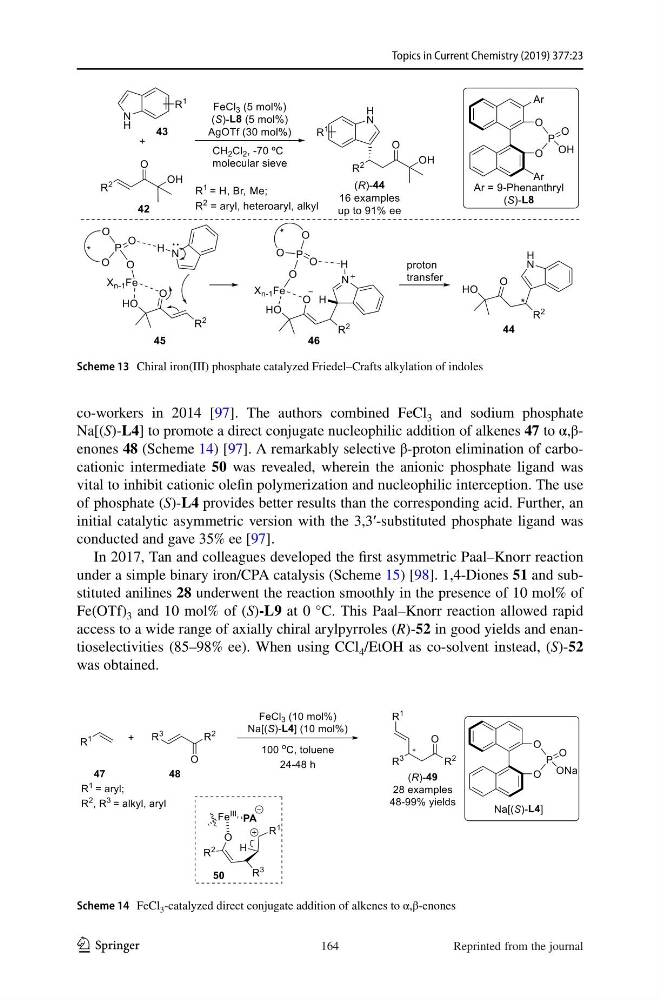
co-workers in 2014 [97]. The authors combined FeCl 3 and sodium phosphate
Na[(S)-L4] to promote a direct conjugate nucleophilic addition of alkenes 47 to α,βenones 48 (Scheme 14) [97]. A remarkably selective β-proton elimination of carbocationic intermediate 50 was revealed, wherein the anionic phosphate ligand was
vital to inhibit cationic olefin polymerization and nucleophilic interception. The use
of phosphate (S)-L4 provides better results than the corresponding acid. Further, an
initial catalytic asymmetric version with the 3,3′-substituted phosphate ligand was
conducted and gave 35% ee [97].
In 2017, Tan and colleagues developed the first asymmetric Paal–Knorr reaction
under a simple binary iron/CPA catalysis (Scheme 15) [98]. 1,4-Diones 51 and substituted anilines 28 underwent the reaction smoothly in the presence of 10 mol% of
Fe(OTf) 3 and 10 mol% of (S)-L9 at 0 °C. This Paal–Knorr reaction allowed rapid
access to a wide range of axially chiral arylpyrroles (R)-52 in good yields and enantioselectivities (85–98% ee). When using CCl 4 /EtOH as co-solvent instead, (S)-52
was obtained.
Scheme 13 Chiral iron(III) phosphate catalyzed Friedel–Crafts alkylation of indoles
Scheme 14 FeCl 3 -catalyzed direct conjugate addition of alkenes to α,β-enones
Reprinted from the journal
164
1 3
co-workers in 2014 [97]. The authors combined FeCl 3 and sodium phosphate
Na[(S)-L4] to promote a direct conjugate nucleophilic addition of alkenes 47 to α,βenones 48 (Scheme 14) [97]. A remarkably selective β-proton elimination of carbocationic intermediate 50 was revealed, wherein the anionic phosphate ligand was
vital to inhibit cationic olefin polymerization and nucleophilic interception. The use
of phosphate (S)-L4 provides better results than the corresponding acid. Further, an
initial catalytic asymmetric version with the 3,3′-substituted phosphate ligand was
conducted and gave 35% ee [97].
In 2017, Tan and colleagues developed the first asymmetric Paal–Knorr reaction
under a simple binary iron/CPA catalysis (Scheme 15) [98]. 1,4-Diones 51 and substituted anilines 28 underwent the reaction smoothly in the presence of 10 mol% of
Fe(OTf) 3 and 10 mol% of (S)-L9 at 0 °C. This Paal–Knorr reaction allowed rapid
access to a wide range of axially chiral arylpyrroles (R)-52 in good yields and enantioselectivities (85–98% ee). When using CCl 4 /EtOH as co-solvent instead, (S)-52
was obtained.
Scheme 13 Chiral iron(III) phosphate catalyzed Friedel–Crafts alkylation of indoles
Scheme 14 FeCl 3 -catalyzed direct conjugate addition of alkenes to α,β-enones
Reprinted from the journal
164