

1 3
Topics in Current Chemistry (2019) 377:23
The subsequent stepwise hydrogenation of imine, where phosphoric acid acts as a
proton donor, afforded the final product 33.
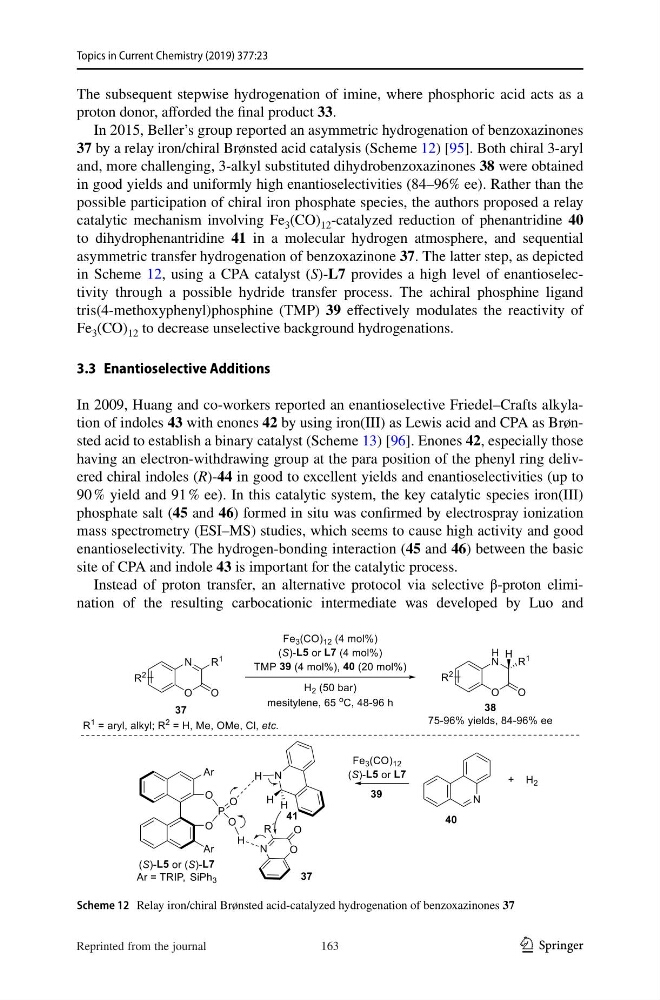
In 2015, Beller’s group reported an asymmetric hydrogenation of benzoxazinones
37 by a relay iron/chiral Brønsted acid catalysis (Scheme 12) [95]. Both chiral 3-aryl
and, more challenging, 3-alkyl substituted dihydrobenzoxazinones 38 were obtained
in good yields and uniformly high enantioselectivities (84–96% ee). Rather than the
possible participation of chiral iron phosphate species, the authors proposed a relay
catalytic mechanism involving Fe 3 (CO) 12 -catalyzed reduction of phenantridine 40
to dihydrophenantridine 41 in a molecular hydrogen atmosphere, and sequential
asymmetric transfer hydrogenation of benzoxazinone 37. The latter step, as depicted
in Scheme 12, using a CPA catalyst (S)-L7 provides a high level of enantioselectivity through a possible hydride transfer process. The achiral phosphine ligand
tris(4-methoxyphenyl)phosphine (TMP) 39 effectively modulates the reactivity of
Fe 3 (CO) 12 to decrease unselective background hydrogenations.
3.3 Enantioselective Additions
In 2009, Huang and co-workers reported an enantioselective Friedel–Crafts alkylation of indoles 43 with enones 42 by using iron(III) as Lewis acid and CPA as Brønsted acid to establish a binary catalyst (Scheme 13) [96]. Enones 42, especially those
having an electron-withdrawing group at the para position of the phenyl ring delivered chiral indoles (R)-44 in good to excellent yields and enantioselectivities (up to
90 % yield and 91 % ee). In this catalytic system, the key catalytic species iron(III)
phosphate salt (45 and 46) formed in situ was confirmed by electrospray ionization
mass spectrometry (ESI–MS) studies, which seems to cause high activity and good
enantioselectivity. The hydrogen-bonding interaction (45 and 46) between the basic
site of CPA and indole 43 is important for the catalytic process.
Instead of proton transfer, an alternative protocol via selective β-proton elimination of the resulting carbocationic intermediate was developed by Luo and
Scheme 12 Relay iron/chiral Brønsted acid-catalyzed hydrogenation of benzoxazinones 37
Reprinted from the journal
163
Topics in Current Chemistry (2019) 377:23
The subsequent stepwise hydrogenation of imine, where phosphoric acid acts as a
proton donor, afforded the final product 33.
In 2015, Beller’s group reported an asymmetric hydrogenation of benzoxazinones
37 by a relay iron/chiral Brønsted acid catalysis (Scheme 12) [95]. Both chiral 3-aryl
and, more challenging, 3-alkyl substituted dihydrobenzoxazinones 38 were obtained
in good yields and uniformly high enantioselectivities (84–96% ee). Rather than the
possible participation of chiral iron phosphate species, the authors proposed a relay
catalytic mechanism involving Fe 3 (CO) 12 -catalyzed reduction of phenantridine 40
to dihydrophenantridine 41 in a molecular hydrogen atmosphere, and sequential
asymmetric transfer hydrogenation of benzoxazinone 37. The latter step, as depicted
in Scheme 12, using a CPA catalyst (S)-L7 provides a high level of enantioselectivity through a possible hydride transfer process. The achiral phosphine ligand
tris(4-methoxyphenyl)phosphine (TMP) 39 effectively modulates the reactivity of
Fe 3 (CO) 12 to decrease unselective background hydrogenations.
3.3 Enantioselective Additions
In 2009, Huang and co-workers reported an enantioselective Friedel–Crafts alkylation of indoles 43 with enones 42 by using iron(III) as Lewis acid and CPA as Brønsted acid to establish a binary catalyst (Scheme 13) [96]. Enones 42, especially those
having an electron-withdrawing group at the para position of the phenyl ring delivered chiral indoles (R)-44 in good to excellent yields and enantioselectivities (up to
90 % yield and 91 % ee). In this catalytic system, the key catalytic species iron(III)
phosphate salt (45 and 46) formed in situ was confirmed by electrospray ionization
mass spectrometry (ESI–MS) studies, which seems to cause high activity and good
enantioselectivity. The hydrogen-bonding interaction (45 and 46) between the basic
site of CPA and indole 43 is important for the catalytic process.
Instead of proton transfer, an alternative protocol via selective β-proton elimination of the resulting carbocationic intermediate was developed by Luo and
Scheme 12 Relay iron/chiral Brønsted acid-catalyzed hydrogenation of benzoxazinones 37
Reprinted from the journal
163