

Topics in Current Chemistry (2019) 377:35
1 3
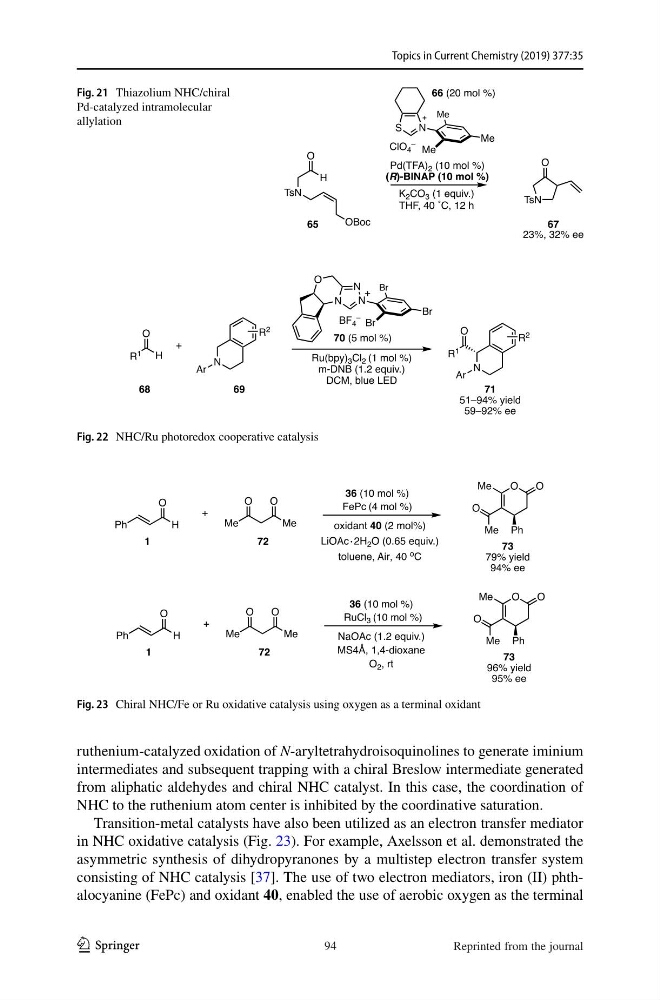
ruthenium-catalyzed oxidation of N-aryltetrahydroisoquinolines to generate iminium
intermediates and subsequent trapping with a chiral Breslow intermediate generated
from aliphatic aldehydes and chiral NHC catalyst. In this case, the coordination of
NHC to the ruthenium atom center is inhibited by the coordinative saturation.
Transition-metal catalysts have also been utilized as an electron transfer mediator
in NHC oxidative catalysis (Fig. 23). For example, Axelsson et al. demonstrated the
asymmetric synthesis of dihydropyranones by a multistep electron transfer system
consisting of NHC catalysis [37]. The use of two electron mediators, iron (II) phthalocyanine (FePc) and oxidant 40, enabled the use of aerobic oxygen as the terminal
Fig. 21 Thiazolium NHC/chiral
Pd-catalyzed intramolecular
allylation
Fig. 22 NHC/Ru photoredox cooperative catalysis
Fig. 23 Chiral NHC/Fe or Ru oxidative catalysis using oxygen as a terminal oxidant
Reprinted from the journal
94
1 3
ruthenium-catalyzed oxidation of N-aryltetrahydroisoquinolines to generate iminium
intermediates and subsequent trapping with a chiral Breslow intermediate generated
from aliphatic aldehydes and chiral NHC catalyst. In this case, the coordination of
NHC to the ruthenium atom center is inhibited by the coordinative saturation.
Transition-metal catalysts have also been utilized as an electron transfer mediator
in NHC oxidative catalysis (Fig. 23). For example, Axelsson et al. demonstrated the
asymmetric synthesis of dihydropyranones by a multistep electron transfer system
consisting of NHC catalysis [37]. The use of two electron mediators, iron (II) phthalocyanine (FePc) and oxidant 40, enabled the use of aerobic oxygen as the terminal
Fig. 21 Thiazolium NHC/chiral
Pd-catalyzed intramolecular
allylation
Fig. 22 NHC/Ru photoredox cooperative catalysis
Fig. 23 Chiral NHC/Fe or Ru oxidative catalysis using oxygen as a terminal oxidant
Reprinted from the journal
94