

1 3
Topics in Current Chemistry (2019) 377:35
Chiral NHC/Cu cooperative catalysis was also demonstrated by Zhang et al.,
who described the asymmetric synthesis of spirooxindoles through enantioselective
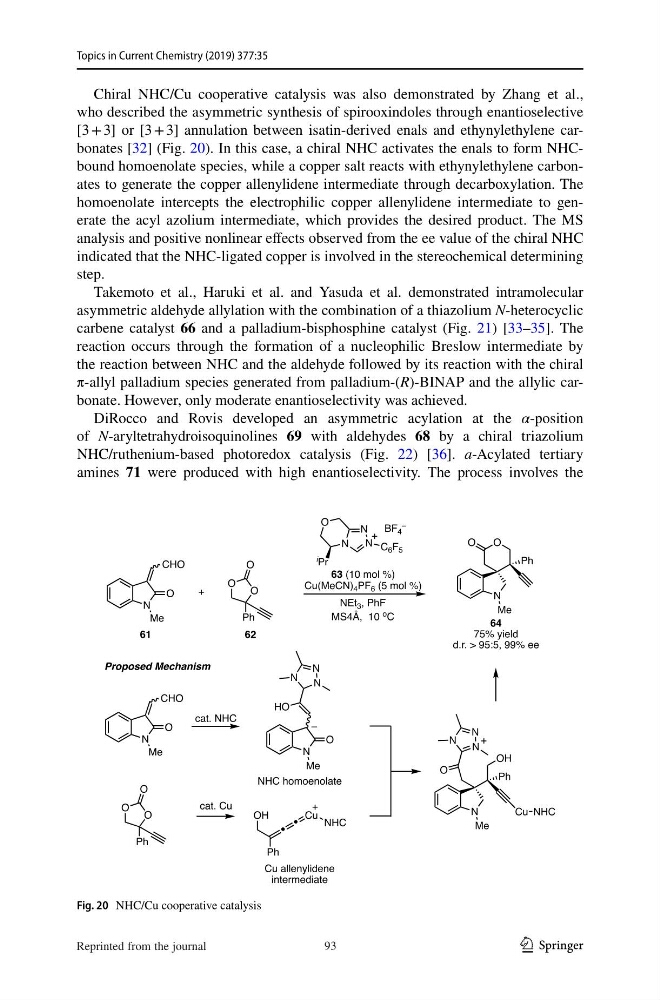
[3 + 3] or [3 + 3] annulation between isatin-derived enals and ethynylethylene carbonates [32] (Fig. 20). In this case, a chiral NHC activates the enals to form NHCbound homoenolate species, while a copper salt reacts with ethynylethylene carbonates to generate the copper allenylidene intermediate through decarboxylation. The
homoenolate intercepts the electrophilic copper allenylidene intermediate to generate the acyl azolium intermediate, which provides the desired product. The MS
analysis and positive nonlinear effects observed from the ee value of the chiral NHC
indicated that the NHC-ligated copper is involved in the stereochemical determining
step.
Takemoto et al., Haruki et al. and Yasuda et al. demonstrated intramolecular
asymmetric aldehyde allylation with the combination of a thiazolium N-heterocyclic
carbene catalyst 66 and a palladium-bisphosphine catalyst (Fig. 21) [33–35]. The
reaction occurs through the formation of a nucleophilic Breslow intermediate by
the reaction between NHC and the aldehyde followed by its reaction with the chiral
π-allyl palladium species generated from palladium-(R)-BINAP and the allylic carbonate. However, only moderate enantioselectivity was achieved.
DiRocco and Rovis developed an asymmetric acylation at the α-position
of N-aryltetrahydroisoquinolines 69 with aldehydes 68 by a chiral triazolium
NHC/ruthenium-based photoredox catalysis (Fig. 22) [36]. a-Acylated tertiary
amines 71 were produced with high enantioselectivity. The process involves the
Fig. 20 NHC/Cu cooperative catalysis
Reprinted from the journal
93
Topics in Current Chemistry (2019) 377:35
Chiral NHC/Cu cooperative catalysis was also demonstrated by Zhang et al.,
who described the asymmetric synthesis of spirooxindoles through enantioselective
[3 + 3] or [3 + 3] annulation between isatin-derived enals and ethynylethylene carbonates [32] (Fig. 20). In this case, a chiral NHC activates the enals to form NHCbound homoenolate species, while a copper salt reacts with ethynylethylene carbonates to generate the copper allenylidene intermediate through decarboxylation. The
homoenolate intercepts the electrophilic copper allenylidene intermediate to generate the acyl azolium intermediate, which provides the desired product. The MS
analysis and positive nonlinear effects observed from the ee value of the chiral NHC
indicated that the NHC-ligated copper is involved in the stereochemical determining
step.
Takemoto et al., Haruki et al. and Yasuda et al. demonstrated intramolecular
asymmetric aldehyde allylation with the combination of a thiazolium N-heterocyclic
carbene catalyst 66 and a palladium-bisphosphine catalyst (Fig. 21) [33–35]. The
reaction occurs through the formation of a nucleophilic Breslow intermediate by
the reaction between NHC and the aldehyde followed by its reaction with the chiral
π-allyl palladium species generated from palladium-(R)-BINAP and the allylic carbonate. However, only moderate enantioselectivity was achieved.
DiRocco and Rovis developed an asymmetric acylation at the α-position
of N-aryltetrahydroisoquinolines 69 with aldehydes 68 by a chiral triazolium
NHC/ruthenium-based photoredox catalysis (Fig. 22) [36]. a-Acylated tertiary
amines 71 were produced with high enantioselectivity. The process involves the
Fig. 20 NHC/Cu cooperative catalysis
Reprinted from the journal
93