

of interactions between outer Solar System objects leaving a population of bodies
beyond the orbit of Neptune that may have experienced relatively little change over
the past 4.6 billion years.
It is the fact that comets are active that leads to the suspicion that they were
involved in this process. This activity is produced by the sublimation of ice (mostly
water ice) from the surfaces of small, irregular-shaped, solid nuclei. The probable
presence of ices (including many that are far more volatile than water ice such as
carbon monoxide) suggests that these objects have not been significantly thermally
processed since their formation. Other objects in our Solar System have been heated
through gravitational or collisional processes and have either lost their surface ice or
the ice has been structurally modified (e.g. through melting). In the case of some
objects, notably asteroids, water ice might still be present at depth, but this is, at least
partially, the subject of speculation.
The possibility that the Solar System still contains remnants that have hardly been
altered since the completion of the planetary formation process is a tantalizing
prospect. Understanding the conditions under which Solar System formation
began would clearly be a major step in trying to establish the frequency with
which planetary systems like our own form. The current drive to determine the
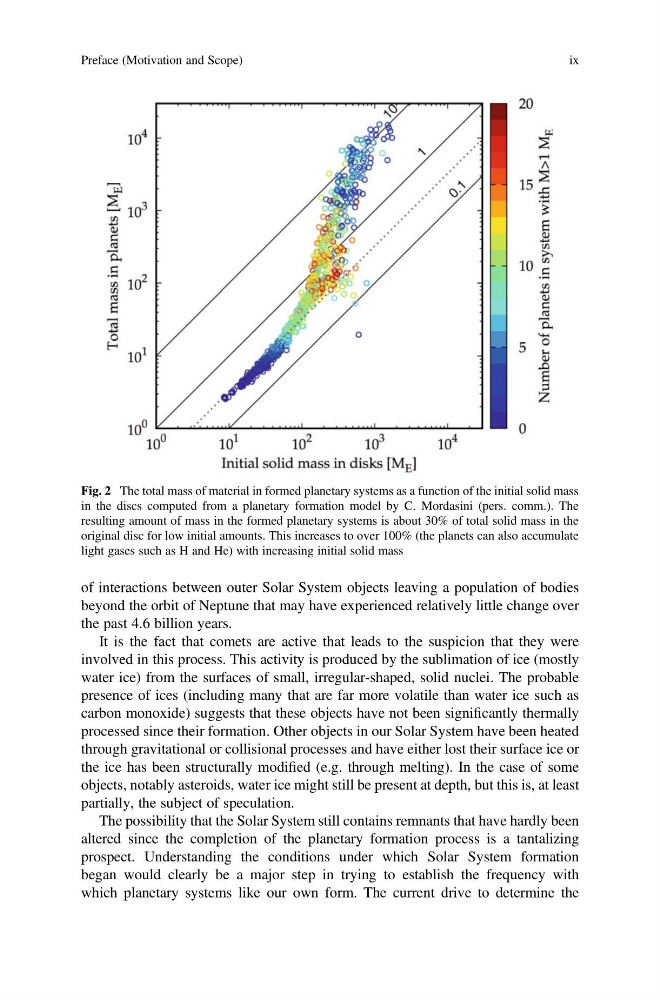
Fig. 2 The total mass of material in formed planetary systems as a function of the initial solid mass
in the discs computed from a planetary formation model by C. Mordasini (pers. comm.). The
resulting amount of mass in the formed planetary systems is about 30% of total solid mass in the
original disc for low initial amounts. This increases to over 100% (the planets can also accumulate
light gases such as H and He) with increasing initial solid mass
Preface (Motivation and Scope)
ix
beyond the orbit of Neptune that may have experienced relatively little change over
the past 4.6 billion years.
It is the fact that comets are active that leads to the suspicion that they were
involved in this process. This activity is produced by the sublimation of ice (mostly
water ice) from the surfaces of small, irregular-shaped, solid nuclei. The probable
presence of ices (including many that are far more volatile than water ice such as
carbon monoxide) suggests that these objects have not been significantly thermally
processed since their formation. Other objects in our Solar System have been heated
through gravitational or collisional processes and have either lost their surface ice or
the ice has been structurally modified (e.g. through melting). In the case of some
objects, notably asteroids, water ice might still be present at depth, but this is, at least
partially, the subject of speculation.
The possibility that the Solar System still contains remnants that have hardly been
altered since the completion of the planetary formation process is a tantalizing
prospect. Understanding the conditions under which Solar System formation
began would clearly be a major step in trying to establish the frequency with
which planetary systems like our own form. The current drive to determine the
Fig. 2 The total mass of material in formed planetary systems as a function of the initial solid mass
in the discs computed from a planetary formation model by C. Mordasini (pers. comm.). The
resulting amount of mass in the formed planetary systems is about 30% of total solid mass in the
original disc for low initial amounts. This increases to over 100% (the planets can also accumulate
light gases such as H and He) with increasing initial solid mass
Preface (Motivation and Scope)
ix