

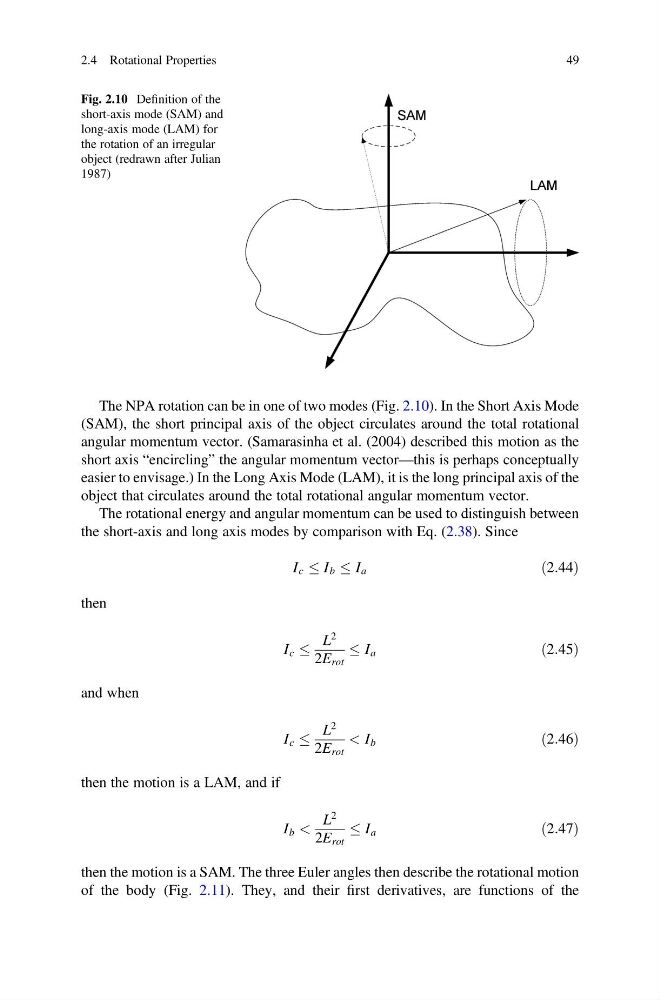
The NPA rotation can be in one of two modes (Fig. 2.10). In the Short Axis Mode
(SAM), the short principal axis of the object circulates around the total rotational
angular momentum vector. (Samarasinha et al. (2004) described this motion as the
short axis “encircling” the angular momentum vector—this is perhaps conceptually
easier to envisage.) In the Long Axis Mode (LAM), it is the long principal axis of the
object that circulates around the total rotational angular momentum vector.
The rotational energy and angular momentum can be used to distinguish between
the short-axis and long axis modes by comparison with Eq. (2.38). Since
I c I b I a
ð2:44Þ
then
I c
L
2
2E rot
I a
ð2:45Þ
and when
I c
L
2
2E rot
< I b
ð2:46Þ
then the motion is a LAM, and if
I b <
L
2
2E rot
I a
ð2:47Þ
then the motion is a SAM. The three Euler angles then describe the rotational motion
of the body (Fig. 2.11). They, and their first derivatives, are functions of the
Fig. 2.10 Definition of the
short-axis mode (SAM) and
long-axis mode (LAM) for
the rotation of an irregular
object (redrawn after Julian
1987)
2.4 Rotational Properties
49
(SAM), the short principal axis of the object circulates around the total rotational
angular momentum vector. (Samarasinha et al. (2004) described this motion as the
short axis “encircling” the angular momentum vector—this is perhaps conceptually
easier to envisage.) In the Long Axis Mode (LAM), it is the long principal axis of the
object that circulates around the total rotational angular momentum vector.
The rotational energy and angular momentum can be used to distinguish between
the short-axis and long axis modes by comparison with Eq. (2.38). Since
I c I b I a
ð2:44Þ
then
I c
L
2
2E rot
I a
ð2:45Þ
and when
I c
L
2
2E rot
< I b
ð2:46Þ
then the motion is a LAM, and if
I b <
L
2
2E rot
I a
ð2:47Þ
then the motion is a SAM. The three Euler angles then describe the rotational motion
of the body (Fig. 2.11). They, and their first derivatives, are functions of the
Fig. 2.10 Definition of the
short-axis mode (SAM) and
long-axis mode (LAM) for
the rotation of an irregular
object (redrawn after Julian
1987)
2.4 Rotational Properties
49