

Mueller 2015; see also Kaasalainen 2001). Rotation about the intermediate and long
axes are possible but also excited and form special cases of principal axis rotation.
When the rotation is more complex, two reference frames, the body-fixed frame
and the inertial reference frame, need to be defined and kept clearly separated. The
body-fixed frame is typically defined with respect to the principal axes of the body.
The inertial frame usually aligns one of the axes to the total rotational angular
momentum vector as viewed by a remote observer.
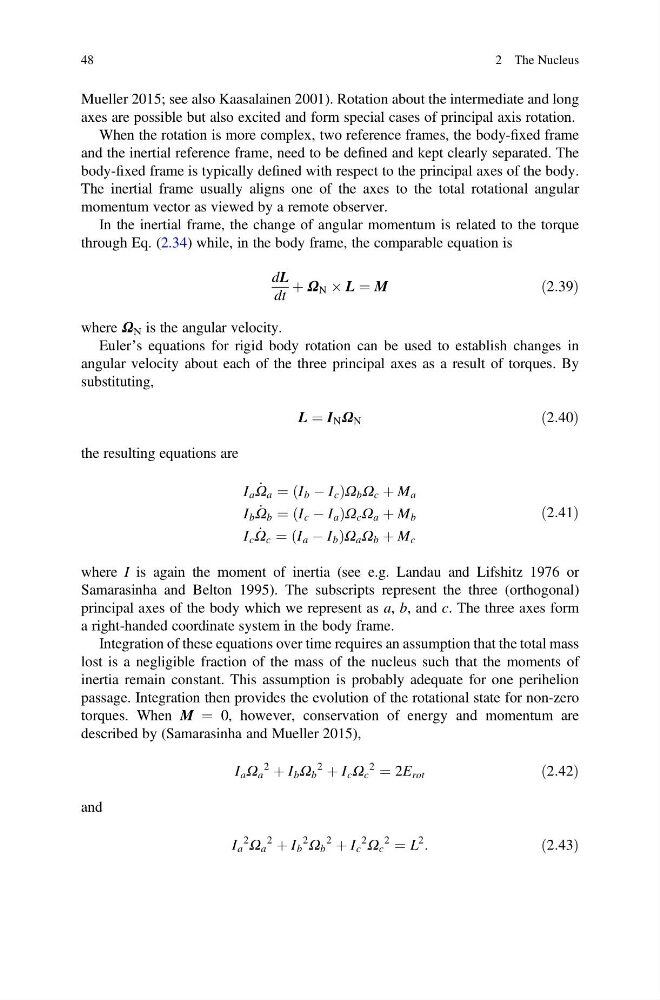
In the inertial frame, the change of angular momentum is related to the torque
through Eq. (2.34) while, in the body frame, the comparable equation is
dL
dt
þ Ω N Â L ¼ M
ð2:39Þ
where Ω N is the angular velocity.
Euler’s equations for rigid body rotation can be used to establish changes in
angular velocity about each of the three principal axes as a result of torques. By
substituting,
L ¼ I N Ω N
ð2:40Þ
the resulting equations are
I a _
Ω a ¼ I b À I c
ð
ÞΩ b Ω c þ M a
I b _
Ω b ¼ I c À I a
ð
ÞΩ c Ω a þ M b
I c _
Ω c ¼ I a À I b
ð
ÞΩ a Ω b þ M c
ð2:41Þ
where I is again the moment of inertia (see e.g. Landau and Lifshitz 1976 or
Samarasinha and Belton 1995). The subscripts represent the three (orthogonal)
principal axes of the body which we represent as a, b, and c. The three axes form
a right-handed coordinate system in the body frame.
Integration of these equations over time requires an assumption that the total mass
lost is a negligible fraction of the mass of the nucleus such that the moments of
inertia remain constant. This assumption is probably adequate for one perihelion
passage. Integration then provides the evolution of the rotational state for non-zero
torques. When M ¼ 0, however, conservation of energy and momentum are
described by (Samarasinha and Mueller 2015),
I a Ω a
2
þ I b Ω b
2
þ I c Ω c
2
¼ 2E rot
ð2:42Þ
and
I a
2
Ω a
2
þ I b
2
Ω b
2
þ I c
2
Ω c
2
¼ L
2
:
ð2:43Þ
48
2 The Nucleus
axes are possible but also excited and form special cases of principal axis rotation.
When the rotation is more complex, two reference frames, the body-fixed frame
and the inertial reference frame, need to be defined and kept clearly separated. The
body-fixed frame is typically defined with respect to the principal axes of the body.
The inertial frame usually aligns one of the axes to the total rotational angular
momentum vector as viewed by a remote observer.
In the inertial frame, the change of angular momentum is related to the torque
through Eq. (2.34) while, in the body frame, the comparable equation is
dL
dt
þ Ω N Â L ¼ M
ð2:39Þ
where Ω N is the angular velocity.
Euler’s equations for rigid body rotation can be used to establish changes in
angular velocity about each of the three principal axes as a result of torques. By
substituting,
L ¼ I N Ω N
ð2:40Þ
the resulting equations are
I a _
Ω a ¼ I b À I c
ð
ÞΩ b Ω c þ M a
I b _
Ω b ¼ I c À I a
ð
ÞΩ c Ω a þ M b
I c _
Ω c ¼ I a À I b
ð
ÞΩ a Ω b þ M c
ð2:41Þ
where I is again the moment of inertia (see e.g. Landau and Lifshitz 1976 or
Samarasinha and Belton 1995). The subscripts represent the three (orthogonal)
principal axes of the body which we represent as a, b, and c. The three axes form
a right-handed coordinate system in the body frame.
Integration of these equations over time requires an assumption that the total mass
lost is a negligible fraction of the mass of the nucleus such that the moments of
inertia remain constant. This assumption is probably adequate for one perihelion
passage. Integration then provides the evolution of the rotational state for non-zero
torques. When M ¼ 0, however, conservation of energy and momentum are
described by (Samarasinha and Mueller 2015),
I a Ω a
2
þ I b Ω b
2
þ I c Ω c
2
¼ 2E rot
ð2:42Þ
and
I a
2
Ω a
2
þ I b
2
Ω b
2
þ I c
2
Ω c
2
¼ L
2
:
ð2:43Þ
48
2 The Nucleus