

substantial anisotropy. Hence, numerical solutions must be sought by dividing the
surface into facets of varying activity as also discussed in Sect. 1.3.
The reactive torque, M, caused by this activity distribution can then be calculated
through the equation
M t
ð Þ ¼ À
X N
i¼1
Z i t
ð Þ r N,i  v i
ð
Þ
ð 2:31Þ
where Z i is the mass ejection rate from the i-th facet (Eq. 1.24), r N,i is the radius
vector of the facet in the body frame, and v i is the effective velocity of the ejected
matter (Samarasinha and Belton 1995; Neishtadt et al. 2002). Ideally, the quantities,
Z i and v i as a function of time, should be consistent with the equation for the
non-gravitational force (Eq. 1.24). The difficulty in determining these two quantities
was discussed earlier.
The change in angular momentum can then be computed through the usual
relation to the torque,
M t
ð Þ ¼
dL t
ð Þ
dt
ð2:32Þ
and this relates to the change in angular velocity through
M t
ð Þ ¼ I N
dΩ N t
ð Þ
dt
ð2:33Þ
if the moment of inertia, I N , can be assumed to remain constant (which is not strictly
correct of course because of the mass loss producing the torque but is a reasonable
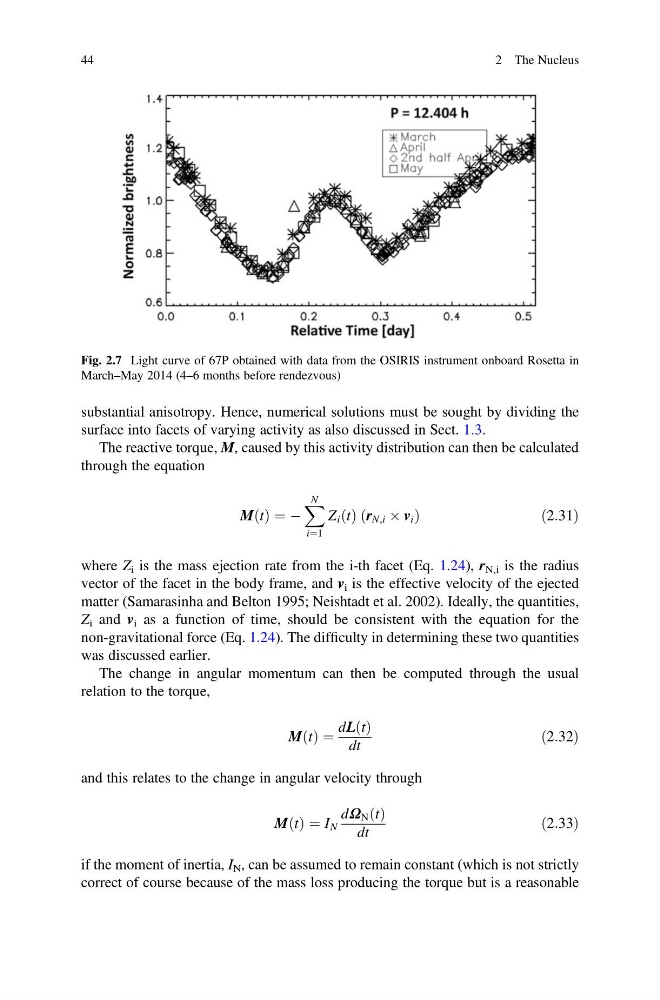
Fig. 2.7 Light curve of 67P obtained with data from the OSIRIS instrument onboard Rosetta in
March–May 2014 (4–6 months before rendezvous)
44
2 The Nucleus
surface into facets of varying activity as also discussed in Sect. 1.3.
The reactive torque, M, caused by this activity distribution can then be calculated
through the equation
M t
ð Þ ¼ À
X N
i¼1
Z i t
ð Þ r N,i  v i
ð
Þ
ð 2:31Þ
where Z i is the mass ejection rate from the i-th facet (Eq. 1.24), r N,i is the radius
vector of the facet in the body frame, and v i is the effective velocity of the ejected
matter (Samarasinha and Belton 1995; Neishtadt et al. 2002). Ideally, the quantities,
Z i and v i as a function of time, should be consistent with the equation for the
non-gravitational force (Eq. 1.24). The difficulty in determining these two quantities
was discussed earlier.
The change in angular momentum can then be computed through the usual
relation to the torque,
M t
ð Þ ¼
dL t
ð Þ
dt
ð2:32Þ
and this relates to the change in angular velocity through
M t
ð Þ ¼ I N
dΩ N t
ð Þ
dt
ð2:33Þ
if the moment of inertia, I N , can be assumed to remain constant (which is not strictly
correct of course because of the mass loss producing the torque but is a reasonable
Fig. 2.7 Light curve of 67P obtained with data from the OSIRIS instrument onboard Rosetta in
March–May 2014 (4–6 months before rendezvous)
44
2 The Nucleus