

large fraction of water ice expected to be in the nucleus and a significant non-volatile
(and heavier) component, the porosity of the nucleus, Ψ , seems to be substantial. By
making some assumptions about the densities of the constituents, Pätzold et al.
concluded that a mean porosity of 72–74% was probable.
The mass lost by the nucleus of 67P during the 2015 perihelion passage could
also be determined by the Radio Science Investigation on Rosetta (Pätzold et al.
2019). A value of 10.5 Æ 3.4 Â 10
9 kg, or about 0.1% of the nucleus mass, was
found. This is a very important number as it provides, by far, the tightest constraint
on the total mass lost from 67P during its 2015 apparition and also gives a timescale
for the lifetime against complete erosion of the nucleus in the current orbit of ~6000
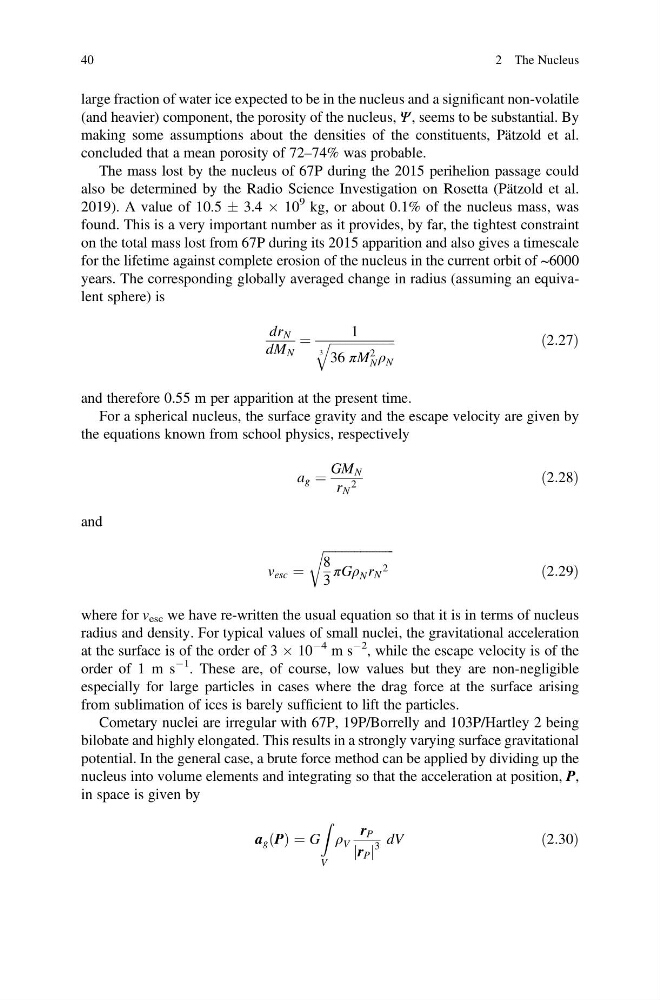
years. The corresponding globally averaged change in radius (assuming an equivalent sphere) is
dr N
dM N
¼
1
ffiffiffiffiffiffiffiffiffiffiffiffiffiffiffiffiffiffiffiffiffi
36 πM
2
N ρ N
3
q
ð2:27Þ
and therefore 0.55 m per apparition at the present time.
For a spherical nucleus, the surface gravity and the escape velocity are given by
the equations known from school physics, respectively
a g ¼
GM N
r N
2
ð2:28Þ
and
v esc ¼
ffiffiffiffiffiffiffiffiffiffiffiffiffiffiffiffiffiffiffiffiffiffi ffi
8
3
πGρ N r N
2
r
ð2:29Þ
where for v esc we have re-written the usual equation so that it is in terms of nucleus
radius and density. For typical values of small nuclei, the gravitational acceleration
at the surface is of the order of 3 Â 10
À4 m s
À2 , while the escape velocity is of the
order of 1 m s
À1 . These are, of course, low values but they are non-negligible
especially for large particles in cases where the drag force at the surface arising
from sublimation of ices is barely sufficient to lift the particles.
Cometary nuclei are irregular with 67P, 19P/Borrelly and 103P/Hartley 2 being
bilobate and highly elongated. This results in a strongly varying surface gravitational
potential. In the general case, a brute force method can be applied by dividing up the
nucleus into volume elements and integrating so that the acceleration at position, P,
in space is given by
a g P
ð Þ ¼ G
Z
V
ρ V
r P
r P
j j
3
dV
ð2:30Þ
40
2 The Nucleus
(and heavier) component, the porosity of the nucleus, Ψ , seems to be substantial. By
making some assumptions about the densities of the constituents, Pätzold et al.
concluded that a mean porosity of 72–74% was probable.
The mass lost by the nucleus of 67P during the 2015 perihelion passage could
also be determined by the Radio Science Investigation on Rosetta (Pätzold et al.
2019). A value of 10.5 Æ 3.4 Â 10
9 kg, or about 0.1% of the nucleus mass, was
found. This is a very important number as it provides, by far, the tightest constraint
on the total mass lost from 67P during its 2015 apparition and also gives a timescale
for the lifetime against complete erosion of the nucleus in the current orbit of ~6000
years. The corresponding globally averaged change in radius (assuming an equivalent sphere) is
dr N
dM N
¼
1
ffiffiffiffiffiffiffiffiffiffiffiffiffiffiffiffiffiffiffiffiffi
36 πM
2
N ρ N
3
q
ð2:27Þ
and therefore 0.55 m per apparition at the present time.
For a spherical nucleus, the surface gravity and the escape velocity are given by
the equations known from school physics, respectively
a g ¼
GM N
r N
2
ð2:28Þ
and
v esc ¼
ffiffiffiffiffiffiffiffiffiffiffiffiffiffiffiffiffiffiffiffiffiffi ffi
8
3
πGρ N r N
2
r
ð2:29Þ
where for v esc we have re-written the usual equation so that it is in terms of nucleus
radius and density. For typical values of small nuclei, the gravitational acceleration
at the surface is of the order of 3 Â 10
À4 m s
À2 , while the escape velocity is of the
order of 1 m s
À1 . These are, of course, low values but they are non-negligible
especially for large particles in cases where the drag force at the surface arising
from sublimation of ices is barely sufficient to lift the particles.
Cometary nuclei are irregular with 67P, 19P/Borrelly and 103P/Hartley 2 being
bilobate and highly elongated. This results in a strongly varying surface gravitational
potential. In the general case, a brute force method can be applied by dividing up the
nucleus into volume elements and integrating so that the acceleration at position, P,
in space is given by
a g P
ð Þ ¼ G
Z
V
ρ V
r P
r P
j j
3
dV
ð2:30Þ
40
2 The Nucleus