

split by the centrifugal forces. As measurement and modelling capabilities improved
further, refinement of the estimates appeared possible. Davidsson and Gutierrez
(2004), for example, used NGFs to derive a value of 180–300 kg m
À3 for
19P/Borrelly. A higher value (490 kg m
À3 ) had previously been found by Farnham
and Cochran (2002) but it was clear here that much of the difference between the two
results could be traced to the assumptions made.
A major breakthrough came with the Deep Impact experiment where modelling
of the observed ejecta cloud from the impact of the copper projectile allowed a
nucleus mass estimate that could be converted to a bulk density using imaging
observations of the volume. This resulted in a density of 400–500 kg m
À3
(Richardson et al. 2007; Holsapple and Housen 2007) clearly indicating densities
around ½ of that of solid water ice.
The close orbit of Rosetta about the nucleus of 67P has, as expected, led to a very
precise value of the mass by studying the Doppler shift of the two-way coherent
radio link between Earth ground stations and the spacecraft. The standard gravitational parameter was found to be μ N ¼ GM N ¼ 666.2 Æ 0.2 m
3 s
À2 giving a mass of
9.982(Æ0.003) Â 10
12 kg (Pätzold et al. 2016). The nucleus volume is required to
obtain the bulk density. This is less precisely known than the mass but the high
quality shape models now lead to a bulk density, ρ N , of 537.8(Æ0.6) kg m
À3 . With a
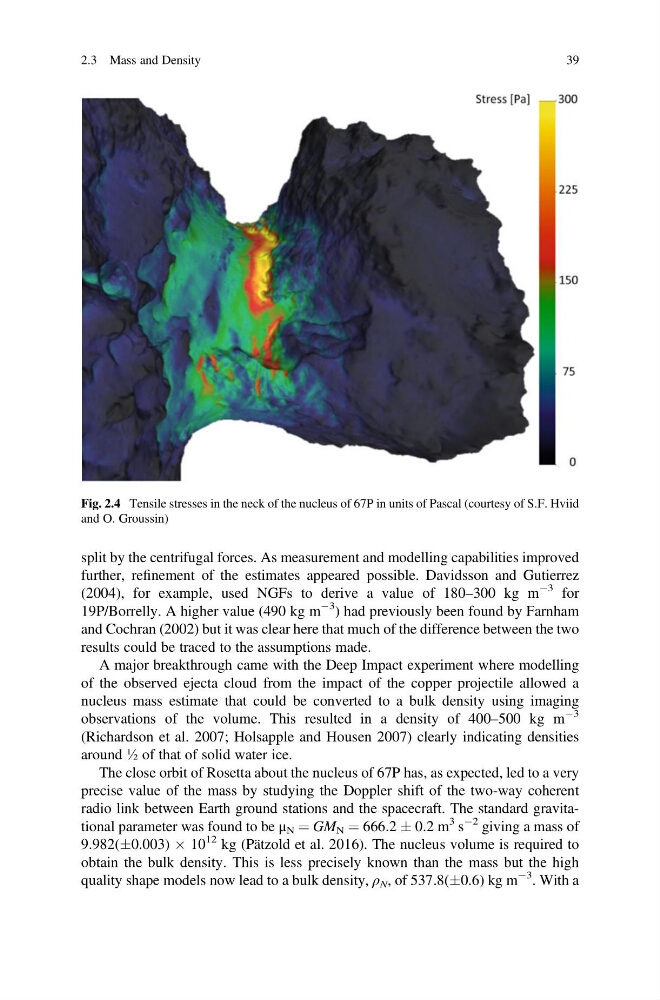
Fig. 2.4 Tensile stresses in the neck of the nucleus of 67P in units of Pascal (courtesy of S.F. Hviid
and O. Groussin)
2.3 Mass and Density
39
further, refinement of the estimates appeared possible. Davidsson and Gutierrez
(2004), for example, used NGFs to derive a value of 180–300 kg m
À3 for
19P/Borrelly. A higher value (490 kg m
À3 ) had previously been found by Farnham
and Cochran (2002) but it was clear here that much of the difference between the two
results could be traced to the assumptions made.
A major breakthrough came with the Deep Impact experiment where modelling
of the observed ejecta cloud from the impact of the copper projectile allowed a
nucleus mass estimate that could be converted to a bulk density using imaging
observations of the volume. This resulted in a density of 400–500 kg m
À3
(Richardson et al. 2007; Holsapple and Housen 2007) clearly indicating densities
around ½ of that of solid water ice.
The close orbit of Rosetta about the nucleus of 67P has, as expected, led to a very
precise value of the mass by studying the Doppler shift of the two-way coherent
radio link between Earth ground stations and the spacecraft. The standard gravitational parameter was found to be μ N ¼ GM N ¼ 666.2 Æ 0.2 m
3 s
À2 giving a mass of
9.982(Æ0.003) Â 10
12 kg (Pätzold et al. 2016). The nucleus volume is required to
obtain the bulk density. This is less precisely known than the mass but the high
quality shape models now lead to a bulk density, ρ N , of 537.8(Æ0.6) kg m
À3 . With a
Fig. 2.4 Tensile stresses in the neck of the nucleus of 67P in units of Pascal (courtesy of S.F. Hviid
and O. Groussin)
2.3 Mass and Density
39