

observation of OH emission from its 18 cm lines; Sect. 3.2) to provide a first
constraint. The recoil force is then calculated at facet level and integrated to provide
the radial, traverse, and normal forces at each timestep which, after division by the
mass, can be included in the equation of motion. We can express this at one point in
time as
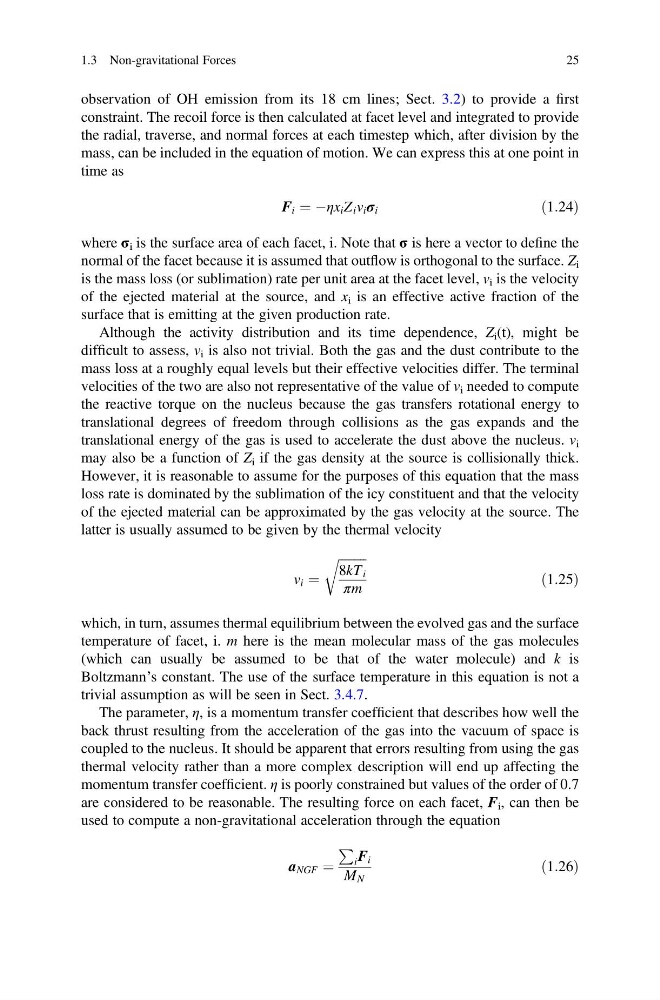
F i ¼ Àηx i Z i v i σ i
ð1:24Þ
where σ i is the surface area of each facet, i. Note that σ is here a vector to define the
normal of the facet because it is assumed that outflow is orthogonal to the surface. Z i
is the mass loss (or sublimation) rate per unit area at the facet level, v i is the velocity
of the ejected material at the source, and x i is an effective active fraction of the
surface that is emitting at the given production rate.
Although the activity distribution and its time dependence, Z i (t), might be
difficult to assess, v i is also not trivial. Both the gas and the dust contribute to the
mass loss at a roughly equal levels but their effective velocities differ. The terminal
velocities of the two are also not representative of the value of v i needed to compute
the reactive torque on the nucleus because the gas transfers rotational energy to
translational degrees of freedom through collisions as the gas expands and the
translational energy of the gas is used to accelerate the dust above the nucleus. v i
may also be a function of Z i if the gas density at the source is collisionally thick.
However, it is reasonable to assume for the purposes of this equation that the mass
loss rate is dominated by the sublimation of the icy constituent and that the velocity
of the ejected material can be approximated by the gas velocity at the source. The
latter is usually assumed to be given by the thermal velocity
v i ¼
ffiffiffiffiffiffiffiffiffi
8kT i
πm
r
ð1:25Þ
which, in turn, assumes thermal equilibrium between the evolved gas and the surface
temperature of facet, i. m here is the mean molecular mass of the gas molecules
(which can usually be assumed to be that of the water molecule) and k is
Boltzmann’s constant. The use of the surface temperature in this equation is not a
trivial assumption as will be seen in Sect. 3.4.7.
The parameter, η, is a momentum transfer coefficient that describes how well the
back thrust resulting from the acceleration of the gas into the vacuum of space is
coupled to the nucleus. It should be apparent that errors resulting from using the gas
thermal velocity rather than a more complex description will end up affecting the
momentum transfer coefficient. η is poorly constrained but values of the order of 0.7
are considered to be reasonable. The resulting force on each facet, F i , can then be
used to compute a non-gravitational acceleration through the equation
a NGF ¼
P
i F i
M N
ð1:26Þ
1.3 Non-gravitational Forces
25
constraint. The recoil force is then calculated at facet level and integrated to provide
the radial, traverse, and normal forces at each timestep which, after division by the
mass, can be included in the equation of motion. We can express this at one point in
time as
F i ¼ Àηx i Z i v i σ i
ð1:24Þ
where σ i is the surface area of each facet, i. Note that σ is here a vector to define the
normal of the facet because it is assumed that outflow is orthogonal to the surface. Z i
is the mass loss (or sublimation) rate per unit area at the facet level, v i is the velocity
of the ejected material at the source, and x i is an effective active fraction of the
surface that is emitting at the given production rate.
Although the activity distribution and its time dependence, Z i (t), might be
difficult to assess, v i is also not trivial. Both the gas and the dust contribute to the
mass loss at a roughly equal levels but their effective velocities differ. The terminal
velocities of the two are also not representative of the value of v i needed to compute
the reactive torque on the nucleus because the gas transfers rotational energy to
translational degrees of freedom through collisions as the gas expands and the
translational energy of the gas is used to accelerate the dust above the nucleus. v i
may also be a function of Z i if the gas density at the source is collisionally thick.
However, it is reasonable to assume for the purposes of this equation that the mass
loss rate is dominated by the sublimation of the icy constituent and that the velocity
of the ejected material can be approximated by the gas velocity at the source. The
latter is usually assumed to be given by the thermal velocity
v i ¼
ffiffiffiffiffiffiffiffiffi
8kT i
πm
r
ð1:25Þ
which, in turn, assumes thermal equilibrium between the evolved gas and the surface
temperature of facet, i. m here is the mean molecular mass of the gas molecules
(which can usually be assumed to be that of the water molecule) and k is
Boltzmann’s constant. The use of the surface temperature in this equation is not a
trivial assumption as will be seen in Sect. 3.4.7.
The parameter, η, is a momentum transfer coefficient that describes how well the
back thrust resulting from the acceleration of the gas into the vacuum of space is
coupled to the nucleus. It should be apparent that errors resulting from using the gas
thermal velocity rather than a more complex description will end up affecting the
momentum transfer coefficient. η is poorly constrained but values of the order of 0.7
are considered to be reasonable. The resulting force on each facet, F i , can then be
used to compute a non-gravitational acceleration through the equation
a NGF ¼
P
i F i
M N
ð1:26Þ
1.3 Non-gravitational Forces
25