

distance further while conserving the T U parameter. This process of transfer from an
outer giant planet to an inner one continues until the object comes under the control
of Jupiter and moves towards a JFC-type orbit. Hence, as had been speculated since
their discovery, Centaurs are objects in transit between SDOs and JFCs. However,
calculations by Tiscareno and Malhotra (2003) suggest that the process has additional complexity. In their model, ~2/3rds of Centaurs will be ejected from the Solar
System by gravitational interactions with only 1/3rd finally contributing to the JFC
population. About 20% of Centaurs have lifetimes within Centaur-like orbits shorter
than 1 Myr. Further investigation of this process through numerical simulation has
been performed by, for example, Grazier et al. (2019).
Unfortunately, this link between SDOs and JFCs does not guarantee that one is
sampling an object from the scattered disk when investigating one of these objects.
The work of Fouchard et al. (2017a, b) has shown that Oort cloud comets can
achieve Centaur-like orbits directly. There are also unusual objects in the planetary
system that do not obviously fall into any category unambiguously. As a result, only
a statistical argument can be made to claim that a specific object is from a specific
source. This should be borne in mind when inferences are made for one specific
object.
Sarid et al. (2019) have performed numerical simulations of a Centaur population
and showed that objects reaching non-Jupiter crossing, low eccentricity, orbits, but
with aphelia well separated from Saturn, will frequently reach JFC-type orbits on
rather short (<1000 year) timescales. This “Gateway” into the inner Solar System is
currently populated by the active objects 29P/Schwassmann-Wachmann 1, P/2010
TO20 Linear-Grauer, and P/2008 CL94 Lemmon and the asteroid 2016 LN8 (Sarid
et al. 2019). It is also noted that JFCs can pass back through this gateway to become
Centaurs again.
These considerations leave us with an evolutionary picture that looks like
Fig. 1.17 although it must be stressed that there may be objects that can follow
other pathways through unusual circumstances.
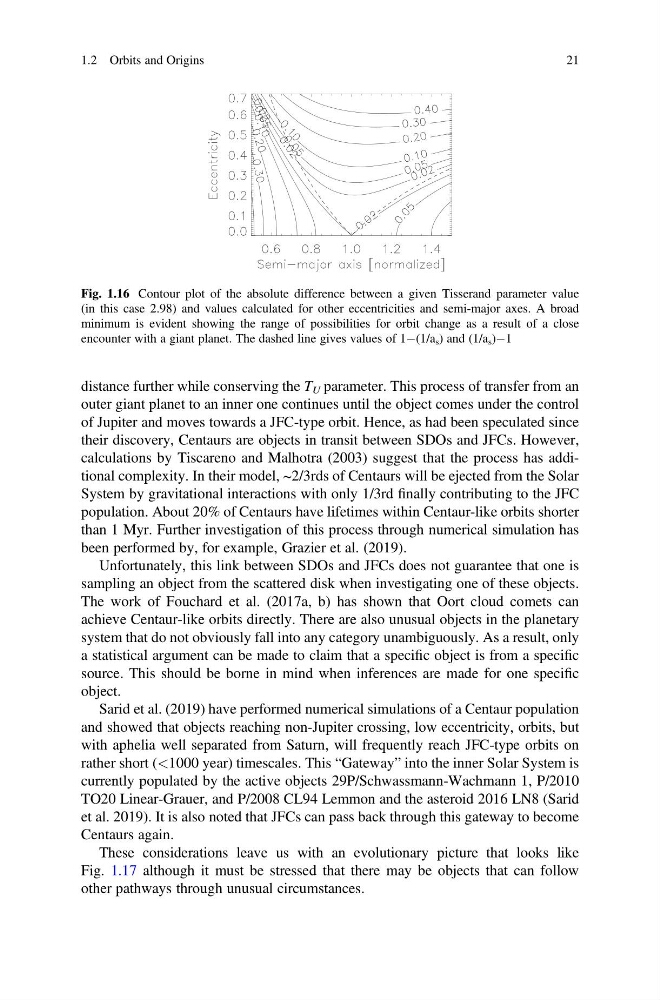
Fig. 1.16 Contour plot of the absolute difference between a given Tisserand parameter value
(in this case 2.98) and values calculated for other eccentricities and semi-major axes. A broad
minimum is evident showing the range of possibilities for orbit change as a result of a close
encounter with a giant planet. The dashed line gives values of 1À(1/a s ) and (1/a s )À1
1.2 Orbits and Origins
21
outer giant planet to an inner one continues until the object comes under the control
of Jupiter and moves towards a JFC-type orbit. Hence, as had been speculated since
their discovery, Centaurs are objects in transit between SDOs and JFCs. However,
calculations by Tiscareno and Malhotra (2003) suggest that the process has additional complexity. In their model, ~2/3rds of Centaurs will be ejected from the Solar
System by gravitational interactions with only 1/3rd finally contributing to the JFC
population. About 20% of Centaurs have lifetimes within Centaur-like orbits shorter
than 1 Myr. Further investigation of this process through numerical simulation has
been performed by, for example, Grazier et al. (2019).
Unfortunately, this link between SDOs and JFCs does not guarantee that one is
sampling an object from the scattered disk when investigating one of these objects.
The work of Fouchard et al. (2017a, b) has shown that Oort cloud comets can
achieve Centaur-like orbits directly. There are also unusual objects in the planetary
system that do not obviously fall into any category unambiguously. As a result, only
a statistical argument can be made to claim that a specific object is from a specific
source. This should be borne in mind when inferences are made for one specific
object.
Sarid et al. (2019) have performed numerical simulations of a Centaur population
and showed that objects reaching non-Jupiter crossing, low eccentricity, orbits, but
with aphelia well separated from Saturn, will frequently reach JFC-type orbits on
rather short (<1000 year) timescales. This “Gateway” into the inner Solar System is
currently populated by the active objects 29P/Schwassmann-Wachmann 1, P/2010
TO20 Linear-Grauer, and P/2008 CL94 Lemmon and the asteroid 2016 LN8 (Sarid
et al. 2019). It is also noted that JFCs can pass back through this gateway to become
Centaurs again.
These considerations leave us with an evolutionary picture that looks like
Fig. 1.17 although it must be stressed that there may be objects that can follow
other pathways through unusual circumstances.
Fig. 1.16 Contour plot of the absolute difference between a given Tisserand parameter value
(in this case 2.98) and values calculated for other eccentricities and semi-major axes. A broad
minimum is evident showing the range of possibilities for orbit change as a result of a close
encounter with a giant planet. The dashed line gives values of 1À(1/a s ) and (1/a s )À1
1.2 Orbits and Origins
21