

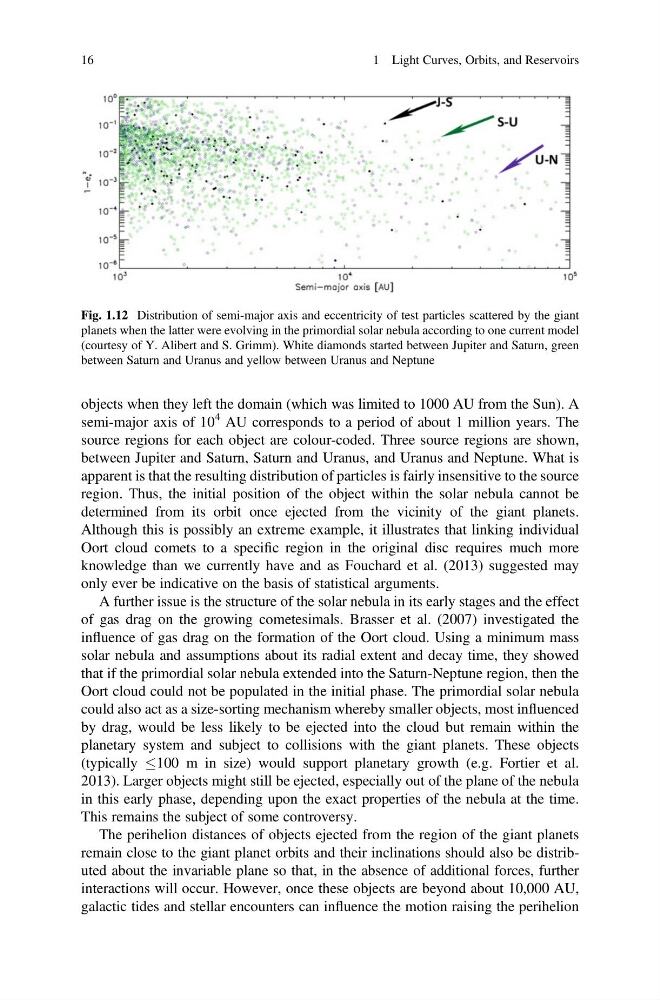
objects when they left the domain (which was limited to 1000 AU from the Sun). A
semi-major axis of 10
4 AU corresponds to a period of about 1 million years. The
source regions for each object are colour-coded. Three source regions are shown,
between Jupiter and Saturn, Saturn and Uranus, and Uranus and Neptune. What is
apparent is that the resulting distribution of particles is fairly insensitive to the source
region. Thus, the initial position of the object within the solar nebula cannot be
determined from its orbit once ejected from the vicinity of the giant planets.
Although this is possibly an extreme example, it illustrates that linking individual
Oort cloud comets to a specific region in the original disc requires much more
knowledge than we currently have and as Fouchard et al. (2013) suggested may
only ever be indicative on the basis of statistical arguments.
A further issue is the structure of the solar nebula in its early stages and the effect
of gas drag on the growing cometesimals. Brasser et al. (2007) investigated the
influence of gas drag on the formation of the Oort cloud. Using a minimum mass
solar nebula and assumptions about its radial extent and decay time, they showed
that if the primordial solar nebula extended into the Saturn-Neptune region, then the
Oort cloud could not be populated in the initial phase. The primordial solar nebula
could also act as a size-sorting mechanism whereby smaller objects, most influenced
by drag, would be less likely to be ejected into the cloud but remain within the
planetary system and subject to collisions with the giant planets. These objects
(typically 100 m in size) would support planetary growth (e.g. Fortier et al.
2013). Larger objects might still be ejected, especially out of the plane of the nebula
in this early phase, depending upon the exact properties of the nebula at the time.
This remains the subject of some controversy.
The perihelion distances of objects ejected from the region of the giant planets
remain close to the giant planet orbits and their inclinations should also be distributed about the invariable plane so that, in the absence of additional forces, further
interactions will occur. However, once these objects are beyond about 10,000 AU,
galactic tides and stellar encounters can influence the motion raising the perihelion
Fig. 1.12 Distribution of semi-major axis and eccentricity of test particles scattered by the giant
planets when the latter were evolving in the primordial solar nebula according to one current model
(courtesy of Y. Alibert and S. Grimm). White diamonds started between Jupiter and Saturn, green
between Saturn and Uranus and yellow between Uranus and Neptune
16
1 Light Curves, Orbits, and Reservoirs
semi-major axis of 10
4 AU corresponds to a period of about 1 million years. The
source regions for each object are colour-coded. Three source regions are shown,
between Jupiter and Saturn, Saturn and Uranus, and Uranus and Neptune. What is
apparent is that the resulting distribution of particles is fairly insensitive to the source
region. Thus, the initial position of the object within the solar nebula cannot be
determined from its orbit once ejected from the vicinity of the giant planets.
Although this is possibly an extreme example, it illustrates that linking individual
Oort cloud comets to a specific region in the original disc requires much more
knowledge than we currently have and as Fouchard et al. (2013) suggested may
only ever be indicative on the basis of statistical arguments.
A further issue is the structure of the solar nebula in its early stages and the effect
of gas drag on the growing cometesimals. Brasser et al. (2007) investigated the
influence of gas drag on the formation of the Oort cloud. Using a minimum mass
solar nebula and assumptions about its radial extent and decay time, they showed
that if the primordial solar nebula extended into the Saturn-Neptune region, then the
Oort cloud could not be populated in the initial phase. The primordial solar nebula
could also act as a size-sorting mechanism whereby smaller objects, most influenced
by drag, would be less likely to be ejected into the cloud but remain within the
planetary system and subject to collisions with the giant planets. These objects
(typically 100 m in size) would support planetary growth (e.g. Fortier et al.
2013). Larger objects might still be ejected, especially out of the plane of the nebula
in this early phase, depending upon the exact properties of the nebula at the time.
This remains the subject of some controversy.
The perihelion distances of objects ejected from the region of the giant planets
remain close to the giant planet orbits and their inclinations should also be distributed about the invariable plane so that, in the absence of additional forces, further
interactions will occur. However, once these objects are beyond about 10,000 AU,
galactic tides and stellar encounters can influence the motion raising the perihelion
Fig. 1.12 Distribution of semi-major axis and eccentricity of test particles scattered by the giant
planets when the latter were evolving in the primordial solar nebula according to one current model
(courtesy of Y. Alibert and S. Grimm). White diamonds started between Jupiter and Saturn, green
between Saturn and Uranus and yellow between Uranus and Neptune
16
1 Light Curves, Orbits, and Reservoirs