

The Oort cloud is often considered to be the source of the HTCs with T J < 2 and it
appears that perturbation of returning LPCs by Jupiter and Saturn can result in
reducing the semi-major axes and “leakage” of Oort cloud comets into the planetary
domain. Inactive long-period asteroids with T J < 2 have also been found and are
now being referred to as Damocloids following the prototype inactive asteroid
(5335) Damocles in this HTC-like orbit (Jewitt 2005). It is now assumed that
Damocloids are dormant, inactive, HTCs. Similarly, there are over 20 inactive
asteroids in JFC type orbits (r p < 1.5 AU and r a > 4.9 AU) including (3552) Don
Quixote and (5370) Taranis that suggest that some JFCs may ultimately become
totally inactive or dormant. (We shall refer to these as “Taranoids” in a subsequent
diagram for convenience but this is not a term that has been used by other authors.)
The difficulty in deducing the source regions in the primordial solar nebula for
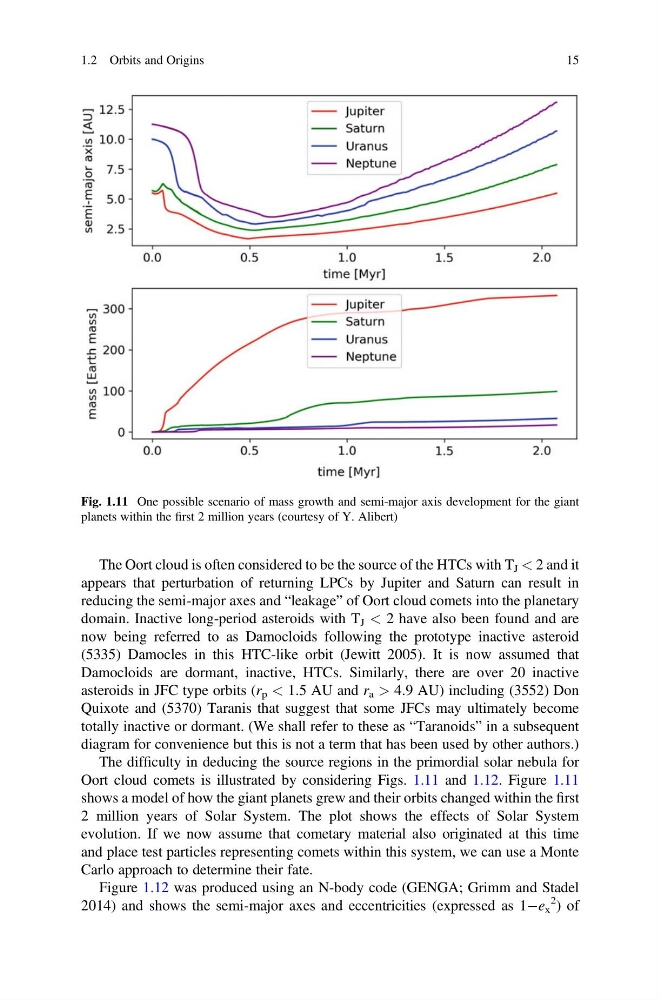
Oort cloud comets is illustrated by considering Figs. 1.11 and 1.12. Figure 1.11
shows a model of how the giant planets grew and their orbits changed within the first
2 million years of Solar System. The plot shows the effects of Solar System
evolution. If we now assume that cometary material also originated at this time
and place test particles representing comets within this system, we can use a Monte
Carlo approach to determine their fate.
Figure 1.12 was produced using an N-body code (GENGA; Grimm and Stadel
2014) and shows the semi-major axes and eccentricities (expressed as 1Àe x
2 ) of
Fig. 1.11 One possible scenario of mass growth and semi-major axis development for the giant
planets within the first 2 million years (courtesy of Y. Alibert)
1.2 Orbits and Origins
15
appears that perturbation of returning LPCs by Jupiter and Saturn can result in
reducing the semi-major axes and “leakage” of Oort cloud comets into the planetary
domain. Inactive long-period asteroids with T J < 2 have also been found and are
now being referred to as Damocloids following the prototype inactive asteroid
(5335) Damocles in this HTC-like orbit (Jewitt 2005). It is now assumed that
Damocloids are dormant, inactive, HTCs. Similarly, there are over 20 inactive
asteroids in JFC type orbits (r p < 1.5 AU and r a > 4.9 AU) including (3552) Don
Quixote and (5370) Taranis that suggest that some JFCs may ultimately become
totally inactive or dormant. (We shall refer to these as “Taranoids” in a subsequent
diagram for convenience but this is not a term that has been used by other authors.)
The difficulty in deducing the source regions in the primordial solar nebula for
Oort cloud comets is illustrated by considering Figs. 1.11 and 1.12. Figure 1.11
shows a model of how the giant planets grew and their orbits changed within the first
2 million years of Solar System. The plot shows the effects of Solar System
evolution. If we now assume that cometary material also originated at this time
and place test particles representing comets within this system, we can use a Monte
Carlo approach to determine their fate.
Figure 1.12 was produced using an N-body code (GENGA; Grimm and Stadel
2014) and shows the semi-major axes and eccentricities (expressed as 1Àe x
2 ) of
Fig. 1.11 One possible scenario of mass growth and semi-major axis development for the giant
planets within the first 2 million years (courtesy of Y. Alibert)
1.2 Orbits and Origins
15