

the main belt and this has led Jewitt to prefer the term “active asteroids” for this
object class rather than the previously used “Main-Belt Comets”.
It was inferred that the previously thought to be inactive asteroid (3200) Phaethon
was a dead comet based upon IRAS observations of a dust trail visible along its
orbital path. Phaethon has now gained a comet designation following clear evidence
of aperiodic activity (see e.g. Jewitt 2012). Jewitt had previously suggested radiation
pressure sweeping as a contributing mechanism for loss from objects with small
perihelia such as Phaethon. A further example is 324P/La Sagra which was originally given an asteroid designation (2010 R2) and is in an asteroid orbit with
T J ¼ 3.099. However, it has shown activity consistent with sublimation (Jewitt
et al. 2016a).
To summarize, it is arguable whether these objects should be considered to be
within a common category or whether they should be treated as individuals. Jewitt
(2012), for example, looked at several objects individually to try to assess which of
the mechanisms in Table 6.1 might be responsible in specific cases. Activity through
sublimation is probable in several cases (e.g. 324P/La Sagra; Jewitt et al. (2016a)
and 313P/Gibbs; Jewitt et al. (2015)) and cometary designations assigned. On the
other hand, for other objects the situation is less clear.
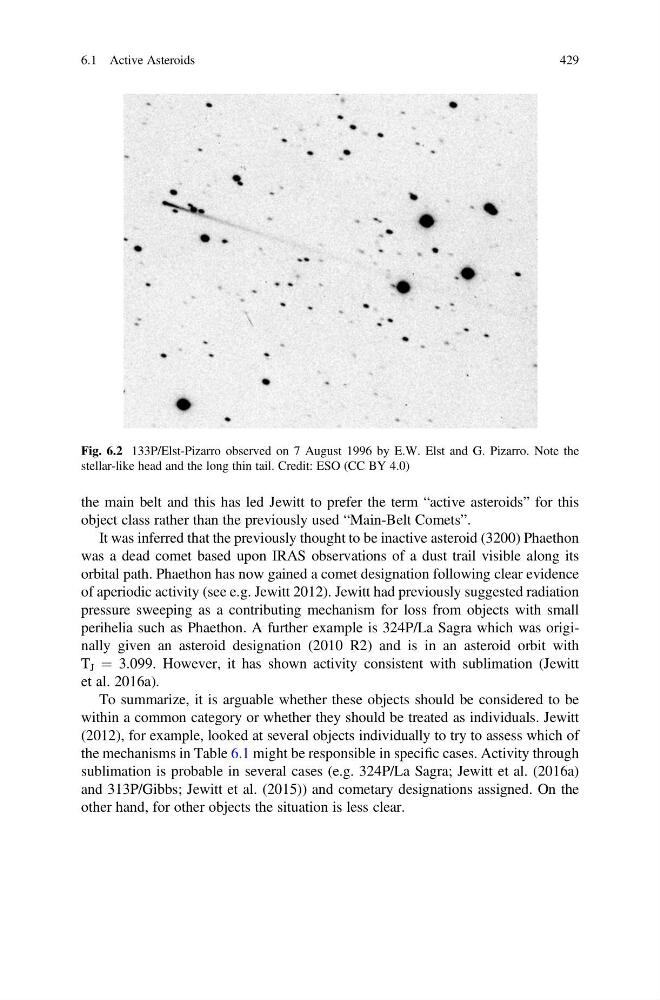
Fig. 6.2 133P/Elst-Pizarro observed on 7 August 1996 by E.W. Elst and G. Pizarro. Note the
stellar-like head and the long thin tail. Credit: ESO (CC BY 4.0)
6.1 Active Asteroids
429
object class rather than the previously used “Main-Belt Comets”.
It was inferred that the previously thought to be inactive asteroid (3200) Phaethon
was a dead comet based upon IRAS observations of a dust trail visible along its
orbital path. Phaethon has now gained a comet designation following clear evidence
of aperiodic activity (see e.g. Jewitt 2012). Jewitt had previously suggested radiation
pressure sweeping as a contributing mechanism for loss from objects with small
perihelia such as Phaethon. A further example is 324P/La Sagra which was originally given an asteroid designation (2010 R2) and is in an asteroid orbit with
T J ¼ 3.099. However, it has shown activity consistent with sublimation (Jewitt
et al. 2016a).
To summarize, it is arguable whether these objects should be considered to be
within a common category or whether they should be treated as individuals. Jewitt
(2012), for example, looked at several objects individually to try to assess which of
the mechanisms in Table 6.1 might be responsible in specific cases. Activity through
sublimation is probable in several cases (e.g. 324P/La Sagra; Jewitt et al. (2016a)
and 313P/Gibbs; Jewitt et al. (2015)) and cometary designations assigned. On the
other hand, for other objects the situation is less clear.
Fig. 6.2 133P/Elst-Pizarro observed on 7 August 1996 by E.W. Elst and G. Pizarro. Note the
stellar-like head and the long thin tail. Credit: ESO (CC BY 4.0)
6.1 Active Asteroids
429