

narrow tail with no appreciable coma suggesting very low particle outflow velocities
and little influence of gas drag. However, Hsieh et al. (2004) showed that the activity
was recurrent making the impact hypothesis somewhat unlikely.
107P/Wilson-Harrington, (3200) Phaethon, and (2201) Oljato are dynamically
asteroidal bodies (T J > 3) in which mass loss has been reported, but they are not in
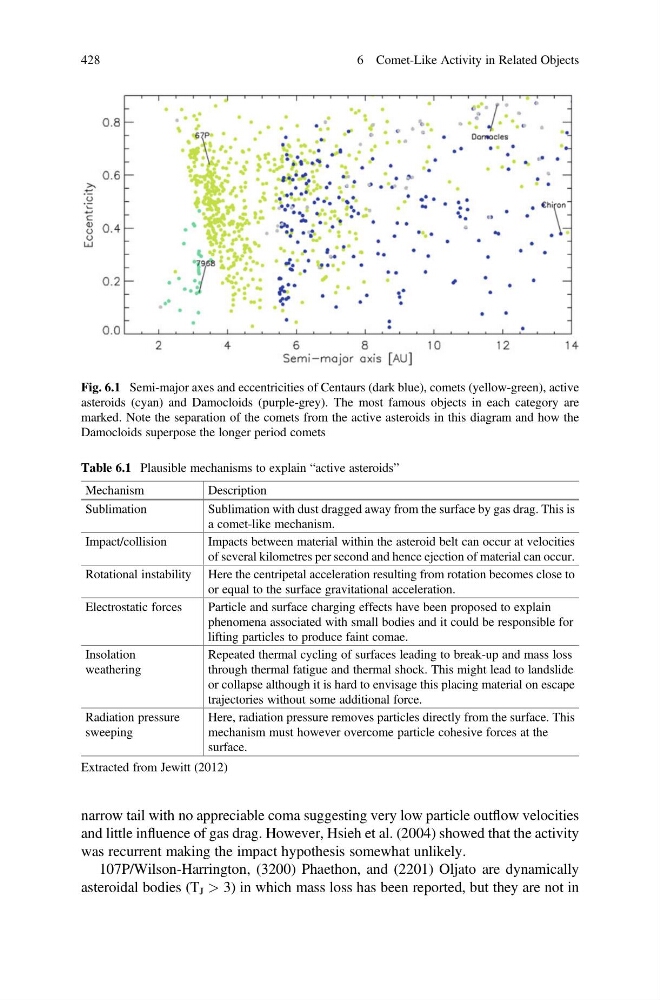
Fig. 6.1 Semi-major axes and eccentricities of Centaurs (dark blue), comets (yellow-green), active
asteroids (cyan) and Damocloids (purple-grey). The most famous objects in each category are
marked. Note the separation of the comets from the active asteroids in this diagram and how the
Damocloids superpose the longer period comets
Table 6.1 Plausible mechanisms to explain “active asteroids”
Mechanism
Description
Sublimation
Sublimation with dust dragged away from the surface by gas drag. This is
a comet-like mechanism.
Impact/collision
Impacts between material within the asteroid belt can occur at velocities
of several kilometres per second and hence ejection of material can occur.
Rotational instability Here the centripetal acceleration resulting from rotation becomes close to
or equal to the surface gravitational acceleration.
Electrostatic forces
Particle and surface charging effects have been proposed to explain
phenomena associated with small bodies and it could be responsible for
lifting particles to produce faint comae.
Insolation
weathering
Repeated thermal cycling of surfaces leading to break-up and mass loss
through thermal fatigue and thermal shock. This might lead to landslide
or collapse although it is hard to envisage this placing material on escape
trajectories without some additional force.
Radiation pressure
sweeping
Here, radiation pressure removes particles directly from the surface. This
mechanism must however overcome particle cohesive forces at the
surface.
Extracted from Jewitt (2012)
428
6 Comet-Like Activity in Related Objects
and little influence of gas drag. However, Hsieh et al. (2004) showed that the activity
was recurrent making the impact hypothesis somewhat unlikely.
107P/Wilson-Harrington, (3200) Phaethon, and (2201) Oljato are dynamically
asteroidal bodies (T J > 3) in which mass loss has been reported, but they are not in
Fig. 6.1 Semi-major axes and eccentricities of Centaurs (dark blue), comets (yellow-green), active
asteroids (cyan) and Damocloids (purple-grey). The most famous objects in each category are
marked. Note the separation of the comets from the active asteroids in this diagram and how the
Damocloids superpose the longer period comets
Table 6.1 Plausible mechanisms to explain “active asteroids”
Mechanism
Description
Sublimation
Sublimation with dust dragged away from the surface by gas drag. This is
a comet-like mechanism.
Impact/collision
Impacts between material within the asteroid belt can occur at velocities
of several kilometres per second and hence ejection of material can occur.
Rotational instability Here the centripetal acceleration resulting from rotation becomes close to
or equal to the surface gravitational acceleration.
Electrostatic forces
Particle and surface charging effects have been proposed to explain
phenomena associated with small bodies and it could be responsible for
lifting particles to produce faint comae.
Insolation
weathering
Repeated thermal cycling of surfaces leading to break-up and mass loss
through thermal fatigue and thermal shock. This might lead to landslide
or collapse although it is hard to envisage this placing material on escape
trajectories without some additional force.
Radiation pressure
sweeping
Here, radiation pressure removes particles directly from the surface. This
mechanism must however overcome particle cohesive forces at the
surface.
Extracted from Jewitt (2012)
428
6 Comet-Like Activity in Related Objects