

(982.47 Æ 0.5 Å; Table 5.2; Katayama et al. 1973) in the extreme ultraviolet. With
the daughter electron energy arising from the excess energy above threshold,
photoionization by photons of around 500 Å wavelength are required to give the
electrons that amount of energy. The relative amount of energy that the newborn
electron receives is a stochastic variable which can vary between 0 and 100% of the
excess energy but the energy distribution function between these two extremes is not
well known (Lummerzheim and Lilensten 1994; Heritier et al. 2018). The slightly
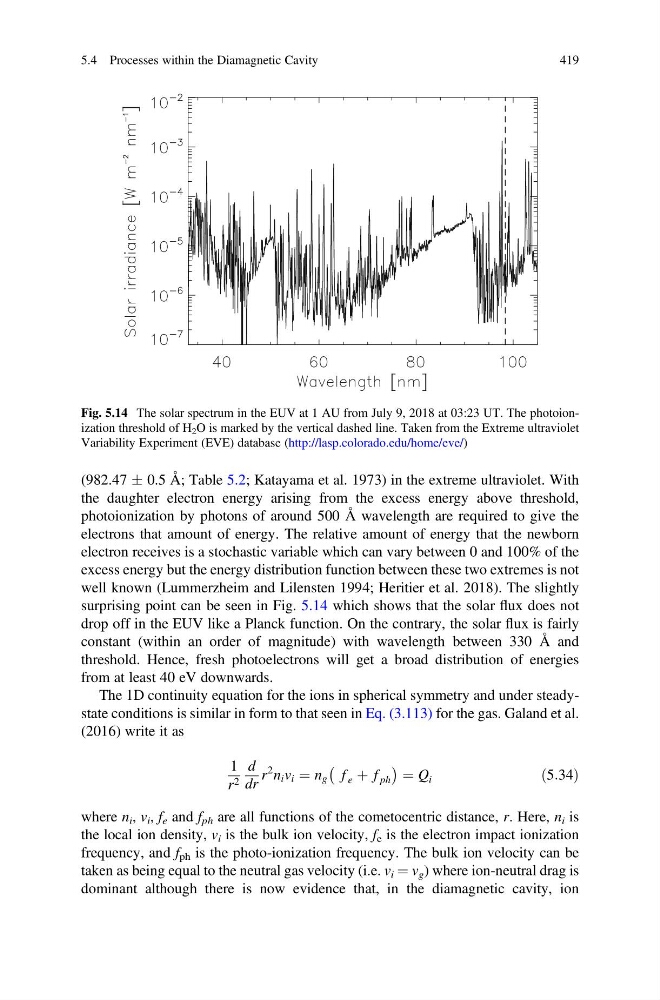
surprising point can be seen in Fig. 5.14 which shows that the solar flux does not
drop off in the EUV like a Planck function. On the contrary, the solar flux is fairly
constant (within an order of magnitude) with wavelength between 330 Å and
threshold. Hence, fresh photoelectrons will get a broad distribution of energies
from at least 40 eV downwards.
The 1D continuity equation for the ions in spherical symmetry and under steadystate conditions is similar in form to that seen in Eq. (3.113) for the gas. Galand et al.
(2016) write it as
1
r 2
d
dr
r
2 n i v i ¼ n g f e þ f ph
À
Á ¼ Q i
ð5:34Þ
where n i , v i , f e and f ph are all functions of the cometocentric distance, r. Here, n i is
the local ion density, v i is the bulk ion velocity, f e is the electron impact ionization
frequency, and f ph is the photo-ionization frequency. The bulk ion velocity can be
taken as being equal to the neutral gas velocity (i.e. v i ¼ v g ) where ion-neutral drag is
dominant although there is now evidence that, in the diamagnetic cavity, ion
Fig. 5.14 The solar spectrum in the EUV at 1 AU from July 9, 2018 at 03:23 UT. The photoionization threshold of H 2 O is marked by the vertical dashed line. Taken from the Extreme ultraviolet
Variability Experiment (EVE) database (http://lasp.colorado.edu/home/eve/)
5.4 Processes within the Diamagnetic Cavity
419
the daughter electron energy arising from the excess energy above threshold,
photoionization by photons of around 500 Å wavelength are required to give the
electrons that amount of energy. The relative amount of energy that the newborn
electron receives is a stochastic variable which can vary between 0 and 100% of the
excess energy but the energy distribution function between these two extremes is not
well known (Lummerzheim and Lilensten 1994; Heritier et al. 2018). The slightly
surprising point can be seen in Fig. 5.14 which shows that the solar flux does not
drop off in the EUV like a Planck function. On the contrary, the solar flux is fairly
constant (within an order of magnitude) with wavelength between 330 Å and
threshold. Hence, fresh photoelectrons will get a broad distribution of energies
from at least 40 eV downwards.
The 1D continuity equation for the ions in spherical symmetry and under steadystate conditions is similar in form to that seen in Eq. (3.113) for the gas. Galand et al.
(2016) write it as
1
r 2
d
dr
r
2 n i v i ¼ n g f e þ f ph
À
Á ¼ Q i
ð5:34Þ
where n i , v i , f e and f ph are all functions of the cometocentric distance, r. Here, n i is
the local ion density, v i is the bulk ion velocity, f e is the electron impact ionization
frequency, and f ph is the photo-ionization frequency. The bulk ion velocity can be
taken as being equal to the neutral gas velocity (i.e. v i ¼ v g ) where ion-neutral drag is
dominant although there is now evidence that, in the diamagnetic cavity, ion
Fig. 5.14 The solar spectrum in the EUV at 1 AU from July 9, 2018 at 03:23 UT. The photoionization threshold of H 2 O is marked by the vertical dashed line. Taken from the Extreme ultraviolet
Variability Experiment (EVE) database (http://lasp.colorado.edu/home/eve/)
5.4 Processes within the Diamagnetic Cavity
419