

fluids, ion-electron elastic collisions that couple the ion and electron fluids, and
electron-neutral elastic collisions that couple the electrons to the neutrals.
5.4 Processes within the Diamagnetic Cavity
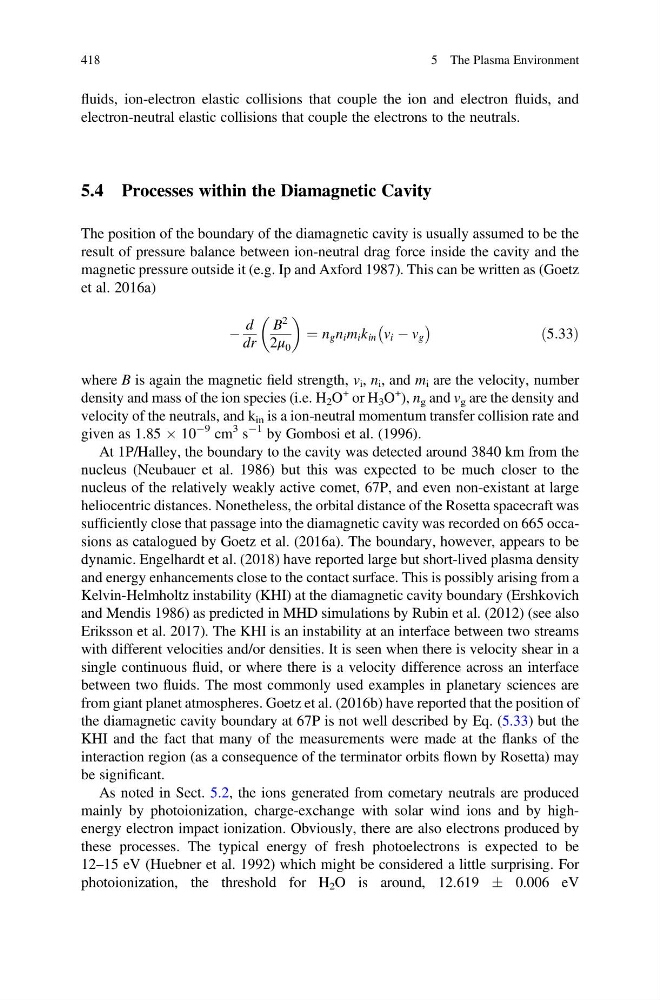
The position of the boundary of the diamagnetic cavity is usually assumed to be the
result of pressure balance between ion-neutral drag force inside the cavity and the
magnetic pressure outside it (e.g. Ip and Axford 1987). This can be written as (Goetz
et al. 2016a)
À
d
dr
B
2
2μ 0
¼ n g n i m i k in v i À v g
À
Á
ð5:33Þ
where B is again the magnetic field strength, v i , n i , and m i are the velocity, number
density and mass of the ion species (i.e. H 2 O
+ or H 3 O
+
), n g and v g are the density and
velocity of the neutrals, and k in is a ion-neutral momentum transfer collision rate and
given as 1.85 Â 10
À9 cm
3 s
À1 by Gombosi et al. (1996).
At 1P/Halley, the boundary to the cavity was detected around 3840 km from the
nucleus (Neubauer et al. 1986) but this was expected to be much closer to the
nucleus of the relatively weakly active comet, 67P, and even non-existant at large
heliocentric distances. Nonetheless, the orbital distance of the Rosetta spacecraft was
sufficiently close that passage into the diamagnetic cavity was recorded on 665 occasions as catalogued by Goetz et al. (2016a). The boundary, however, appears to be
dynamic. Engelhardt et al. (2018) have reported large but short-lived plasma density
and energy enhancements close to the contact surface. This is possibly arising from a
Kelvin-Helmholtz instability (KHI) at the diamagnetic cavity boundary (Ershkovich
and Mendis 1986) as predicted in MHD simulations by Rubin et al. (2012) (see also
Eriksson et al. 2017). The KHI is an instability at an interface between two streams
with different velocities and/or densities. It is seen when there is velocity shear in a
single continuous fluid, or where there is a velocity difference across an interface
between two fluids. The most commonly used examples in planetary sciences are
from giant planet atmospheres. Goetz et al. (2016b) have reported that the position of
the diamagnetic cavity boundary at 67P is not well described by Eq. (5.33) but the
KHI and the fact that many of the measurements were made at the flanks of the
interaction region (as a consequence of the terminator orbits flown by Rosetta) may
be significant.
As noted in Sect. 5.2, the ions generated from cometary neutrals are produced
mainly by photoionization, charge-exchange with solar wind ions and by highenergy electron impact ionization. Obviously, there are also electrons produced by
these processes. The typical energy of fresh photoelectrons is expected to be
12–15 eV (Huebner et al. 1992) which might be considered a little surprising. For
photoionization, the threshold for H 2 O is around, 12.619 Æ 0.006 eV
418
5 The Plasma Environment
electron-neutral elastic collisions that couple the electrons to the neutrals.
5.4 Processes within the Diamagnetic Cavity
The position of the boundary of the diamagnetic cavity is usually assumed to be the
result of pressure balance between ion-neutral drag force inside the cavity and the
magnetic pressure outside it (e.g. Ip and Axford 1987). This can be written as (Goetz
et al. 2016a)
À
d
dr
B
2
2μ 0
¼ n g n i m i k in v i À v g
À
Á
ð5:33Þ
where B is again the magnetic field strength, v i , n i , and m i are the velocity, number
density and mass of the ion species (i.e. H 2 O
+ or H 3 O
+
), n g and v g are the density and
velocity of the neutrals, and k in is a ion-neutral momentum transfer collision rate and
given as 1.85 Â 10
À9 cm
3 s
À1 by Gombosi et al. (1996).
At 1P/Halley, the boundary to the cavity was detected around 3840 km from the
nucleus (Neubauer et al. 1986) but this was expected to be much closer to the
nucleus of the relatively weakly active comet, 67P, and even non-existant at large
heliocentric distances. Nonetheless, the orbital distance of the Rosetta spacecraft was
sufficiently close that passage into the diamagnetic cavity was recorded on 665 occasions as catalogued by Goetz et al. (2016a). The boundary, however, appears to be
dynamic. Engelhardt et al. (2018) have reported large but short-lived plasma density
and energy enhancements close to the contact surface. This is possibly arising from a
Kelvin-Helmholtz instability (KHI) at the diamagnetic cavity boundary (Ershkovich
and Mendis 1986) as predicted in MHD simulations by Rubin et al. (2012) (see also
Eriksson et al. 2017). The KHI is an instability at an interface between two streams
with different velocities and/or densities. It is seen when there is velocity shear in a
single continuous fluid, or where there is a velocity difference across an interface
between two fluids. The most commonly used examples in planetary sciences are
from giant planet atmospheres. Goetz et al. (2016b) have reported that the position of
the diamagnetic cavity boundary at 67P is not well described by Eq. (5.33) but the
KHI and the fact that many of the measurements were made at the flanks of the
interaction region (as a consequence of the terminator orbits flown by Rosetta) may
be significant.
As noted in Sect. 5.2, the ions generated from cometary neutrals are produced
mainly by photoionization, charge-exchange with solar wind ions and by highenergy electron impact ionization. Obviously, there are also electrons produced by
these processes. The typical energy of fresh photoelectrons is expected to be
12–15 eV (Huebner et al. 1992) which might be considered a little surprising. For
photoionization, the threshold for H 2 O is around, 12.619 Æ 0.006 eV
418
5 The Plasma Environment