

photolysis must also be accounted for requiring an exponential decay term. Therefore, this calculation can quickly become complicated for a network of reactions.
The dominant neutral species in the outflow is usually assumed to be water
vapour although, as we have noted above, other molecules may compete or dominate
under specific conditions. Huebner et al. (1992) have given threshold wavelengths
for the multiple photolytic pathways in which water vapour can be broken down
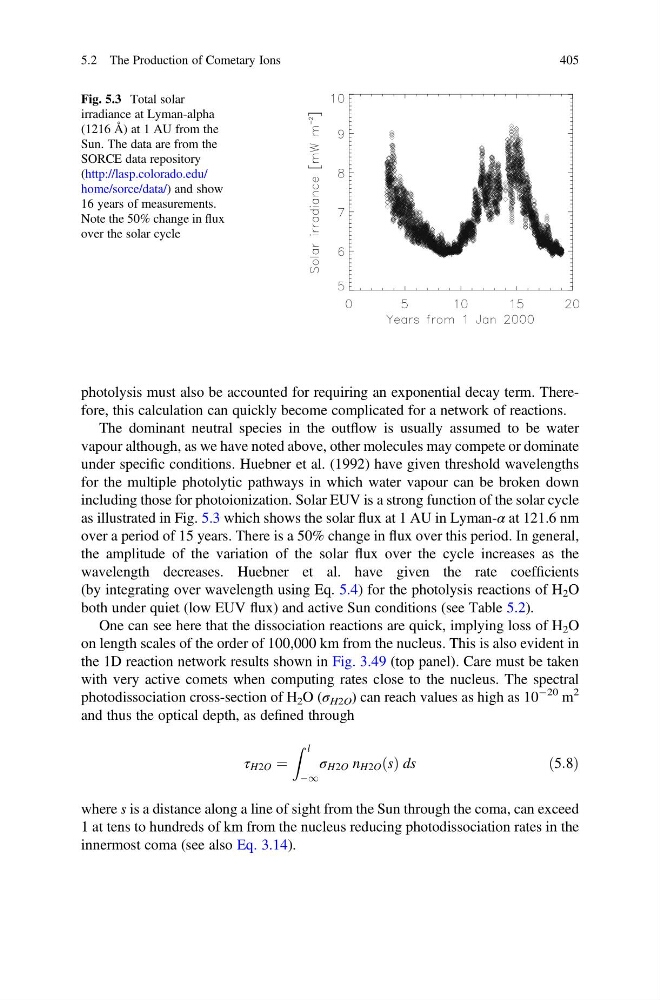
including those for photoionization. Solar EUV is a strong function of the solar cycle
as illustrated in Fig. 5.3 which shows the solar flux at 1 AU in Lyman-α at 121.6 nm
over a period of 15 years. There is a 50% change in flux over this period. In general,
the amplitude of the variation of the solar flux over the cycle increases as the
wavelength decreases. Huebner et al. have given the rate coefficients
(by integrating over wavelength using Eq. 5.4) for the photolysis reactions of H 2 O
both under quiet (low EUV flux) and active Sun conditions (see Table 5.2).
One can see here that the dissociation reactions are quick, implying loss of H 2 O
on length scales of the order of 100,000 km from the nucleus. This is also evident in
the 1D reaction network results shown in Fig. 3.49 (top panel). Care must be taken
with very active comets when computing rates close to the nucleus. The spectral
photodissociation cross-section of H 2 O (σ H2O ) can reach values as high as 10
À20 m
2
and thus the optical depth, as defined through
τ H2O ¼
Z l
À1
σ H2O n H2O s
ð Þ ds
ð5:8Þ
where s is a distance along a line of sight from the Sun through the coma, can exceed
1 at tens to hundreds of km from the nucleus reducing photodissociation rates in the
innermost coma (see also Eq. 3.14).
Fig. 5.3 Total solar
irradiance at Lyman-alpha
(1216 Å) at 1 AU from the
Sun. The data are from the
SORCE data repository
(http://lasp.colorado.edu/
home/sorce/data/) and show
16 years of measurements.
Note the 50% change in flux
over the solar cycle
5.2 The Production of Cometary Ions
405
The dominant neutral species in the outflow is usually assumed to be water
vapour although, as we have noted above, other molecules may compete or dominate
under specific conditions. Huebner et al. (1992) have given threshold wavelengths
for the multiple photolytic pathways in which water vapour can be broken down
including those for photoionization. Solar EUV is a strong function of the solar cycle
as illustrated in Fig. 5.3 which shows the solar flux at 1 AU in Lyman-α at 121.6 nm
over a period of 15 years. There is a 50% change in flux over this period. In general,
the amplitude of the variation of the solar flux over the cycle increases as the
wavelength decreases. Huebner et al. have given the rate coefficients
(by integrating over wavelength using Eq. 5.4) for the photolysis reactions of H 2 O
both under quiet (low EUV flux) and active Sun conditions (see Table 5.2).
One can see here that the dissociation reactions are quick, implying loss of H 2 O
on length scales of the order of 100,000 km from the nucleus. This is also evident in
the 1D reaction network results shown in Fig. 3.49 (top panel). Care must be taken
with very active comets when computing rates close to the nucleus. The spectral
photodissociation cross-section of H 2 O (σ H2O ) can reach values as high as 10
À20 m
2
and thus the optical depth, as defined through
τ H2O ¼
Z l
À1
σ H2O n H2O s
ð Þ ds
ð5:8Þ
where s is a distance along a line of sight from the Sun through the coma, can exceed
1 at tens to hundreds of km from the nucleus reducing photodissociation rates in the
innermost coma (see also Eq. 3.14).
Fig. 5.3 Total solar
irradiance at Lyman-alpha
(1216 Å) at 1 AU from the
Sun. The data are from the
SORCE data repository
(http://lasp.colorado.edu/
home/sorce/data/) and show
16 years of measurements.
Note the 50% change in flux
over the solar cycle
5.2 The Production of Cometary Ions
405