

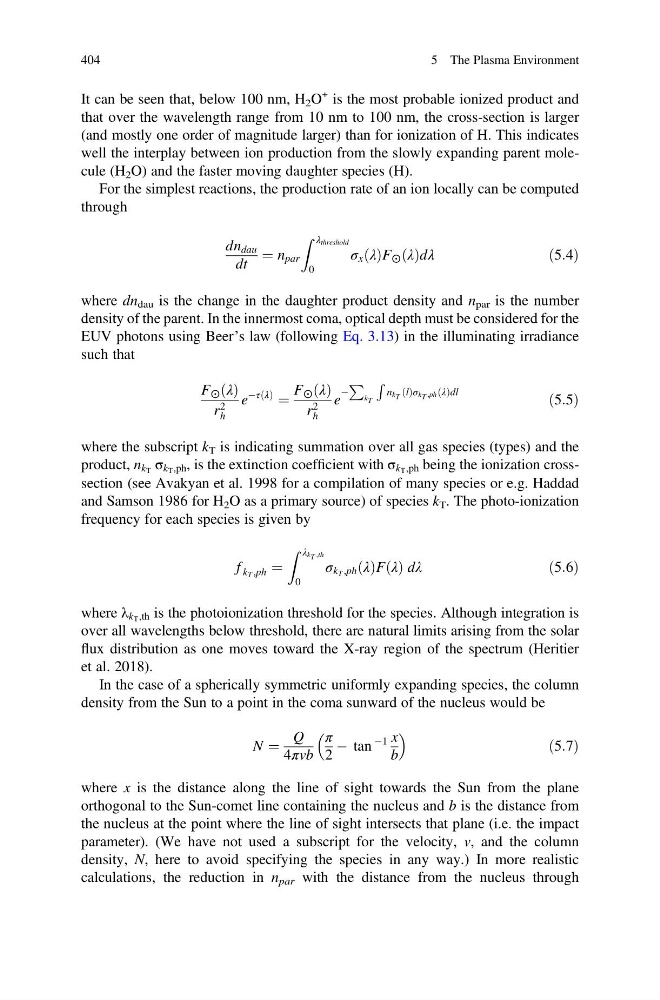
It can be seen that, below 100 nm, H 2 O
+ is the most probable ionized product and
that over the wavelength range from 10 nm to 100 nm, the cross-section is larger
(and mostly one order of magnitude larger) than for ionization of H. This indicates
well the interplay between ion production from the slowly expanding parent molecule (H 2 O) and the faster moving daughter species (H).
For the simplest reactions, the production rate of an ion locally can be computed
through
dn dau
dt
¼ n par
Z λ threshold
0
σ x λ
ð ÞF ⨀ λ
ð Þdλ
ð5:4Þ
where dn dau is the change in the daughter product density and n par is the number
density of the parent. In the innermost coma, optical depth must be considered for the
EUV photons using Beer’s law (following Eq. 3.13) in the illuminating irradiance
such that
F ⨀ λ
ð Þ
r 2
h
e
Àτ λ
ð Þ
¼
F ⨀ λ
ð Þ
r 2
h
e
À
P
k T
R
n k T l
ð Þσ k T ,ph λ
ð Þdl
ð5:5Þ
where the subscript k T is indicating summation over all gas species (types) and the
product, n k T σ k T ,ph , is the extinction coefficient with σ k T ,ph being the ionization crosssection (see Avakyan et al. 1998 for a compilation of many species or e.g. Haddad
and Samson 1986 for H 2 O as a primary source) of species k T . The photo-ionization
frequency for each species is given by
f k T ,ph ¼
Z λ k T ,th
0
σ k T ,ph λ
ð ÞF λ
ð Þ dλ
ð5:6Þ
where λ k T ,th is the photoionization threshold for the species. Although integration is
over all wavelengths below threshold, there are natural limits arising from the solar
flux distribution as one moves toward the X-ray region of the spectrum (Heritier
et al. 2018).
In the case of a spherically symmetric uniformly expanding species, the column
density from the Sun to a point in the coma sunward of the nucleus would be
N ¼
Q
4πvb
π
2
À tan
À1 x
b
ð5:7Þ
where x is the distance along the line of sight towards the Sun from the plane
orthogonal to the Sun-comet line containing the nucleus and b is the distance from
the nucleus at the point where the line of sight intersects that plane (i.e. the impact
parameter). (We have not used a subscript for the velocity, v, and the column
density, N, here to avoid specifying the species in any way.) In more realistic
calculations, the reduction in n par with the distance from the nucleus through
404
5 The Plasma Environment
+ is the most probable ionized product and
that over the wavelength range from 10 nm to 100 nm, the cross-section is larger
(and mostly one order of magnitude larger) than for ionization of H. This indicates
well the interplay between ion production from the slowly expanding parent molecule (H 2 O) and the faster moving daughter species (H).
For the simplest reactions, the production rate of an ion locally can be computed
through
dn dau
dt
¼ n par
Z λ threshold
0
σ x λ
ð ÞF ⨀ λ
ð Þdλ
ð5:4Þ
where dn dau is the change in the daughter product density and n par is the number
density of the parent. In the innermost coma, optical depth must be considered for the
EUV photons using Beer’s law (following Eq. 3.13) in the illuminating irradiance
such that
F ⨀ λ
ð Þ
r 2
h
e
Àτ λ
ð Þ
¼
F ⨀ λ
ð Þ
r 2
h
e
À
P
k T
R
n k T l
ð Þσ k T ,ph λ
ð Þdl
ð5:5Þ
where the subscript k T is indicating summation over all gas species (types) and the
product, n k T σ k T ,ph , is the extinction coefficient with σ k T ,ph being the ionization crosssection (see Avakyan et al. 1998 for a compilation of many species or e.g. Haddad
and Samson 1986 for H 2 O as a primary source) of species k T . The photo-ionization
frequency for each species is given by
f k T ,ph ¼
Z λ k T ,th
0
σ k T ,ph λ
ð ÞF λ
ð Þ dλ
ð5:6Þ
where λ k T ,th is the photoionization threshold for the species. Although integration is
over all wavelengths below threshold, there are natural limits arising from the solar
flux distribution as one moves toward the X-ray region of the spectrum (Heritier
et al. 2018).
In the case of a spherically symmetric uniformly expanding species, the column
density from the Sun to a point in the coma sunward of the nucleus would be
N ¼
Q
4πvb
π
2
À tan
À1 x
b
ð5:7Þ
where x is the distance along the line of sight towards the Sun from the plane
orthogonal to the Sun-comet line containing the nucleus and b is the distance from
the nucleus at the point where the line of sight intersects that plane (i.e. the impact
parameter). (We have not used a subscript for the velocity, v, and the column
density, N, here to avoid specifying the species in any way.) In more realistic
calculations, the reduction in n par with the distance from the nucleus through
404
5 The Plasma Environment