

Even though pure ices can be more readily identified by remote sensing, the effect
of mixing them with dark minerals leads to non-linearities that can further lead to
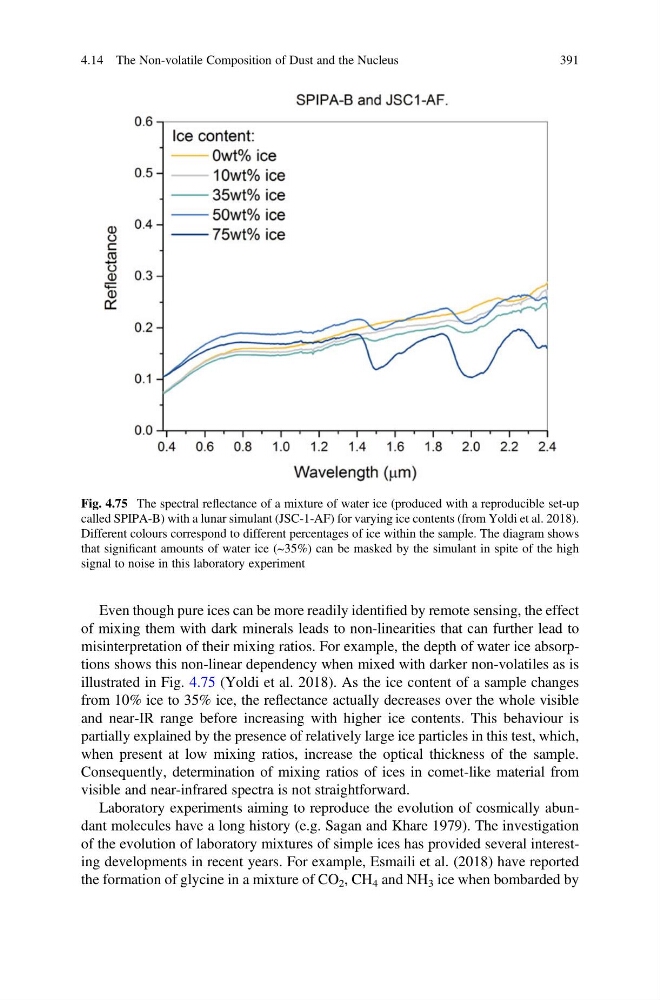
misinterpretation of their mixing ratios. For example, the depth of water ice absorptions shows this non-linear dependency when mixed with darker non-volatiles as is
illustrated in Fig. 4.75 (Yoldi et al. 2018). As the ice content of a sample changes
from 10% ice to 35% ice, the reflectance actually decreases over the whole visible
and near-IR range before increasing with higher ice contents. This behaviour is
partially explained by the presence of relatively large ice particles in this test, which,
when present at low mixing ratios, increase the optical thickness of the sample.
Consequently, determination of mixing ratios of ices in comet-like material from
visible and near-infrared spectra is not straightforward.
Laboratory experiments aiming to reproduce the evolution of cosmically abundant molecules have a long history (e.g. Sagan and Khare 1979). The investigation
of the evolution of laboratory mixtures of simple ices has provided several interesting developments in recent years. For example, Esmaili et al. (2018) have reported
the formation of glycine in a mixture of CO 2 , CH 4 and NH 3 ice when bombarded by
Fig. 4.75 The spectral reflectance of a mixture of water ice (produced with a reproducible set-up
called SPIPA-B) with a lunar simulant (JSC-1-AF) for varying ice contents (from Yoldi et al. 2018).
Different colours correspond to different percentages of ice within the sample. The diagram shows
that significant amounts of water ice (~35%) can be masked by the simulant in spite of the high
signal to noise in this laboratory experiment
4.14 The Non-volatile Composition of Dust and the Nucleus
391
of mixing them with dark minerals leads to non-linearities that can further lead to
misinterpretation of their mixing ratios. For example, the depth of water ice absorptions shows this non-linear dependency when mixed with darker non-volatiles as is
illustrated in Fig. 4.75 (Yoldi et al. 2018). As the ice content of a sample changes
from 10% ice to 35% ice, the reflectance actually decreases over the whole visible
and near-IR range before increasing with higher ice contents. This behaviour is
partially explained by the presence of relatively large ice particles in this test, which,
when present at low mixing ratios, increase the optical thickness of the sample.
Consequently, determination of mixing ratios of ices in comet-like material from
visible and near-infrared spectra is not straightforward.
Laboratory experiments aiming to reproduce the evolution of cosmically abundant molecules have a long history (e.g. Sagan and Khare 1979). The investigation
of the evolution of laboratory mixtures of simple ices has provided several interesting developments in recent years. For example, Esmaili et al. (2018) have reported
the formation of glycine in a mixture of CO 2 , CH 4 and NH 3 ice when bombarded by
Fig. 4.75 The spectral reflectance of a mixture of water ice (produced with a reproducible set-up
called SPIPA-B) with a lunar simulant (JSC-1-AF) for varying ice contents (from Yoldi et al. 2018).
Different colours correspond to different percentages of ice within the sample. The diagram shows
that significant amounts of water ice (~35%) can be masked by the simulant in spite of the high
signal to noise in this laboratory experiment
4.14 The Non-volatile Composition of Dust and the Nucleus
391