

and crystalline olivine) were evident. There were significant changes in the mineralogical composition observed post-impact suggesting heterogeneity with depth.
Ambiguity in spectral fitting is a significant issue in most attempts to derive a
detailed mineral composition from spectroscopy. Grain size and intimate mixtures of
multiple species can influence the depths of absorption features, for example. The
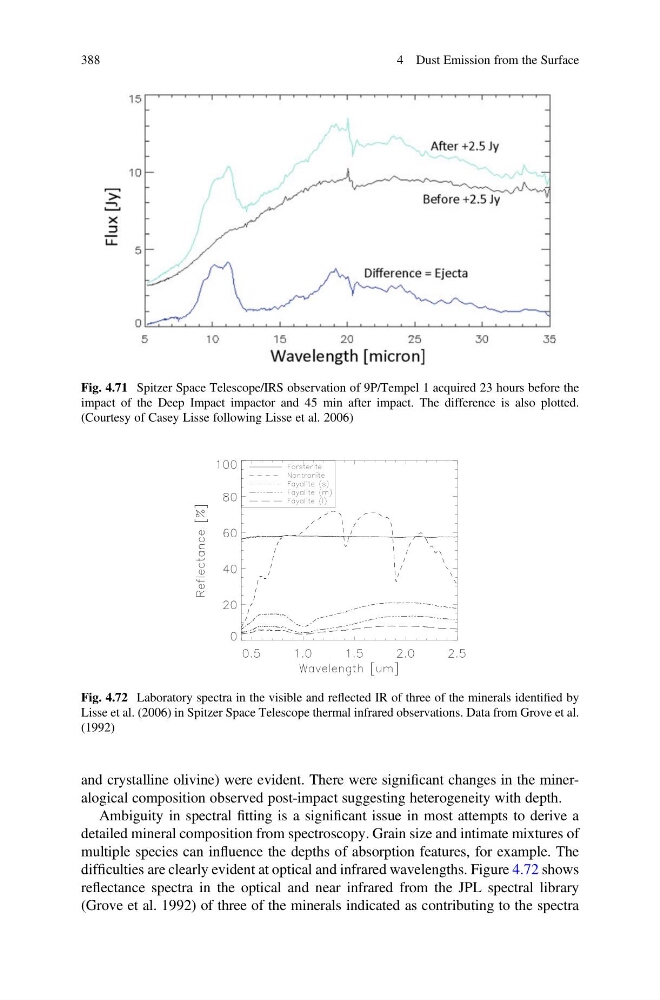
difficulties are clearly evident at optical and infrared wavelengths. Figure 4.72 shows
reflectance spectra in the optical and near infrared from the JPL spectral library
(Grove et al. 1992) of three of the minerals indicated as contributing to the spectra
Fig. 4.72 Laboratory spectra in the visible and reflected IR of three of the minerals identified by
Lisse et al. (2006) in Spitzer Space Telescope thermal infrared observations. Data from Grove et al.
(1992)
Fig. 4.71 Spitzer Space Telescope/IRS observation of 9P/Tempel 1 acquired 23 hours before the
impact of the Deep Impact impactor and 45 min after impact. The difference is also plotted.
(Courtesy of Casey Lisse following Lisse et al. 2006)
388
4 Dust Emission from the Surface
Ambiguity in spectral fitting is a significant issue in most attempts to derive a
detailed mineral composition from spectroscopy. Grain size and intimate mixtures of
multiple species can influence the depths of absorption features, for example. The
difficulties are clearly evident at optical and infrared wavelengths. Figure 4.72 shows
reflectance spectra in the optical and near infrared from the JPL spectral library
(Grove et al. 1992) of three of the minerals indicated as contributing to the spectra
Fig. 4.72 Laboratory spectra in the visible and reflected IR of three of the minerals identified by
Lisse et al. (2006) in Spitzer Space Telescope thermal infrared observations. Data from Grove et al.
(1992)
Fig. 4.71 Spitzer Space Telescope/IRS observation of 9P/Tempel 1 acquired 23 hours before the
impact of the Deep Impact impactor and 45 min after impact. The difference is also plotted.
(Courtesy of Casey Lisse following Lisse et al. 2006)
388
4 Dust Emission from the Surface