

one-sided Boltzmann distribution for the dust ejection speeds (1 σ ¼ 0.6 m/s), the
column density over the dayside when steady-state is reached can be determined and
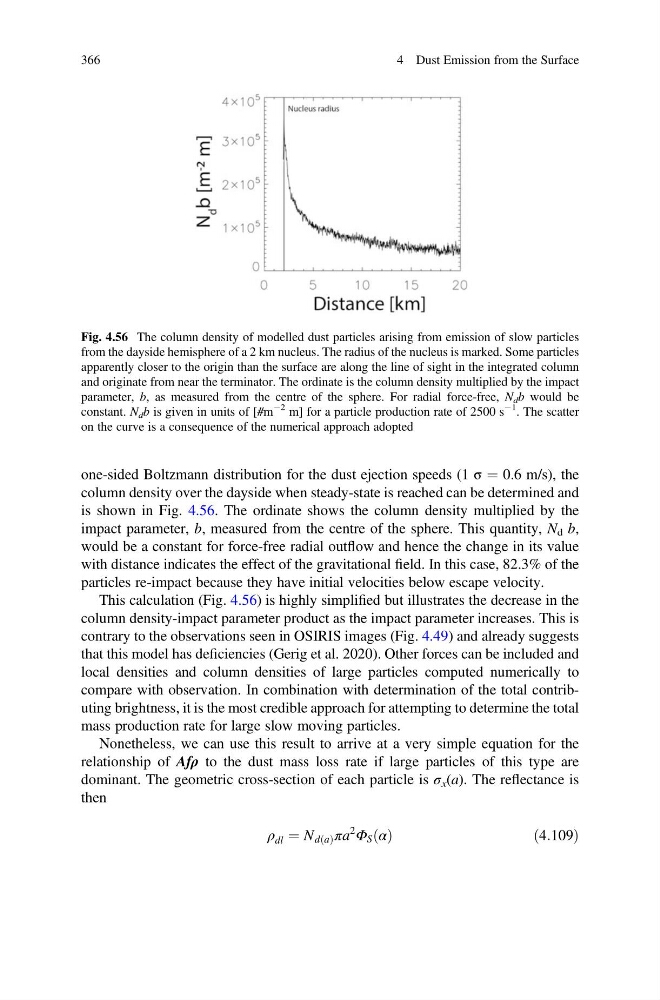
is shown in Fig. 4.56. The ordinate shows the column density multiplied by the
impact parameter, b, measured from the centre of the sphere. This quantity, N d b,
would be a constant for force-free radial outflow and hence the change in its value
with distance indicates the effect of the gravitational field. In this case, 82.3% of the
particles re-impact because they have initial velocities below escape velocity.
This calculation (Fig. 4.56) is highly simplified but illustrates the decrease in the
column density-impact parameter product as the impact parameter increases. This is
contrary to the observations seen in OSIRIS images (Fig. 4.49) and already suggests
that this model has deficiencies (Gerig et al. 2020). Other forces can be included and
local densities and column densities of large particles computed numerically to
compare with observation. In combination with determination of the total contributing brightness, it is the most credible approach for attempting to determine the total
mass production rate for large slow moving particles.
Nonetheless, we can use this result to arrive at a very simple equation for the
relationship of Afρ to the dust mass loss rate if large particles of this type are
dominant. The geometric cross-section of each particle is σ x (a). The reflectance is
then
ρ dl ¼ N d a
ð Þ πa
2
Φ S α
ð Þ
ð4:109Þ
Fig. 4.56 The column density of modelled dust particles arising from emission of slow particles
from the dayside hemisphere of a 2 km nucleus. The radius of the nucleus is marked. Some particles
apparently closer to the origin than the surface are along the line of sight in the integrated column
and originate from near the terminator. The ordinate is the column density multiplied by the impact
parameter, b, as measured from the centre of the sphere. For radial force-free, N d b would be
constant. N d b is given in units of [#m
À2 m] for a particle production rate of 2500 s
À1
. The scatter
on the curve is a consequence of the numerical approach adopted
366
4 Dust Emission from the Surface
column density over the dayside when steady-state is reached can be determined and
is shown in Fig. 4.56. The ordinate shows the column density multiplied by the
impact parameter, b, measured from the centre of the sphere. This quantity, N d b,
would be a constant for force-free radial outflow and hence the change in its value
with distance indicates the effect of the gravitational field. In this case, 82.3% of the
particles re-impact because they have initial velocities below escape velocity.
This calculation (Fig. 4.56) is highly simplified but illustrates the decrease in the
column density-impact parameter product as the impact parameter increases. This is
contrary to the observations seen in OSIRIS images (Fig. 4.49) and already suggests
that this model has deficiencies (Gerig et al. 2020). Other forces can be included and
local densities and column densities of large particles computed numerically to
compare with observation. In combination with determination of the total contributing brightness, it is the most credible approach for attempting to determine the total
mass production rate for large slow moving particles.
Nonetheless, we can use this result to arrive at a very simple equation for the
relationship of Afρ to the dust mass loss rate if large particles of this type are
dominant. The geometric cross-section of each particle is σ x (a). The reflectance is
then
ρ dl ¼ N d a
ð Þ πa
2
Φ S α
ð Þ
ð4:109Þ
Fig. 4.56 The column density of modelled dust particles arising from emission of slow particles
from the dayside hemisphere of a 2 km nucleus. The radius of the nucleus is marked. Some particles
apparently closer to the origin than the surface are along the line of sight in the integrated column
and originate from near the terminator. The ordinate is the column density multiplied by the impact
parameter, b, as measured from the centre of the sphere. For radial force-free, N d b would be
constant. N d b is given in units of [#m
À2 m] for a particle production rate of 2500 s
À1
. The scatter
on the curve is a consequence of the numerical approach adopted
366
4 Dust Emission from the Surface