

the fainter the streak which leads to detection limits for faint fast particles and
observational selection effects. It is to be noted that the individuals identified by
the algorithm in this image contribute only 10% to the total brightness in the frame.
The dashed line in Fig. 4.55 (bottom right) shows how the brightness of a particle at
rest with an I/F of 2 10
À7 would need to increase to have the same apparent
brightness per pixel as its speed increases in the image plane. This represents a
crude detection threshold for individuals in this image and corresponds roughly to
stationary 2 mm diameter particles at 10 km distance. Figure 4.55 (bottom left)
shows the speeds in 2D (the velocity component along the line of sight cannot be
determined) that 100 particles in the sample would need to have if the observed
streak were a combination of spacecraft motion and particle motion directly away
from the comet. This speed is however a strong function of the distance between the
particle and the camera and solutions show a large degree of degeneracy. However,
if these assumptions are valid then the observed particles will in general be at speeds
of 0.5–10 m s
À1 and 1–20 mm in diameter.
The number of individual large particles in the vicinity of 67P has become the
subject of considerable controversy. It is an important quantity for two major
reasons. Firstly, slow moving, large particles are probably the main contributors to
the sedimentation mechanism (airfall) that influences the surface morphology. The
rate of deposition is, however, not well established. Secondly, large particles may be
responsible for most of the cometary mass loss. While large particle loss cannot be
doubted, the subject remains controversial because the total mass of large particles
(both that ejected from the system and that falling back onto the nucleus) and the
possible errors on the numbers are highly disputed (Choukroun et al. 2020).
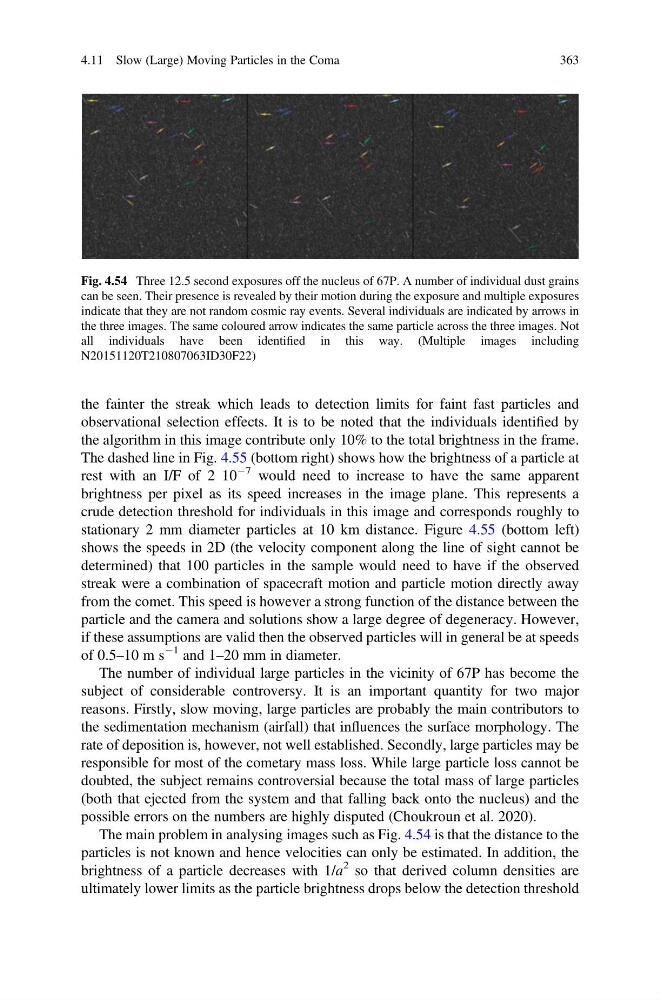
The main problem in analysing images such as Fig. 4.54 is that the distance to the
particles is not known and hence velocities can only be estimated. In addition, the
brightness of a particle decreases with 1/a
2 so that derived column densities are
ultimately lower limits as the particle brightness drops below the detection threshold
Fig. 4.54 Three 12.5 second exposures off the nucleus of 67P. A number of individual dust grains
can be seen. Their presence is revealed by their motion during the exposure and multiple exposures
indicate that they are not random cosmic ray events. Several individuals are indicated by arrows in
the three images. The same coloured arrow indicates the same particle across the three images. Not
all individuals have been identified in this way. (Multiple images including
N20151120T210807063ID30F22)
4.11 Slow (Large) Moving Particles in the Coma
363
observational selection effects. It is to be noted that the individuals identified by
the algorithm in this image contribute only 10% to the total brightness in the frame.
The dashed line in Fig. 4.55 (bottom right) shows how the brightness of a particle at
rest with an I/F of 2 10
À7 would need to increase to have the same apparent
brightness per pixel as its speed increases in the image plane. This represents a
crude detection threshold for individuals in this image and corresponds roughly to
stationary 2 mm diameter particles at 10 km distance. Figure 4.55 (bottom left)
shows the speeds in 2D (the velocity component along the line of sight cannot be
determined) that 100 particles in the sample would need to have if the observed
streak were a combination of spacecraft motion and particle motion directly away
from the comet. This speed is however a strong function of the distance between the
particle and the camera and solutions show a large degree of degeneracy. However,
if these assumptions are valid then the observed particles will in general be at speeds
of 0.5–10 m s
À1 and 1–20 mm in diameter.
The number of individual large particles in the vicinity of 67P has become the
subject of considerable controversy. It is an important quantity for two major
reasons. Firstly, slow moving, large particles are probably the main contributors to
the sedimentation mechanism (airfall) that influences the surface morphology. The
rate of deposition is, however, not well established. Secondly, large particles may be
responsible for most of the cometary mass loss. While large particle loss cannot be
doubted, the subject remains controversial because the total mass of large particles
(both that ejected from the system and that falling back onto the nucleus) and the
possible errors on the numbers are highly disputed (Choukroun et al. 2020).
The main problem in analysing images such as Fig. 4.54 is that the distance to the
particles is not known and hence velocities can only be estimated. In addition, the
brightness of a particle decreases with 1/a
2 so that derived column densities are
ultimately lower limits as the particle brightness drops below the detection threshold
Fig. 4.54 Three 12.5 second exposures off the nucleus of 67P. A number of individual dust grains
can be seen. Their presence is revealed by their motion during the exposure and multiple exposures
indicate that they are not random cosmic ray events. Several individuals are indicated by arrows in
the three images. The same coloured arrow indicates the same particle across the three images. Not
all individuals have been identified in this way. (Multiple images including
N20151120T210807063ID30F22)
4.11 Slow (Large) Moving Particles in the Coma
363