

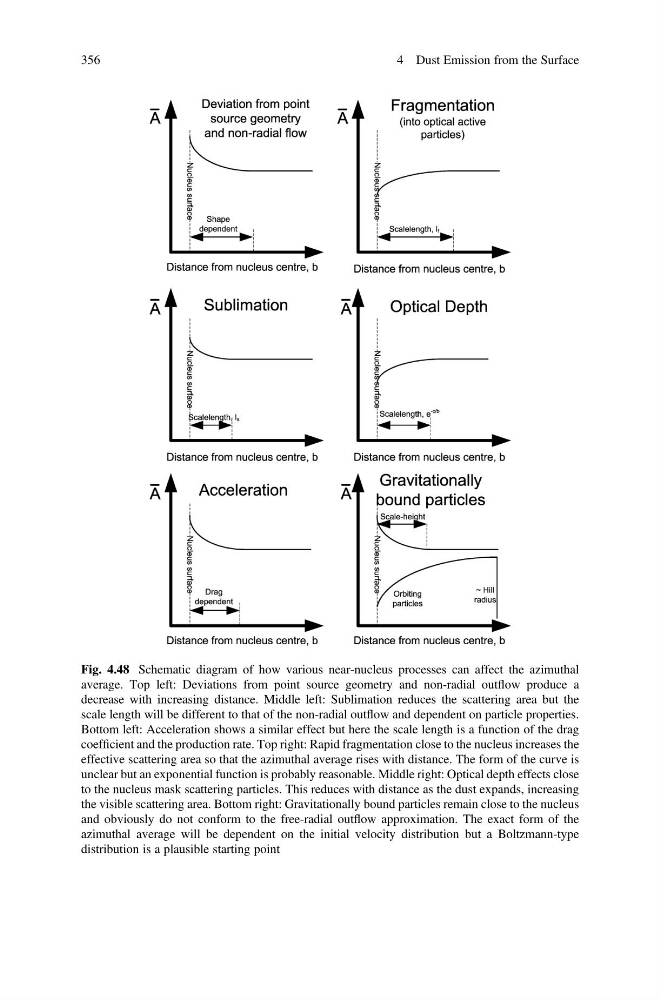
Fig. 4.48 Schematic diagram of how various near-nucleus processes can affect the azimuthal
average. Top left: Deviations from point source geometry and non-radial outflow produce a
decrease with increasing distance. Middle left: Sublimation reduces the scattering area but the
scale length will be different to that of the non-radial outflow and dependent on particle properties.
Bottom left: Acceleration shows a similar effect but here the scale length is a function of the drag
coefficient and the production rate. Top right: Rapid fragmentation close to the nucleus increases the
effective scattering area so that the azimuthal average rises with distance. The form of the curve is
unclear but an exponential function is probably reasonable. Middle right: Optical depth effects close
to the nucleus mask scattering particles. This reduces with distance as the dust expands, increasing
the visible scattering area. Bottom right: Gravitationally bound particles remain close to the nucleus
and obviously do not conform to the free-radial outflow approximation. The exact form of the
azimuthal average will be dependent on the initial velocity distribution but a Boltzmann-type
distribution is a plausible starting point
356
4 Dust Emission from the Surface
average. Top left: Deviations from point source geometry and non-radial outflow produce a
decrease with increasing distance. Middle left: Sublimation reduces the scattering area but the
scale length will be different to that of the non-radial outflow and dependent on particle properties.
Bottom left: Acceleration shows a similar effect but here the scale length is a function of the drag
coefficient and the production rate. Top right: Rapid fragmentation close to the nucleus increases the
effective scattering area so that the azimuthal average rises with distance. The form of the curve is
unclear but an exponential function is probably reasonable. Middle right: Optical depth effects close
to the nucleus mask scattering particles. This reduces with distance as the dust expands, increasing
the visible scattering area. Bottom right: Gravitationally bound particles remain close to the nucleus
and obviously do not conform to the free-radial outflow approximation. The exact form of the
azimuthal average will be dependent on the initial velocity distribution but a Boltzmann-type
distribution is a plausible starting point
356
4 Dust Emission from the Surface