

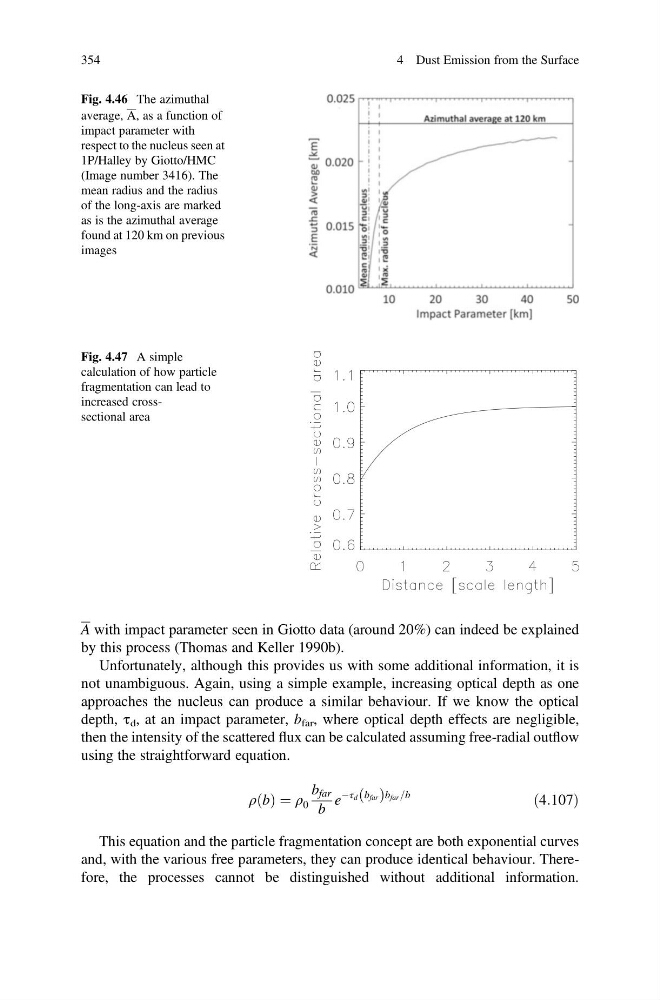
A with impact parameter seen in Giotto data (around 20%) can indeed be explained
by this process (Thomas and Keller 1990b).
Unfortunately, although this provides us with some additional information, it is
not unambiguous. Again, using a simple example, increasing optical depth as one
approaches the nucleus can produce a similar behaviour. If we know the optical
depth, τ d , at an impact parameter, b far , where optical depth effects are negligible,
then the intensity of the scattered flux can be calculated assuming free-radial outflow
using the straightforward equation.
ρ b
ð Þ ¼ ρ 0
b far
b
e
Àτ d b far
ð Þbfar=b
ð4:107Þ
This equation and the particle fragmentation concept are both exponential curves
and, with the various free parameters, they can produce identical behaviour. Therefore, the processes cannot be distinguished without additional information.
Fig. 4.46 The azimuthal
average, A, as a function of
impact parameter with
respect to the nucleus seen at
1P/Halley by Giotto/HMC
(Image number 3416). The
mean radius and the radius
of the long-axis are marked
as is the azimuthal average
found at 120 km on previous
images
Fig. 4.47 A simple
calculation of how particle
fragmentation can lead to
increased crosssectional area
354
4 Dust Emission from the Surface
by this process (Thomas and Keller 1990b).
Unfortunately, although this provides us with some additional information, it is
not unambiguous. Again, using a simple example, increasing optical depth as one
approaches the nucleus can produce a similar behaviour. If we know the optical
depth, τ d , at an impact parameter, b far , where optical depth effects are negligible,
then the intensity of the scattered flux can be calculated assuming free-radial outflow
using the straightforward equation.
ρ b
ð Þ ¼ ρ 0
b far
b
e
Àτ d b far
ð Þbfar=b
ð4:107Þ
This equation and the particle fragmentation concept are both exponential curves
and, with the various free parameters, they can produce identical behaviour. Therefore, the processes cannot be distinguished without additional information.
Fig. 4.46 The azimuthal
average, A, as a function of
impact parameter with
respect to the nucleus seen at
1P/Halley by Giotto/HMC
(Image number 3416). The
mean radius and the radius
of the long-axis are marked
as is the azimuthal average
found at 120 km on previous
images
Fig. 4.47 A simple
calculation of how particle
fragmentation can lead to
increased crosssectional area
354
4 Dust Emission from the Surface