

flow arising from the gas dynamics and unusual (non-spherical) surface geometries
complicate the interpretation severely.
One approach of attacking this problem with a view to understanding the physics
of the initial outflow is to construct a surface about the nucleus and applying
conservation “laws”. In the force-free approximation using a point source, the
proportionality
ρ
h i /
1
2π
Z 2π
0
N d b, θ
ð Þdθ ¼
1
2π
Z 2π
0
Q d θ
ð Þ
4bv d θ
ð Þ
dθ
ð4:106Þ
where <ρ> has been previously defined through Eq. (4.60) and is related to Afρ. In
other words, the dust flux through a surface defined by a cylinder, with its long axis
along the line of sight, and with the nucleus at its centre is a constant and can be
related to the observed intensity if the scattering properties of the dust particles are
neither a function of the impact parameter, b, nor a function of angle.
There is a large list of assumptions made in adopting this equation. The following
processes are neglected,
• Non-point source geometry
• Non-radial flow
• Unusual source geometries
• Acceleration by gas drag
• Optical depth effects
• Excessive numbers of gravitationally bound particles close to the nucleus
• Particle fragmentation
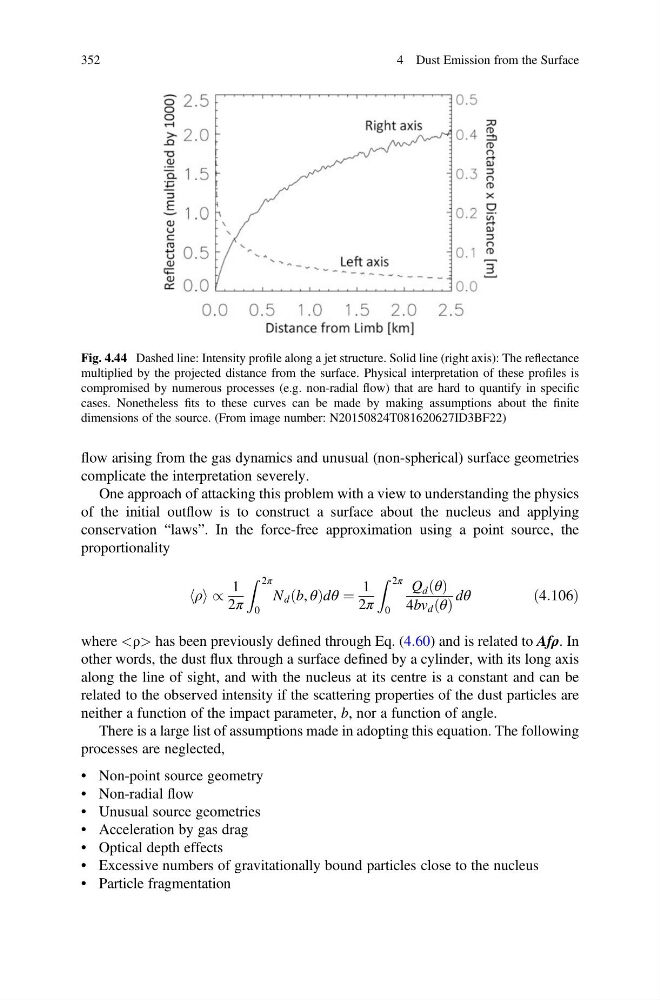
Fig. 4.44 Dashed line: Intensity profile along a jet structure. Solid line (right axis): The reflectance
multiplied by the projected distance from the surface. Physical interpretation of these profiles is
compromised by numerous processes (e.g. non-radial flow) that are hard to quantify in specific
cases. Nonetheless fits to these curves can be made by making assumptions about the finite
dimensions of the source. (From image number: N20150824T081620627ID3BF22)
352
4 Dust Emission from the Surface
complicate the interpretation severely.
One approach of attacking this problem with a view to understanding the physics
of the initial outflow is to construct a surface about the nucleus and applying
conservation “laws”. In the force-free approximation using a point source, the
proportionality
ρ
h i /
1
2π
Z 2π
0
N d b, θ
ð Þdθ ¼
1
2π
Z 2π
0
Q d θ
ð Þ
4bv d θ
ð Þ
dθ
ð4:106Þ
where <ρ> has been previously defined through Eq. (4.60) and is related to Afρ. In
other words, the dust flux through a surface defined by a cylinder, with its long axis
along the line of sight, and with the nucleus at its centre is a constant and can be
related to the observed intensity if the scattering properties of the dust particles are
neither a function of the impact parameter, b, nor a function of angle.
There is a large list of assumptions made in adopting this equation. The following
processes are neglected,
• Non-point source geometry
• Non-radial flow
• Unusual source geometries
• Acceleration by gas drag
• Optical depth effects
• Excessive numbers of gravitationally bound particles close to the nucleus
• Particle fragmentation
Fig. 4.44 Dashed line: Intensity profile along a jet structure. Solid line (right axis): The reflectance
multiplied by the projected distance from the surface. Physical interpretation of these profiles is
compromised by numerous processes (e.g. non-radial flow) that are hard to quantify in specific
cases. Nonetheless fits to these curves can be made by making assumptions about the finite
dimensions of the source. (From image number: N20150824T081620627ID3BF22)
352
4 Dust Emission from the Surface