

radial velocities of the gas and dust are enhanced inside the jet, compared with those
in the background. This type of effect can be seen by close inspection of Fig. 3.33,
for example. The gas also expands laterally. Dragged by this laterally expanding gas
outflow, the dust particles are swept away from the central axis to produce a cone
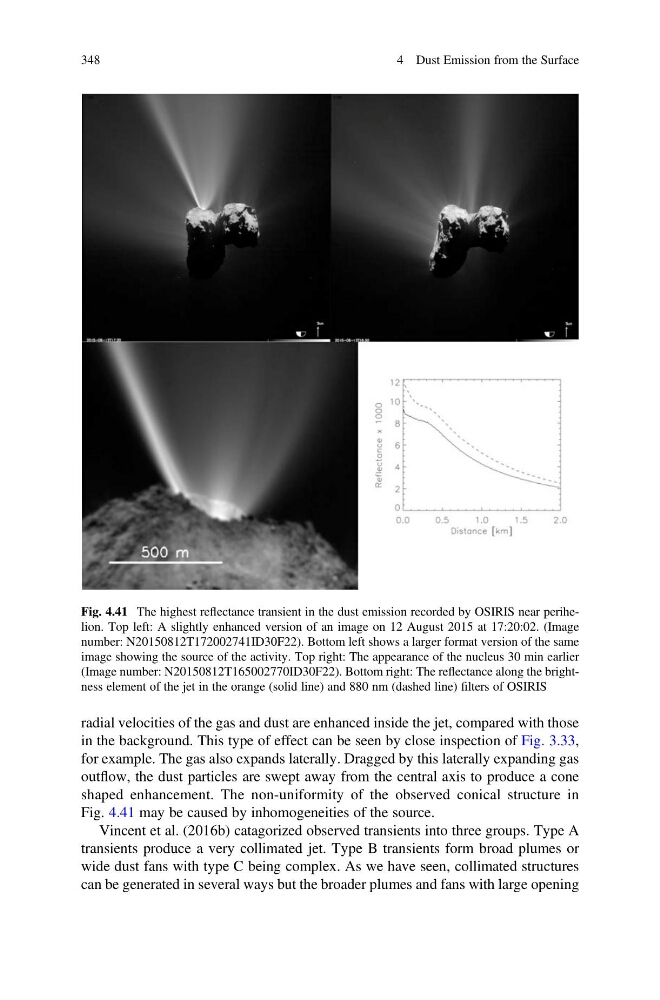
shaped enhancement. The non-uniformity of the observed conical structure in
Fig. 4.41 may be caused by inhomogeneities of the source.
Vincent et al. (2016b) catagorized observed transients into three groups. Type A
transients produce a very collimated jet. Type B transients form broad plumes or
wide dust fans with type C being complex. As we have seen, collimated structures
can be generated in several ways but the broader plumes and fans with large opening
Fig. 4.41 The highest reflectance transient in the dust emission recorded by OSIRIS near perihelion. Top left: A slightly enhanced version of an image on 12 August 2015 at 17:20:02. (Image
number: N20150812T172002741ID30F22). Bottom left shows a larger format version of the same
image showing the source of the activity. Top right: The appearance of the nucleus 30 min earlier
(Image number: N20150812T165002770ID30F22). Bottom right: The reflectance along the brightness element of the jet in the orange (solid line) and 880 nm (dashed line) filters of OSIRIS
348
4 Dust Emission from the Surface
in the background. This type of effect can be seen by close inspection of Fig. 3.33,
for example. The gas also expands laterally. Dragged by this laterally expanding gas
outflow, the dust particles are swept away from the central axis to produce a cone
shaped enhancement. The non-uniformity of the observed conical structure in
Fig. 4.41 may be caused by inhomogeneities of the source.
Vincent et al. (2016b) catagorized observed transients into three groups. Type A
transients produce a very collimated jet. Type B transients form broad plumes or
wide dust fans with type C being complex. As we have seen, collimated structures
can be generated in several ways but the broader plumes and fans with large opening
Fig. 4.41 The highest reflectance transient in the dust emission recorded by OSIRIS near perihelion. Top left: A slightly enhanced version of an image on 12 August 2015 at 17:20:02. (Image
number: N20150812T172002741ID30F22). Bottom left shows a larger format version of the same
image showing the source of the activity. Top right: The appearance of the nucleus 30 min earlier
(Image number: N20150812T165002770ID30F22). Bottom right: The reflectance along the brightness element of the jet in the orange (solid line) and 880 nm (dashed line) filters of OSIRIS
348
4 Dust Emission from the Surface