

whereas the CO 2 /H 2 O was highest (>0.5) in the same regions as CO/H 2 O but also in
the whole latitude band between 30
and 60
S (which includes parts of the Anhur,
Bes, Atum, and Geb regions). They suggested that their results supported the
concept of CO 2 and CO coming from below the surface where thermal variations
produced by insolation would be damped (as illustrated in Fig. 3.39) (cf BockeléeMorvan et al. 2015). This is somewhat at odds with, for example, the Deep Impact
observations of 9P/Tempel 1 and 103P/Hartley 2 which would suggest that inhomogeneity of emission of the more volatile species is required.
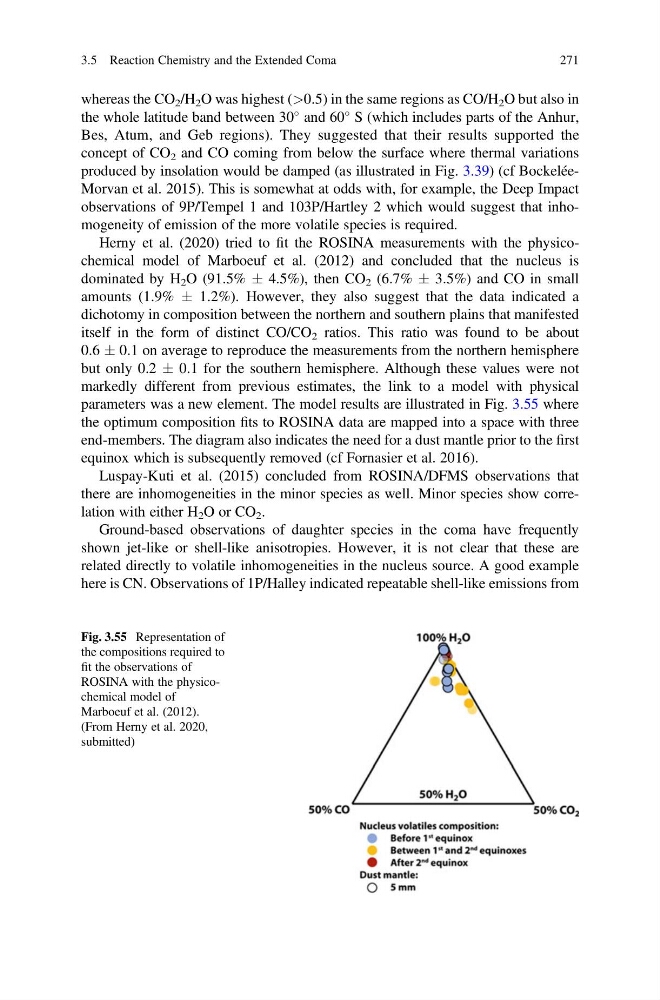
Herny et al. (2020) tried to fit the ROSINA measurements with the physicochemical model of Marboeuf et al. (2012) and concluded that the nucleus is
dominated by H 2 O (91.5% Æ 4.5%), then CO 2 (6.7% Æ 3.5%) and CO in small
amounts (1.9% Æ 1.2%). However, they also suggest that the data indicated a
dichotomy in composition between the northern and southern plains that manifested
itself in the form of distinct CO/CO 2 ratios. This ratio was found to be about
0.6 Æ 0.1 on average to reproduce the measurements from the northern hemisphere
but only 0.2 Æ 0.1 for the southern hemisphere. Although these values were not
markedly different from previous estimates, the link to a model with physical
parameters was a new element. The model results are illustrated in Fig. 3.55 where
the optimum composition fits to ROSINA data are mapped into a space with three
end-members. The diagram also indicates the need for a dust mantle prior to the first
equinox which is subsequently removed (cf Fornasier et al. 2016).
Luspay-Kuti et al. (2015) concluded from ROSINA/DFMS observations that
there are inhomogeneities in the minor species as well. Minor species show correlation with either H 2 O or CO 2 .
Ground-based observations of daughter species in the coma have frequently
shown jet-like or shell-like anisotropies. However, it is not clear that these are
related directly to volatile inhomogeneities in the nucleus source. A good example
here is CN. Observations of 1P/Halley indicated repeatable shell-like emissions from
Fig. 3.55 Representation of
the compositions required to
fit the observations of
ROSINA with the physicochemical model of
Marboeuf et al. (2012).
(From Herny et al. 2020,
submitted)
3.5 Reaction Chemistry and the Extended Coma
271
the whole latitude band between 30
and 60
S (which includes parts of the Anhur,
Bes, Atum, and Geb regions). They suggested that their results supported the
concept of CO 2 and CO coming from below the surface where thermal variations
produced by insolation would be damped (as illustrated in Fig. 3.39) (cf BockeléeMorvan et al. 2015). This is somewhat at odds with, for example, the Deep Impact
observations of 9P/Tempel 1 and 103P/Hartley 2 which would suggest that inhomogeneity of emission of the more volatile species is required.
Herny et al. (2020) tried to fit the ROSINA measurements with the physicochemical model of Marboeuf et al. (2012) and concluded that the nucleus is
dominated by H 2 O (91.5% Æ 4.5%), then CO 2 (6.7% Æ 3.5%) and CO in small
amounts (1.9% Æ 1.2%). However, they also suggest that the data indicated a
dichotomy in composition between the northern and southern plains that manifested
itself in the form of distinct CO/CO 2 ratios. This ratio was found to be about
0.6 Æ 0.1 on average to reproduce the measurements from the northern hemisphere
but only 0.2 Æ 0.1 for the southern hemisphere. Although these values were not
markedly different from previous estimates, the link to a model with physical
parameters was a new element. The model results are illustrated in Fig. 3.55 where
the optimum composition fits to ROSINA data are mapped into a space with three
end-members. The diagram also indicates the need for a dust mantle prior to the first
equinox which is subsequently removed (cf Fornasier et al. 2016).
Luspay-Kuti et al. (2015) concluded from ROSINA/DFMS observations that
there are inhomogeneities in the minor species as well. Minor species show correlation with either H 2 O or CO 2 .
Ground-based observations of daughter species in the coma have frequently
shown jet-like or shell-like anisotropies. However, it is not clear that these are
related directly to volatile inhomogeneities in the nucleus source. A good example
here is CN. Observations of 1P/Halley indicated repeatable shell-like emissions from
Fig. 3.55 Representation of
the compositions required to
fit the observations of
ROSINA with the physicochemical model of
Marboeuf et al. (2012).
(From Herny et al. 2020,
submitted)
3.5 Reaction Chemistry and the Extended Coma
271