

through the (6, 13) P1 line of the Lyman band system (B
1
Σ u
+
À X
1
Σ g
+ ) at 1607.5 Å.
Feldman et al. (2018b) presented evidence that part of the H 2 observed in C/2014 Q2
(Lovejoy) came from photodissociation of formaldehyde (H 2 CO).
The (0,0) band of the A
1
Π – X
1
Σ
+ system of CS is at 2576 Å and has been
detected in nearly all comet spectra acquired by IUE and HST (Feldman et al. 2004).
This led to the inclusion of a narrow band filter in the OSIRIS WAC instrument for
Rosetta although the final filter was of inadequate quality to provide useful results.
This species was detected in 19P/Borrelly by Bockelée-Morvan et al. (2004a) in the
sub-mm range (specifically the J(3–2) and J(5–4) lines at 146.9690 and 244.9356
GHz, respectively (Table 3.2)) and has also been detected (using the J ¼ 5–4 line) in
C/2001 Q4 (NEAT) and C/2002 T7 (LINEAR) by de Val-Borro et al. (2013) with
derived production rates relative to H 2 O of 0.08% and 0.2% respectively. Bogelund
and Hogerheijde (2017) detected CS in C/2012 S1 (ISON) with the ALMA array and
derived a parent scale length for CS of $200 km (two orders of magnitude smaller
than that used in the analysis by De Val-Borro et al. 2013) with a production rate of
0.2% relative to H 2 O. These types of measurements remain relevant because CS
cannot be distinguished from CO 2 in a ROSINA-type mass spectrometer
(cf. Table 3.1). However, there remain uncertainties about the molecule’s parent
species (e.g. CS 2 and OCS are both plausible).
The region of the spectrum shortward of 2000 Å (the far-ultraviolet, FUV) also
contains the resonance transitions of common elements such as carbon, oxygen and
sulphur. The principal excitation mechanism in the ultraviolet is resonant fluorescence of solar radiation but the low photon fluxes have limited observations from
orbiting observatories, such as the International Ultraviolet Explorer, the Hubble
Space Telescope (e.g. Weaver et al. 2011) and the Far Ultraviolet Spectroscopic
Explorer, to moderately active comets within $1.5 AU of the Sun (Feldman et al.
2015)
Observations by the FUV ALICE experiment on Rosetta at 67P showed expected
emissions but it was noted that the relative intensities of the neutral hydrogen and
oxygen multiplets were indicative of the electron impact dissociative excitation of
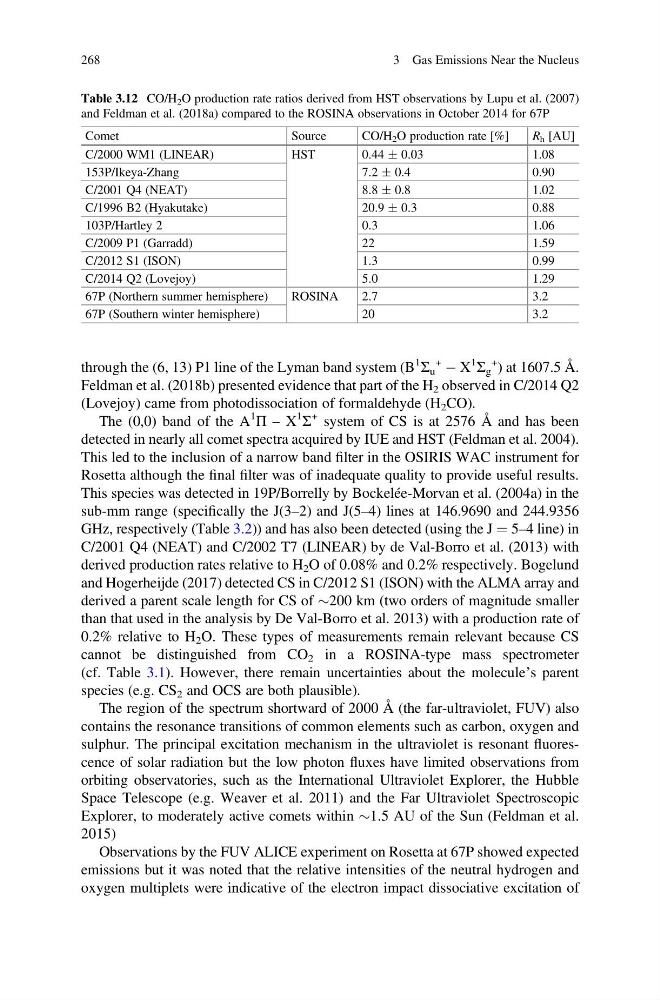
Table 3.12 CO/H 2 O production rate ratios derived from HST observations by Lupu et al. (2007)
and Feldman et al. (2018a) compared to the ROSINA observations in October 2014 for 67P
Comet
Source
CO/H 2 O production rate [%]
R h [AU]
C/2000 WM1 (LINEAR)
HST
0.44 Æ 0.03
1.08
153P/Ikeya-Zhang
7.2 Æ 0.4
0.90
C/2001 Q4 (NEAT)
8.8 Æ 0.8
1.02
C/1996 B2 (Hyakutake)
20.9 Æ 0.3
0.88
103P/Hartley 2
0.3
1.06
C/2009 P1 (Garradd)
22
1.59
C/2012 S1 (ISON)
1.3
0.99
C/2014 Q2 (Lovejoy)
5.0
1.29
67P (Northern summer hemisphere)
ROSINA
2.7
3.2
67P (Southern winter hemisphere)
20
3.2
268
3 Gas Emissions Near the Nucleus
1
Σ u
+
À X
1
Σ g
+ ) at 1607.5 Å.
Feldman et al. (2018b) presented evidence that part of the H 2 observed in C/2014 Q2
(Lovejoy) came from photodissociation of formaldehyde (H 2 CO).
The (0,0) band of the A
1
Π – X
1
Σ
+ system of CS is at 2576 Å and has been
detected in nearly all comet spectra acquired by IUE and HST (Feldman et al. 2004).
This led to the inclusion of a narrow band filter in the OSIRIS WAC instrument for
Rosetta although the final filter was of inadequate quality to provide useful results.
This species was detected in 19P/Borrelly by Bockelée-Morvan et al. (2004a) in the
sub-mm range (specifically the J(3–2) and J(5–4) lines at 146.9690 and 244.9356
GHz, respectively (Table 3.2)) and has also been detected (using the J ¼ 5–4 line) in
C/2001 Q4 (NEAT) and C/2002 T7 (LINEAR) by de Val-Borro et al. (2013) with
derived production rates relative to H 2 O of 0.08% and 0.2% respectively. Bogelund
and Hogerheijde (2017) detected CS in C/2012 S1 (ISON) with the ALMA array and
derived a parent scale length for CS of $200 km (two orders of magnitude smaller
than that used in the analysis by De Val-Borro et al. 2013) with a production rate of
0.2% relative to H 2 O. These types of measurements remain relevant because CS
cannot be distinguished from CO 2 in a ROSINA-type mass spectrometer
(cf. Table 3.1). However, there remain uncertainties about the molecule’s parent
species (e.g. CS 2 and OCS are both plausible).
The region of the spectrum shortward of 2000 Å (the far-ultraviolet, FUV) also
contains the resonance transitions of common elements such as carbon, oxygen and
sulphur. The principal excitation mechanism in the ultraviolet is resonant fluorescence of solar radiation but the low photon fluxes have limited observations from
orbiting observatories, such as the International Ultraviolet Explorer, the Hubble
Space Telescope (e.g. Weaver et al. 2011) and the Far Ultraviolet Spectroscopic
Explorer, to moderately active comets within $1.5 AU of the Sun (Feldman et al.
2015)
Observations by the FUV ALICE experiment on Rosetta at 67P showed expected
emissions but it was noted that the relative intensities of the neutral hydrogen and
oxygen multiplets were indicative of the electron impact dissociative excitation of
Table 3.12 CO/H 2 O production rate ratios derived from HST observations by Lupu et al. (2007)
and Feldman et al. (2018a) compared to the ROSINA observations in October 2014 for 67P
Comet
Source
CO/H 2 O production rate [%]
R h [AU]
C/2000 WM1 (LINEAR)
HST
0.44 Æ 0.03
1.08
153P/Ikeya-Zhang
7.2 Æ 0.4
0.90
C/2001 Q4 (NEAT)
8.8 Æ 0.8
1.02
C/1996 B2 (Hyakutake)
20.9 Æ 0.3
0.88
103P/Hartley 2
0.3
1.06
C/2009 P1 (Garradd)
22
1.59
C/2012 S1 (ISON)
1.3
0.99
C/2014 Q2 (Lovejoy)
5.0
1.29
67P (Northern summer hemisphere)
ROSINA
2.7
3.2
67P (Southern winter hemisphere)
20
3.2
268
3 Gas Emissions Near the Nucleus