

heliocentric distance can be produced. Combi et al. (2018) have studied the production from nine long-period comets, for example, and show that the heliocentric
distance dependence of the production rate varies between these objects over a
wide range with large differences between inbound and outbound slopes. One
example, C/2014 Q1 (PanSTARRS), showed a very steep increase and decrease in
activity pre- and post-perihelion respectively, indicating significant water production
only within 25 days of perihelion when the comet was <0.7 AU from the Sun.
An example for the water production rates of 67P determined using SWAN data
(Combi 2017) is shown in Fig. 3.48. The maximum production is shortly after
perihelion with a production rate of 1.2 10
28 molecule s
À1 . This is from the 2009
apparition of 67P and should be compared with Fig. 1.18 for the 2015 apparition.
Rodgers and Charnley (2002) accounted for the fast by-products of photodissociation reactions in their reaction network calculations by adding additional fluids to
their simulations accounting, not merely for reactions such as H 2 O + hϑ ! H + OH,
but also those reactions involving H 2 , HD and D. These light but fast by-products are
the outlet for excess energy that becomes available through reactions and offer a
means of providing additional heat to the coma.
The temperature of the fluids in the coma have great significance. For example,
we shall see later (Fig. 5.6) that the electron temperature strongly affects the
ionization frequency of the H 2 O molecule which in turn influences the source
distribution of cometary plasma. Neutrals, ions and electrons undergo elastic scattering with each other and the local energy transfer from one type to another can be
computed for each combination. The dominant neutral is water vapour although
more sophisticated computations can incorporate species of lower abundance.
The collision frequency for ion-neutral collisions is given by
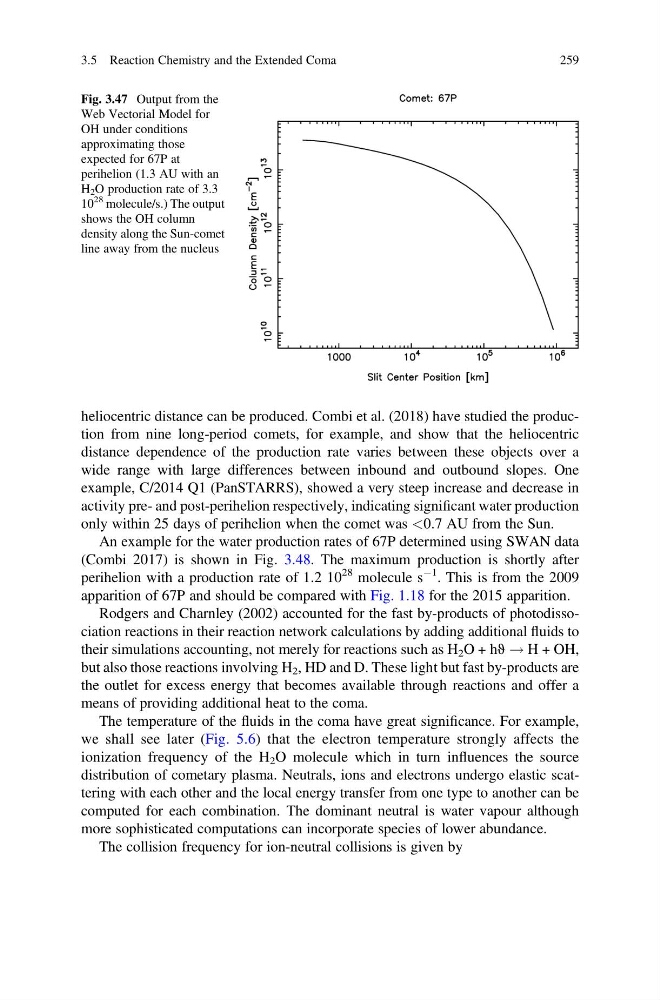
Fig. 3.47 Output from the
Web Vectorial Model for
OH under conditions
approximating those
expected for 67P at
perihelion (1.3 AU with an
H 2 O production rate of 3.3
10
28 molecule/s.) The output
shows the OH column
density along the Sun-comet
line away from the nucleus
3.5 Reaction Chemistry and the Extended Coma
259
distance dependence of the production rate varies between these objects over a
wide range with large differences between inbound and outbound slopes. One
example, C/2014 Q1 (PanSTARRS), showed a very steep increase and decrease in
activity pre- and post-perihelion respectively, indicating significant water production
only within 25 days of perihelion when the comet was <0.7 AU from the Sun.
An example for the water production rates of 67P determined using SWAN data
(Combi 2017) is shown in Fig. 3.48. The maximum production is shortly after
perihelion with a production rate of 1.2 10
28 molecule s
À1 . This is from the 2009
apparition of 67P and should be compared with Fig. 1.18 for the 2015 apparition.
Rodgers and Charnley (2002) accounted for the fast by-products of photodissociation reactions in their reaction network calculations by adding additional fluids to
their simulations accounting, not merely for reactions such as H 2 O + hϑ ! H + OH,
but also those reactions involving H 2 , HD and D. These light but fast by-products are
the outlet for excess energy that becomes available through reactions and offer a
means of providing additional heat to the coma.
The temperature of the fluids in the coma have great significance. For example,
we shall see later (Fig. 5.6) that the electron temperature strongly affects the
ionization frequency of the H 2 O molecule which in turn influences the source
distribution of cometary plasma. Neutrals, ions and electrons undergo elastic scattering with each other and the local energy transfer from one type to another can be
computed for each combination. The dominant neutral is water vapour although
more sophisticated computations can incorporate species of lower abundance.
The collision frequency for ion-neutral collisions is given by
Fig. 3.47 Output from the
Web Vectorial Model for
OH under conditions
approximating those
expected for 67P at
perihelion (1.3 AU with an
H 2 O production rate of 3.3
10
28 molecule/s.) The output
shows the OH column
density along the Sun-comet
line away from the nucleus
3.5 Reaction Chemistry and the Extended Coma
259