

wavelength of 18 cm that are observationally important for H 2 O gas production rate
determinations, a recent example being Wang et al. (2017) for C/2013 US10
(Catalina). The transitions for OH at 1665 and 1667 MHz are also shown in
Fig. 3.45. Examples of observations using these transitions are Crovisier et al.
(2013), which were performed in support of the EPOXI programme, and Howell
et al. (2007) which were performed in support of Deep Impact.
3.5.2 Detailed Reaction Kinetics
Schemes to investigate the reaction kinetics and thereby study the physical chemistry
of the coma in detail have been developed and published since the 1980s (Schmidt
et al. 1988). A more recent example was produced by Rodgers and Charnley (2002).
Both this paper and that of Schmidt et al. (1988) contain descriptions of the
numerical approach. A review of the subject was given by Rodgers et al. (2004).
The starting point is the reduction of the Euler equations (Eqs. 3.50, 3.55, and
3.58) to 1D steady state equations for the bulk fluid. The time dependencies can be
eliminated and the equations for mass, momentum and energy can be reduced to
1
r 2
d
dr
r
2
ρ g v g ¼ Q s
ð3:113Þ
1
r 2
d
dr
r
2
ρ g v g
2
þ
dp
dr
¼ ρ g F
ð3:114Þ
and
1
r 2
d
dr
r
2
ρ g
v g
3
2
þ
γ
γ À 1
pv g
!
¼ ρ g E
ð3:115Þ
respectively, under the assumption of spherical symmetry (Schmidt et al. 1988). A
multi-fluid system can be constructed. Rodgers and Charnley (2002) used a system
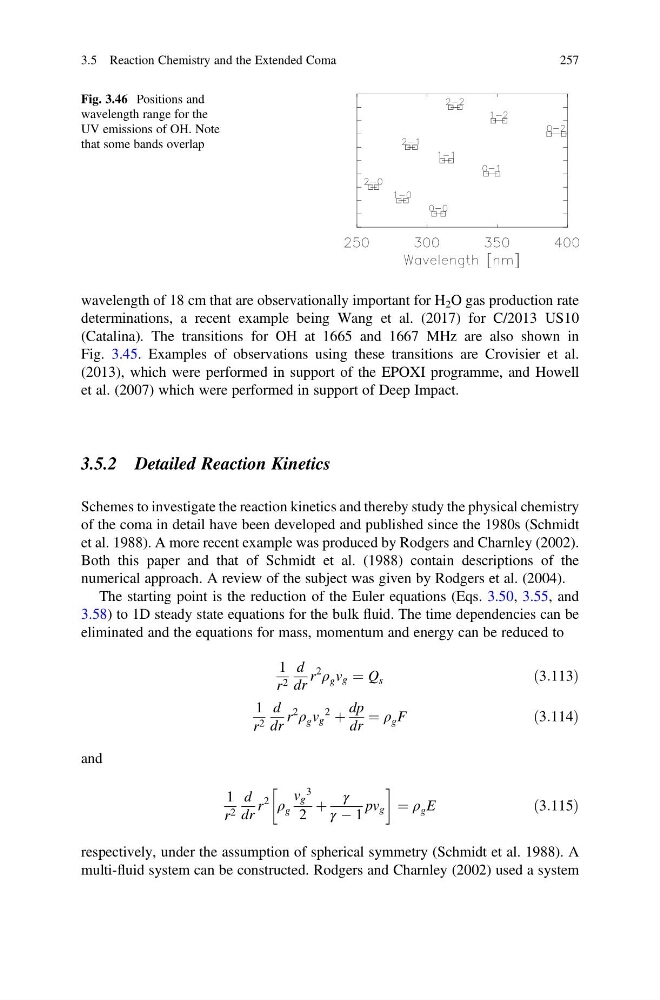
Fig. 3.46 Positions and
wavelength range for the
UV emissions of OH. Note
that some bands overlap
3.5 Reaction Chemistry and the Extended Coma
257
determinations, a recent example being Wang et al. (2017) for C/2013 US10
(Catalina). The transitions for OH at 1665 and 1667 MHz are also shown in
Fig. 3.45. Examples of observations using these transitions are Crovisier et al.
(2013), which were performed in support of the EPOXI programme, and Howell
et al. (2007) which were performed in support of Deep Impact.
3.5.2 Detailed Reaction Kinetics
Schemes to investigate the reaction kinetics and thereby study the physical chemistry
of the coma in detail have been developed and published since the 1980s (Schmidt
et al. 1988). A more recent example was produced by Rodgers and Charnley (2002).
Both this paper and that of Schmidt et al. (1988) contain descriptions of the
numerical approach. A review of the subject was given by Rodgers et al. (2004).
The starting point is the reduction of the Euler equations (Eqs. 3.50, 3.55, and
3.58) to 1D steady state equations for the bulk fluid. The time dependencies can be
eliminated and the equations for mass, momentum and energy can be reduced to
1
r 2
d
dr
r
2
ρ g v g ¼ Q s
ð3:113Þ
1
r 2
d
dr
r
2
ρ g v g
2
þ
dp
dr
¼ ρ g F
ð3:114Þ
and
1
r 2
d
dr
r
2
ρ g
v g
3
2
þ
γ
γ À 1
pv g
!
¼ ρ g E
ð3:115Þ
respectively, under the assumption of spherical symmetry (Schmidt et al. 1988). A
multi-fluid system can be constructed. Rodgers and Charnley (2002) used a system
Fig. 3.46 Positions and
wavelength range for the
UV emissions of OH. Note
that some bands overlap
3.5 Reaction Chemistry and the Extended Coma
257