

allows the temperature of an inert surface layer to rise to close to the black-body
temperature. Gas molecules emitted from below the surface will strike the inert layer
which may result in the molecules receiving additional energy and hence increase
their temperature. This can be a significant source of additional energy for the
subsequent outflow and can lead to increases in the final velocity of the gas.
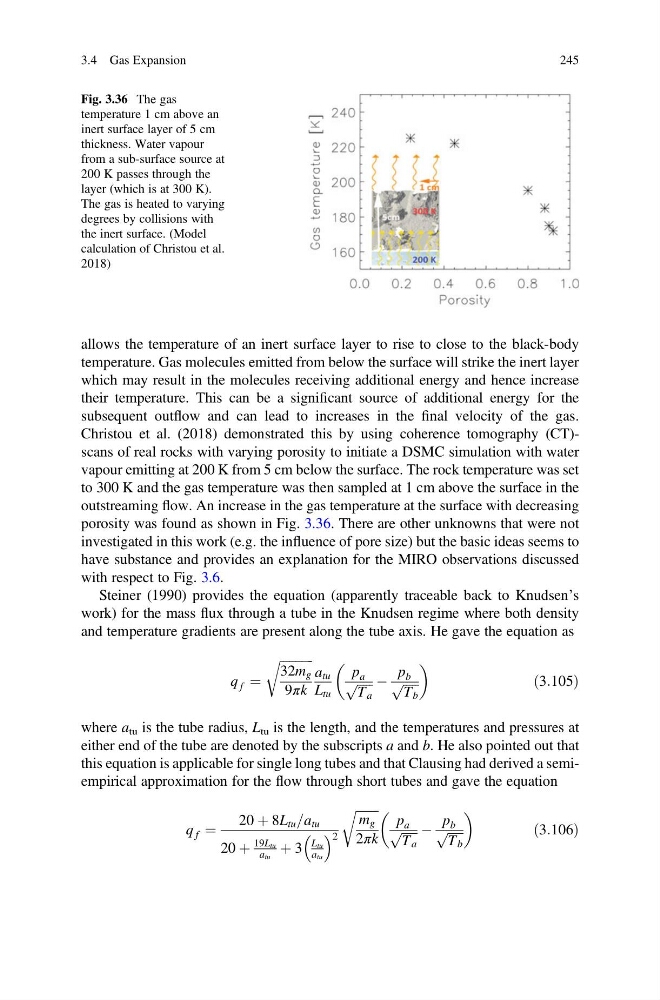
Christou et al. (2018) demonstrated this by using coherence tomography (CT)scans of real rocks with varying porosity to initiate a DSMC simulation with water
vapour emitting at 200 K from 5 cm below the surface. The rock temperature was set
to 300 K and the gas temperature was then sampled at 1 cm above the surface in the
outstreaming flow. An increase in the gas temperature at the surface with decreasing
porosity was found as shown in Fig. 3.36. There are other unknowns that were not
investigated in this work (e.g. the influence of pore size) but the basic ideas seems to
have substance and provides an explanation for the MIRO observations discussed
with respect to Fig. 3.6.
Steiner (1990) provides the equation (apparently traceable back to Knudsen’s
work) for the mass flux through a tube in the Knudsen regime where both density
and temperature gradients are present along the tube axis. He gave the equation as
q f ¼
ffiffiffiffiffiffiffiffiffiffi ffi
32m g
9πk
r
a tu
L tu
p a
ffiffiffiffiffi
T a
p À
p b
ffiffiffiffiffi
T b
p
ð3:105Þ
where a tu is the tube radius, L tu is the length, and the temperatures and pressures at
either end of the tube are denoted by the subscripts a and b. He also pointed out that
this equation is applicable for single long tubes and that Clausing had derived a semiempirical approximation for the flow through short tubes and gave the equation
q f ¼
20 þ 8L tu =a tu
20 þ
19L tu
a tu
þ 3
L tu
a tu
2
ffiffiffiffiffiffiffi ffi
m g
2πk
r
p a
ffiffiffiffiffi
T a
p À
p b
ffiffiffiffiffi
T b
p
ð3:106Þ
Fig. 3.36 The gas
temperature 1 cm above an
inert surface layer of 5 cm
thickness. Water vapour
from a sub-surface source at
200 K passes through the
layer (which is at 300 K).
The gas is heated to varying
degrees by collisions with
the inert surface. (Model
calculation of Christou et al.
2018)
3.4 Gas Expansion
245
temperature. Gas molecules emitted from below the surface will strike the inert layer
which may result in the molecules receiving additional energy and hence increase
their temperature. This can be a significant source of additional energy for the
subsequent outflow and can lead to increases in the final velocity of the gas.
Christou et al. (2018) demonstrated this by using coherence tomography (CT)scans of real rocks with varying porosity to initiate a DSMC simulation with water
vapour emitting at 200 K from 5 cm below the surface. The rock temperature was set
to 300 K and the gas temperature was then sampled at 1 cm above the surface in the
outstreaming flow. An increase in the gas temperature at the surface with decreasing
porosity was found as shown in Fig. 3.36. There are other unknowns that were not
investigated in this work (e.g. the influence of pore size) but the basic ideas seems to
have substance and provides an explanation for the MIRO observations discussed
with respect to Fig. 3.6.
Steiner (1990) provides the equation (apparently traceable back to Knudsen’s
work) for the mass flux through a tube in the Knudsen regime where both density
and temperature gradients are present along the tube axis. He gave the equation as
q f ¼
ffiffiffiffiffiffiffiffiffiffi ffi
32m g
9πk
r
a tu
L tu
p a
ffiffiffiffiffi
T a
p À
p b
ffiffiffiffiffi
T b
p
ð3:105Þ
where a tu is the tube radius, L tu is the length, and the temperatures and pressures at
either end of the tube are denoted by the subscripts a and b. He also pointed out that
this equation is applicable for single long tubes and that Clausing had derived a semiempirical approximation for the flow through short tubes and gave the equation
q f ¼
20 þ 8L tu =a tu
20 þ
19L tu
a tu
þ 3
L tu
a tu
2
ffiffiffiffiffiffiffi ffi
m g
2πk
r
p a
ffiffiffiffiffi
T a
p À
p b
ffiffiffiffiffi
T b
p
ð3:106Þ
Fig. 3.36 The gas
temperature 1 cm above an
inert surface layer of 5 cm
thickness. Water vapour
from a sub-surface source at
200 K passes through the
layer (which is at 300 K).
The gas is heated to varying
degrees by collisions with
the inert surface. (Model
calculation of Christou et al.
2018)
3.4 Gas Expansion
245