

1 (Feaga et al. 2007) and at 103P/Hartley 2 (see Fig. 3.2) provide further proof of
this.
This compositional heterogeneity is perhaps not surprising given the difference in
the free sublimation temperatures of the three species and one would intuitively
expect CO 2 to dominate H 2 O near the terminator and CO to be the dominant
molecule emitted from the nightside when the residual heat arising from thermal
inertia is only sufficient to sublime highly volatile ices (Sect. 2.9.3). Nonetheless, the
effect on the dynamics of the flow remains a relatively unexplored issue. We show
here illustrations of two potential effects that might influence the interpretation
of data.
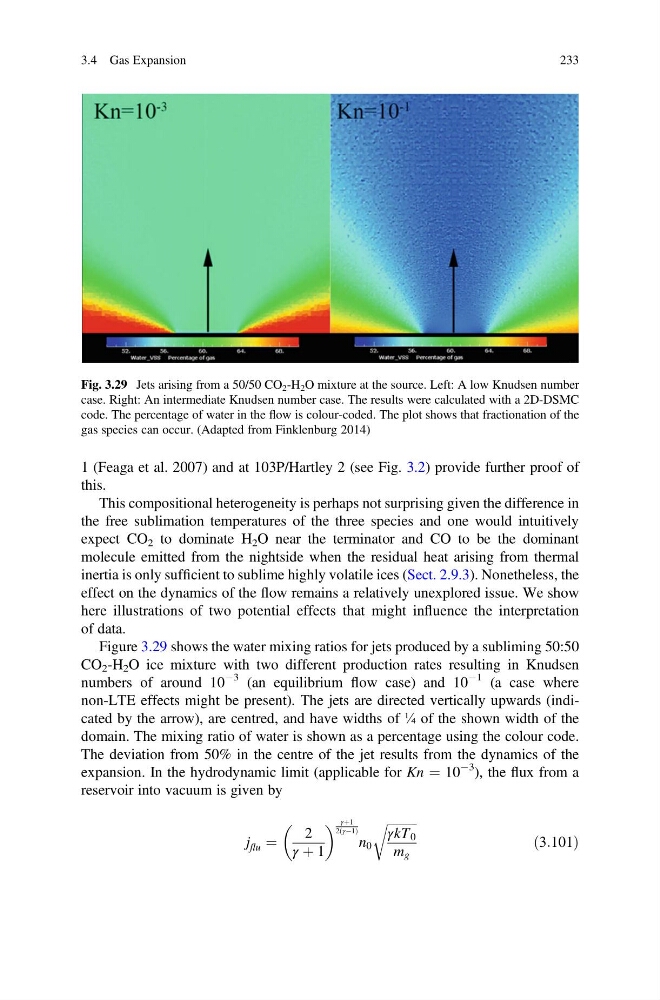
Figure 3.29 shows the water mixing ratios for jets produced by a subliming 50:50
CO 2 -H 2 O ice mixture with two different production rates resulting in Knudsen
numbers of around 10
À3 (an equilibrium flow case) and 10
À1 (a case where
non-LTE effects might be present). The jets are directed vertically upwards (indicated by the arrow), are centred, and have widths of ¼ of the shown width of the
domain. The mixing ratio of water is shown as a percentage using the colour code.
The deviation from 50% in the centre of the jet results from the dynamics of the
expansion. In the hydrodynamic limit (applicable for Kn ¼ 10
À3
), the flux from a
reservoir into vacuum is given by
j flu ¼
2
γ þ 1
γþ1
2 γÀ1
ð
Þ
n 0
ffiffiffiffiffiffiffiffiffi ffi
γkT 0
m g
r
ð3:101Þ
Fig. 3.29 Jets arising from a 50/50 CO 2 -H 2 O mixture at the source. Left: A low Knudsen number
case. Right: An intermediate Knudsen number case. The results were calculated with a 2D-DSMC
code. The percentage of water in the flow is colour-coded. The plot shows that fractionation of the
gas species can occur. (Adapted from Finklenburg 2014)
3.4 Gas Expansion
233
this.
This compositional heterogeneity is perhaps not surprising given the difference in
the free sublimation temperatures of the three species and one would intuitively
expect CO 2 to dominate H 2 O near the terminator and CO to be the dominant
molecule emitted from the nightside when the residual heat arising from thermal
inertia is only sufficient to sublime highly volatile ices (Sect. 2.9.3). Nonetheless, the
effect on the dynamics of the flow remains a relatively unexplored issue. We show
here illustrations of two potential effects that might influence the interpretation
of data.
Figure 3.29 shows the water mixing ratios for jets produced by a subliming 50:50
CO 2 -H 2 O ice mixture with two different production rates resulting in Knudsen
numbers of around 10
À3 (an equilibrium flow case) and 10
À1 (a case where
non-LTE effects might be present). The jets are directed vertically upwards (indicated by the arrow), are centred, and have widths of ¼ of the shown width of the
domain. The mixing ratio of water is shown as a percentage using the colour code.
The deviation from 50% in the centre of the jet results from the dynamics of the
expansion. In the hydrodynamic limit (applicable for Kn ¼ 10
À3
), the flux from a
reservoir into vacuum is given by
j flu ¼
2
γ þ 1
γþ1
2 γÀ1
ð
Þ
n 0
ffiffiffiffiffiffiffiffiffi ffi
γkT 0
m g
r
ð3:101Þ
Fig. 3.29 Jets arising from a 50/50 CO 2 -H 2 O mixture at the source. Left: A low Knudsen number
case. Right: An intermediate Knudsen number case. The results were calculated with a 2D-DSMC
code. The percentage of water in the flow is colour-coded. The plot shows that fractionation of the
gas species can occur. (Adapted from Finklenburg 2014)
3.4 Gas Expansion
233