

bottom. When the sources are strong, a shock region builds along the interaction
plane and cross-contamination of the flow is limited. This has interesting consequences for in situ composition analysis. When Kn p ≳ 1, then molecules from one
source can be detected within another implying that sources with different chemical
compositions are much harder to separate chemically than if the Kn p < < 1. For a
mission such as Rosetta in which 67P passed through a large range of Kn p , this can
be significant for interpretation.
3.4.4.3 The Influence of Composition
The description in the previous sections has said little about composition although
the gas species is evident in the equations in both the mass and the ratio of the
specific heats, γ (e.g. Eq. 3.73). Relatively little numerical modelling work has been
carried out investigating the influence of composition and compositional variation
on the flow field. On the other hand, there is irrefutable evidence that the parent
molecule composition in the innermost coma varies strongly both spatially and
temporally (e.g. Bockelée-Morvan et al. 2015; Hässig et al. 2015).
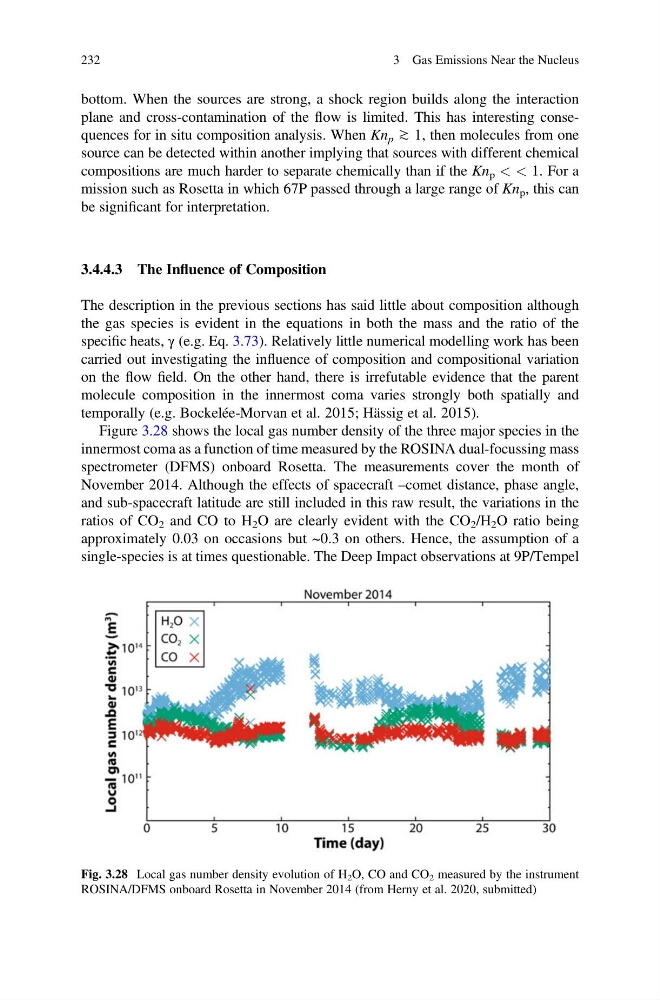
Figure 3.28 shows the local gas number density of the three major species in the
innermost coma as a function of time measured by the ROSINA dual-focussing mass
spectrometer (DFMS) onboard Rosetta. The measurements cover the month of
November 2014. Although the effects of spacecraft –comet distance, phase angle,
and sub-spacecraft latitude are still included in this raw result, the variations in the
ratios of CO 2 and CO to H 2 O are clearly evident with the CO 2 /H 2 O ratio being
approximately 0.03 on occasions but ~0.3 on others. Hence, the assumption of a
single-species is at times questionable. The Deep Impact observations at 9P/Tempel
Fig. 3.28 Local gas number density evolution of H 2 O, CO and CO 2 measured by the instrument
ROSINA/DFMS onboard Rosetta in November 2014 (from Herny et al. 2020, submitted)
232
3 Gas Emissions Near the Nucleus
plane and cross-contamination of the flow is limited. This has interesting consequences for in situ composition analysis. When Kn p ≳ 1, then molecules from one
source can be detected within another implying that sources with different chemical
compositions are much harder to separate chemically than if the Kn p < < 1. For a
mission such as Rosetta in which 67P passed through a large range of Kn p , this can
be significant for interpretation.
3.4.4.3 The Influence of Composition
The description in the previous sections has said little about composition although
the gas species is evident in the equations in both the mass and the ratio of the
specific heats, γ (e.g. Eq. 3.73). Relatively little numerical modelling work has been
carried out investigating the influence of composition and compositional variation
on the flow field. On the other hand, there is irrefutable evidence that the parent
molecule composition in the innermost coma varies strongly both spatially and
temporally (e.g. Bockelée-Morvan et al. 2015; Hässig et al. 2015).
Figure 3.28 shows the local gas number density of the three major species in the
innermost coma as a function of time measured by the ROSINA dual-focussing mass
spectrometer (DFMS) onboard Rosetta. The measurements cover the month of
November 2014. Although the effects of spacecraft –comet distance, phase angle,
and sub-spacecraft latitude are still included in this raw result, the variations in the
ratios of CO 2 and CO to H 2 O are clearly evident with the CO 2 /H 2 O ratio being
approximately 0.03 on occasions but ~0.3 on others. Hence, the assumption of a
single-species is at times questionable. The Deep Impact observations at 9P/Tempel
Fig. 3.28 Local gas number density evolution of H 2 O, CO and CO 2 measured by the instrument
ROSINA/DFMS onboard Rosetta in November 2014 (from Herny et al. 2020, submitted)
232
3 Gas Emissions Near the Nucleus